Control Resonant and Marvel’s Wolverine Show Two Very Different Futures for AAA Gaming
Control Resonant and Marvel’s Wolverine launched just days apart, but they feel like they belong to two completely different schools of blockbuster game design. Both are major AAA releases from respected studios. Both build on familiar properties. Both arrived with high expectations and huge audiences watching. Yet the conversation around them could not be more different.
On one side is Marvel’s Wolverine, a polished, high-budget PlayStation release that appears to follow a proven formula: cinematic presentation, familiar combat rhythms, strong production values, and a structure designed to be instantly understandable. On the other side is Control Resonant, Remedy’s strange, ambitious, reality-bending sequel that seems far more interested in testing the player’s curiosity than offering a predictable comfort zone.
That contrast is what makes the two games so interesting to compare. This is not simply a debate over which game is better. It is a look at what modern AAA games can be when developers either play it safe or decide to push into stranger territory.
Control Resonant has clearly made a strong impression on players who were already invested in Remedy’s world. For anyone who loved the original Control, the sequel feels less like a return trip and more like an escalation. Remedy took a universe already filled with telekinesis, impossible architecture, supernatural bureaucracy, hostile entities, and a shifting government building, then somehow decided it had not gone far enough.
The result is a game that feels risky in a way big-budget releases often avoid. Control Resonant trusts players to deal with confusion. It does not appear desperate to explain every mystery the moment it appears. It leaves room for discovery, interpretation, and surprise. That kind of confidence is rare in a market where many expensive games are built to be as broadly accessible and commercially safe as possible.
Marvel’s Wolverine, by comparison, seems to have inspired a more divided conversation. The game has been widely described as visually impressive, technically polished, and mechanically solid. Those are not small achievements. But many reactions also point to a familiar criticism: it may be too safe. Repetition, limited mechanical evolution, and design choices that feel overly guided have all become recurring talking points.
That does not mean Wolverine is a failure. Far from it. Early sales estimates suggest the game has been a massive commercial success. According to analytics estimates, Marvel’s Wolverine may have sold around 1.9 million copies in its first three days, generating roughly $130 million in revenue. Around one million of those copies were reportedly digital pre-orders. For any AAA release, those are enormous numbers.
Control Resonant’s commercial picture is less clear. Remedy has not shared official sales figures, but early estimates suggest around 300,000 copies sold on Steam. Even if console sales significantly raise that total, the game may still be behind Wolverine’s explosive launch. However, Resonant performed strongly on Steam’s bestseller charts and attracted tens of thousands of concurrent players during its opening weekend, which points to healthy interest and strong word of mouth.
The difference between the two games highlights one of the biggest tensions in modern gaming. A safer, more familiar AAA game can dominate commercially even while facing criticism for lacking boldness. A stranger, more experimental game can win passionate praise and still struggle to match the raw sales power of a massive licensed superhero title.
That is not surprising, but it is worth paying attention to.
Marvel’s Wolverine benefits from one of the most recognizable characters in pop culture, a major platform holder’s marketing machine, and years of anticipation. Insomniac’s previous superhero games built tremendous goodwill, especially with Marvel’s Spider-Man. For many players, Wolverine was always going to be a day-one purchase. The character alone carries enormous appeal.
Control Resonant has a different kind of advantage. The original Control never fully left the minds of the players who connected with it. The Oldest House was not just a setting; it was one of the most memorable spaces in recent AAA gaming. It felt like an office building, a haunted house, a cosmic gateway, and a living organism all at once. Remedy created a world that was bizarre without collapsing into nonsense, and it trusted players to sit with the uncertainty.
That trust is part of what makes Control Resonant stand out. It is not simply trying to deliver more content. It is trying to deepen the weirdness that made the first game unforgettable. Manhattan becomes another playground for supernatural rules, hidden corners, unexpected encounters, and strange environmental storytelling. It invites players to explore not just for rewards, but because the world itself feels worth investigating.
This is where the comparison with Wolverine becomes most revealing. One game seems built around refinement. The other seems built around escalation. One asks how polished and marketable a familiar structure can become. The other asks how far a developer can bend reality before the player loses balance.
Both approaches have value. Not every game needs to reinvent the wheel. There is an audience for polished cinematic action games, and Wolverine appears to satisfy many players who wanted exactly that. But the strongest reactions to Control Resonant suggest that players are still hungry for AAA games with sharper identities and stranger ambitions.
September was packed with major releases, including The Blood of Dawnwalker, a new Silent Hill, an unexpected The Witcher 3 remaster, Marvel’s Wolverine, and Control Resonant. In a crowded release window, standing out matters more than ever. Wolverine had brand power. Control Resonant had personality.
That personality may be its greatest strength. Remedy’s games often feel like they could only come from Remedy. The studio has built a reputation for blending action, surrealism, live-action elements, psychological horror, and self-aware storytelling in ways few major developers attempt. Control Resonant appears to lean fully into that identity instead of sanding it down for mass appeal.
For players tired of AAA games that feel interchangeable, that matters. It matters when a game surprises you. It matters when a world feels like it exists beyond the mission marker. It matters when exploration is driven by curiosity rather than obligation. Control Resonant understands that mystery can be a feature, not a flaw.
The irony is that Wolverine’s commercial success may reinforce the industry’s safest instincts. If a familiar, highly polished, formula-driven blockbuster sells millions in days, publishers will naturally want more of that. Meanwhile, if a more daring game earns passionate praise but sells more slowly, the business lesson may become harder to interpret.
But sales are not the only measure of impact. Some games dominate launch week and fade quickly. Others build long-term loyalty, inspire discussion, and grow through word of mouth. The original Control became more influential over time because its world stuck with people. Control Resonant may follow the same path, especially with a proper day-one Steam release helping it reach PC players immediately.
That PC release is important. The original Control had a staggered PC rollout, and Alan Wake 2 remained limited on PC storefronts. Control Resonant’s broader launch gives it a better chance to capture momentum early, particularly among players who follow Remedy’s connected universe closely.
In the end, Control Resonant and Marvel’s Wolverine are not just two AAA games released close together. They are two competing philosophies.
Marvel’s Wolverine represents the reliable blockbuster model: recognizable IP, cinematic action, premium visuals, and design choices that aim to satisfy the widest possible audience. Control Resonant represents something rarer: a big-budget game willing to be strange, dense, and occasionally disorienting.
The industry has room for both. But if AAA gaming is going to remain exciting, it needs more projects that take the kinds of risks Control Resonant takes. Polished familiarity can sell, but bold imagination is what keeps players talking long after the credits roll.Control Resonant Reminded Me What AAA Games Can Still Be
I originally bought a used PlayStation 4 near the end of its life because of one game: Spider-Man. It let me fly through New York in real time, not through some hollow imitation of the city, but through a version that felt alive, recognizable and exciting. That sense of movement, scale and freedom was enough to sell me on the console.
So when a Wolverine game from the same studio was announced, it felt like an easy win. How do you mess that up? A brutal, character-driven action game starring one of Marvel’s most iconic antiheroes seemed almost impossible to fumble.
Then everything became complicated.
The massive leak in December 2023 exposed unfinished Wolverine footage, internal material and even an early playable build. I never believed any of that should be judged as the final game. Unfinished builds are unfinished for a reason. Still, the leak damaged the mystery around the project. Wolverine had mostly existed as a logo, an idea and a promise. Suddenly, pieces of it were scattered across the internet in rough, half-formed condition.
Sony’s silence did not help. After the initial reveal, Wolverine seemed to disappear from official conversation. That long quiet period turned curiosity into uncertainty.
Then Spider-Man 2 arrived. Many players loved it. I did not. To me, it felt like one of those sequels that is bigger, shinier and more expensive, yet somehow less interesting. It had scale, spectacle and polish, but it did not feel as fresh or as satisfying as the first game. In some ways, it felt like a step back from what made the original Spider-Man so memorable.
Even then, Wolverine never fully left my mind. Part of that is simple: I own a PlayStation 5, and at this point I am desperate for a strong first-party exclusive that gives me a reason to turn the console on. My expectations for Wolverine slowly shifted from “this could be incredible” to “please, just give the PS5 something that feels essential.”
There is also the awkward fact that I am currently avoiding PlayStation purchases, so despite owning the exact console Wolverine was built for, I have not played it. My view of the game comes from released footage, design discussions, common themes across professional criticism and reactions from people who actually bought it.
Control Resonant, however, is different. That game has already taken nearly 40 hours of my life, and it has changed the way I think about modern video games.
I mean that literally and figuratively. After playing games for decades, very few titles have made me reconsider what the medium can do. Control Resonant did.
At first, I was not convinced by every major choice Remedy made. The biggest change was combat. In Control, Jesse’s Service Weapon was one of my favorite guns in any game because it never felt like a normal gun. It shifted forms, worked beautifully with her powers and became part of that incredible rhythm of launching half a room at an enemy before finishing the job with a shot.
Control Resonant largely moves away from that. Dylan gets the Aberrant instead, and the game leans much harder into melee combat. My first reaction was not enthusiasm. I worried it would become just another stylish action game chasing the same formula as countless others.
But slowly, the system clicked. What initially felt like Remedy taking something away started to feel like the studio forcing me to learn a new language. Control Resonant does this constantly. It pushes you out of familiar habits and asks you to meet it on its own terms.
The world design follows the same philosophy. Control Resonant gives you something close to an open world, though arguing over the exact label feels pointless. Its version of Manhattan is large, layered and strange. You can move through streets, enter buildings, cross rooftops and wander into places that seem completely unrelated to your current objective.
But this is not the usual open-world checklist. You are not simply staring at a map full of icons, clearing twelve identical activities and watching a completion percentage rise. Progress comes from paying attention. It comes from curiosity. It comes from interacting with the world instead of treating it like a to-do list.
That is what makes exploration feel meaningful. You might enter a random building just because the door is open and suddenly find yourself searching for pieces of an Altered speaker system scattered across Manhattan. You might return to a familiar field office and discover an NPC you somehow missed for hours.
The game does not place a giant marker above his head. It does not pause to introduce him. It does not flood the map with reminders. He is just there. If you notice him, he gives you tasks. If you miss him, the game lets you continue.
I love that.
Most AAA games would never allow that kind of design to exist without safety rails. They would highlight the character, mark him on the map, add a glowing icon and remind you repeatedly to go talk to him. Control Resonant simply trusts you to notice, or not notice, and live with the result.
That may be the thing I admire most about it. It treats the player like an adult.
I do not want every game to be terrified that I might get confused, lost or temporarily inefficient. Sometimes I want a game to confuse me. I want to stare at a room for ten minutes wondering what I am supposed to do. I want a puzzle that feels awkward. I want to get lost, double back, notice something strange and realize the answer was there all along.
Control Resonant understands that discomfort can be part of the fun.
Its combat also respects the player’s curiosity. The game encourages experimentation with Aberrant forms, powers, finishers and combinations, but it does not constantly throw enemies at you just to satisfy some invisible action quota. When fights happen, they can be thrilling. But the game also gives you space to breathe, explore and chase whatever weird red glow you spotted across the street.
That freedom matters. Sometimes I want a great fight. Sometimes I want to run away because I need to know what is inside the strange building in the distance. Control Resonant allows both.
By now, anyone who follows video games has probably seen praise for Control Resonant’s level design. Even so, it is hard to explain just how strange and impressive some of its spaces are.
A common way to make an open-world game feel bigger is verticality. Add rooftops, underground areas, tall buildings and layered environments. Spider-Man used that beautifully because the character’s movement is built around climbing, swinging and launching through the city. Wolverine appears to borrow some of that same design thinking by adding layers and density to its spaces.
Remedy takes that idea and pushes it into something far more surreal.
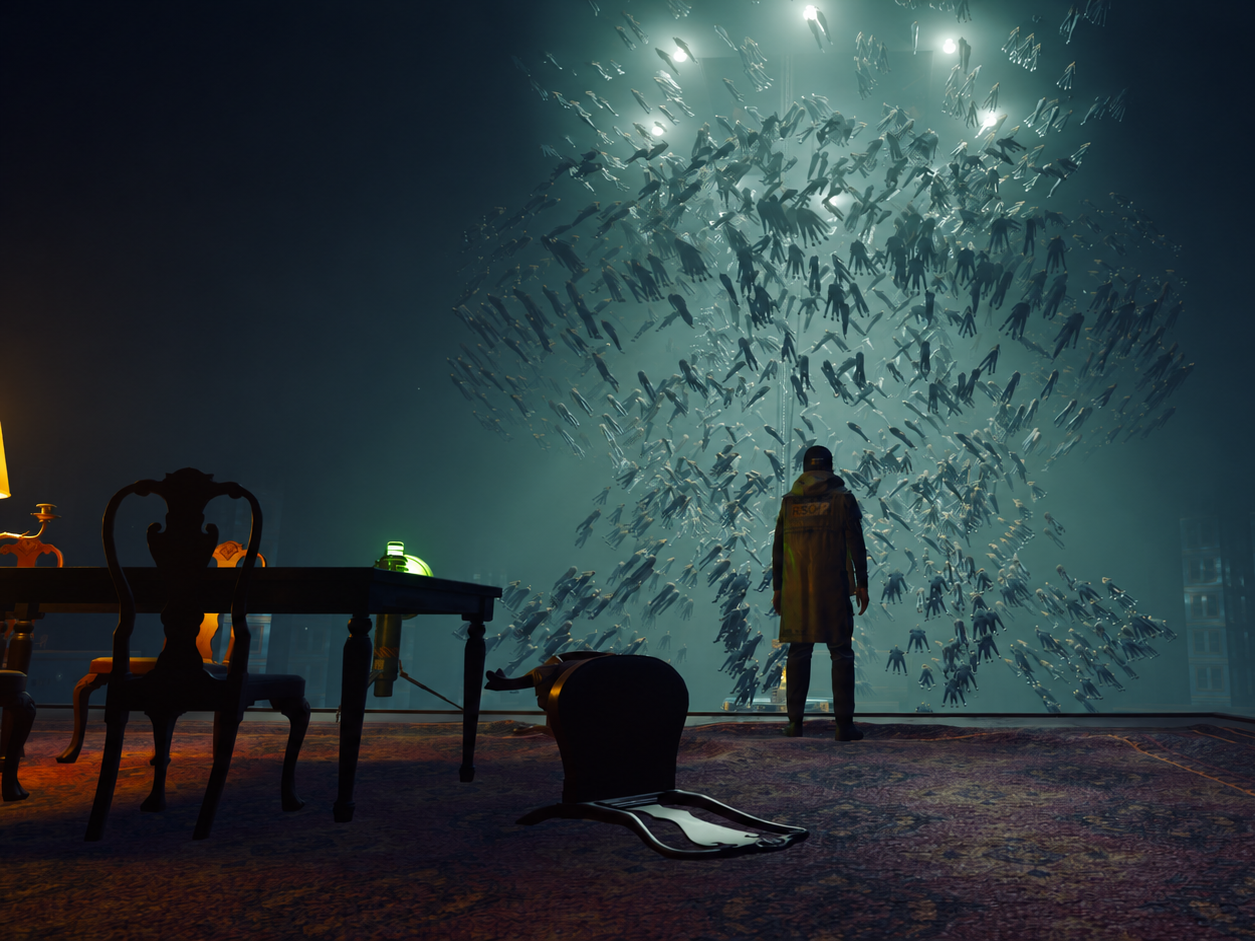
The Patterned areas in Control Resonant feel geometrically hostile. Spaces fold into themselves. Distances stop behaving normally. Architecture bends in ways your brain knows should not function, and then the game asks you to move through it anyway. Later, it asks you to fight enemies across multiple planes of gravity.
That is where Control Resonant becomes something special.
A movie can show impossible architecture. A painting can depict it. A book can describe it. But a game can let you walk through it. It can let you get lost inside it, jump across it, fight through it and slowly understand how its designers expect a human being to navigate it.
That interaction changes everything.
Control Resonant is also stunning to look at. Its art direction, color work, lighting and set pieces are consistently memorable. It can be beautiful, oppressive and disorienting all at once. The game creates awe and discomfort in the same breath, which is exactly what its world demands.
Technically, it also feels like another Remedy project built to challenge high-end gaming hardware for years. The original Control became one of the defining showcases for ray tracing, and Control Resonant seems positioned to carry that legacy forward. It is not just a game that looks expensive. It uses its technology to build atmosphere, scale and unease.
That is why Control Resonant has stayed with me more than many recent big-budget releases. It is not simply polished. It is confident. It is willing to be strange. It is willing to hide things. It is willing to let players miss content. It is willing to make navigation, combat and discovery feel unfamiliar.
In an era where so many AAA games feel designed to avoid friction at all costs, Control Resonant embraces it. It remembers that mystery is powerful. It remembers that exploration is more rewarding when the game does not immediately explain everything. It remembers that players can handle uncertainty.
And that is why, even with Wolverine still lingering in the background as a major PlayStation 5 exclusive, Control Resonant is the game that has reminded me what I want from modern video games.
Not just bigger maps. Not just better graphics. Not just more expensive production values.
I want games that surprise me. I want games that trust me. I want games that make me look at a hallway, a city street or a collapsing piece of impossible architecture and think, “I have never seen anything like this before.”
Control Resonant does exactly that.Control: Resonant and Marvel’s Wolverine could not be more different, and that is exactly why their arrival so close together says so much about the future of AAA gaming.
One of them looks like the kind of blockbuster the industry knows how to sell: a massive superhero game built around one of the most recognizable characters in comic-book history, backed by the weight of PlayStation, Marvel, and a studio with a proven track record. The other is Control: Resonant, a strange, ambitious, deeply unsettling Remedy game that seems determined to challenge what a big-budget title can be.
After spending nearly 40 hours with Control: Resonant, it is hard not to feel like the bar has moved.
When ray tracing first entered the gaming conversation, it was easy to dismiss. For many players, it looked like an expensive gimmick that made puddles shinier while cutting frame rates in half. At the time, that criticism was not entirely unfair. But several hardware generations later, Control: Resonant feels like one of the first games to fully justify the technology as more than a visual checkbox.
Here, advanced lighting, reflections, shadows, and geometry do not simply make the game look prettier. They change how the world feels. They make spaces appear unstable, impossible, and alive. The architecture bends in ways that make you question whether the room is moving, whether you are moving, or whether the game has quietly decided to ignore the rules of physical reality.
That matters because Control: Resonant is not just trying to impress you. It is trying to disorient you.
This is where the divide between Control: Resonant and Marvel’s Wolverine becomes most obvious. Not every player wants to be challenged in that way. Some people have limited free time. They want to sit down, turn on a console, know where to go, enjoy a polished action sequence, and feel rewarded before bed. There is nothing wrong with that. A guided game is not automatically a bad game, and entertainment built around clarity and momentum has a huge audience for a reason.
Marvel’s Wolverine appears to be designed for that kind of experience. It looks direct, cinematic, expensive, and accessible. It is the sort of game that understands many players do not want to spend 20 minutes staring at an impossible staircase, wondering if the answer is hidden in the environment or if the environment itself is lying.
And yet, that is exactly what makes Control: Resonant so unforgettable.
Remedy has made a game that trusts the player. It does not constantly rush to explain itself. It does not always point you toward the solution. It allows confusion to exist. It lets spaces feel hostile, mysterious, and meaningful. Its puzzles are not just obstacles between cutscenes; they are part of the world’s identity.
That confidence gives Control: Resonant something many modern AAA games struggle to capture: soul.
It is an imperfect word, but it fits. Soul cannot be benchmarked. It cannot be measured in resolution, frame rate, or ray-traced reflections. But you know when a game has it. Control: Resonant gets under your skin. Its story lingers long after the screen is off. Its strangest moments do not feel like spectacle for spectacle’s sake; they feel like ideas trying to communicate something uncomfortable and profound.
Few games manage that. Fewer still do it at this scale.
There are moments in Control: Resonant that force you to stop and think about what you have just seen. The Deserter’s backstory, the emotional weight surrounding Dr. Darling and Dylan, and the game’s late-story revelations all carry a kind of psychological force that is rare in big-budget releases. These are not just lore entries or dramatic twists. They are pieces of a larger existential puzzle.
That is the difference. Marvel’s Wolverine looks like entertainment. Control: Resonant feels like an experience.
That may sound dramatic, but games like this are the reason people continue to argue that video games can be more than disposable content. They can be strange. They can be emotionally disruptive. They can explore ideas that stay with players in ways no marketing trailer can fully explain.
The frustrating part is that the industry may not reward the two games equally for what they represent.
Marvel’s Wolverine will almost certainly sell in huge numbers. It has a beloved character, a massive brand, platform backing, and the kind of production values that dominate wishlists before a game even launches. Even if it disappoints some players, the business case will likely remain strong. The brand is too big, the audience too broad, the marketing too powerful.
Control: Resonant does not have that same safety net.
For Remedy, this game carries a very different kind of pressure. It is not just another entry in a guaranteed blockbuster machine. It is a major creative and financial gamble. The studio stands to benefit more if the game succeeds, but it also carries more risk if it falls short. For a developer known for distinctive, authored games, the commercial performance of Control: Resonant could influence how freely it can fund future projects and where those projects eventually appear.
That is the uncomfortable reality of modern AAA game development. Safe games keep getting made because safe games keep making money. Risky games are forced to prove that being bold was financially responsible.
This is why the contrast between Marvel’s Wolverine and Control: Resonant feels so important. For years, players have complained that AAA gaming has become too expensive, too predictable, and too afraid of risk. Development cycles are longer than ever. Budgets are enormous. Publishers have little room for failure, so many big games end up sanding away anything that might confuse, frustrate, or alienate a broad audience.
Then along comes Control: Resonant, reminding everyone that AAA money can still produce something daring.
It shows what happens when cutting-edge technology is used for more than glossy surfaces. It shows that level design can still be mysterious. It shows that a big game can be visually stunning without becoming creatively sterile. It shows that players do not always need a glowing objective marker, a voice line explaining the solution, or a painted path telling them where to climb.
Sometimes, being lost is the point.
And games like this matter beyond sales charts. Somewhere, a young player may be struggling through one of Control: Resonant’s strangest areas right now, frustrated by a puzzle, fascinated by the world, and slowly realizing that games can be built differently. Maybe that player will replay it. Maybe they will read interviews about how it was made. Maybe, years from now, they will become a developer and create something none of us can currently imagine.
That is how a medium moves forward.
It is harder to imagine Marvel’s Wolverine having that same kind of legacy. It may be fun. It may be polished. It may sell millions. But will it inspire the next generation of designers to rethink what games can be? Maybe. But based on what it seems to represent, it feels far more likely to reinforce the formulas the industry already trusts.
That is not an insult to players who prefer those games. Accessibility, clarity, and cinematic pacing are not flaws. Many people want games that respect their limited time, and there is real craft in creating an experience that moves smoothly from one satisfying moment to the next.
The problem begins when that design philosophy becomes the default language of AAA gaming.
If every major release is built around constant guidance, frictionless progression, and immediate readability, then the medium loses something. It loses the thrill of discovery. It loses the pleasure of solving something without being told how. It loses the strange magic of stepping into a world that does not immediately explain itself.
Control: Resonant proves that big-budget games can still be demanding, beautiful, confusing, intelligent, and technically astonishing. It proves that AAA development does not have to mean creative caution. It proves there is still room for games that trust players enough to leave them alone.
The fear is that the industry will applaud it, give it awards, praise its artistry, and then return to safer formulas because the safer game made more money.
That is the real story behind these two releases. Marvel’s Wolverine shows what the industry will likely continue to choose: familiar characters, familiar structure, familiar reassurance. Control: Resonant shows what the industry could become if more studios were willing to take the risk.
One game reflects the commercial logic of modern AAA gaming. The other reflects its artistic potential.
For once, it would be nice if the stranger game won.


