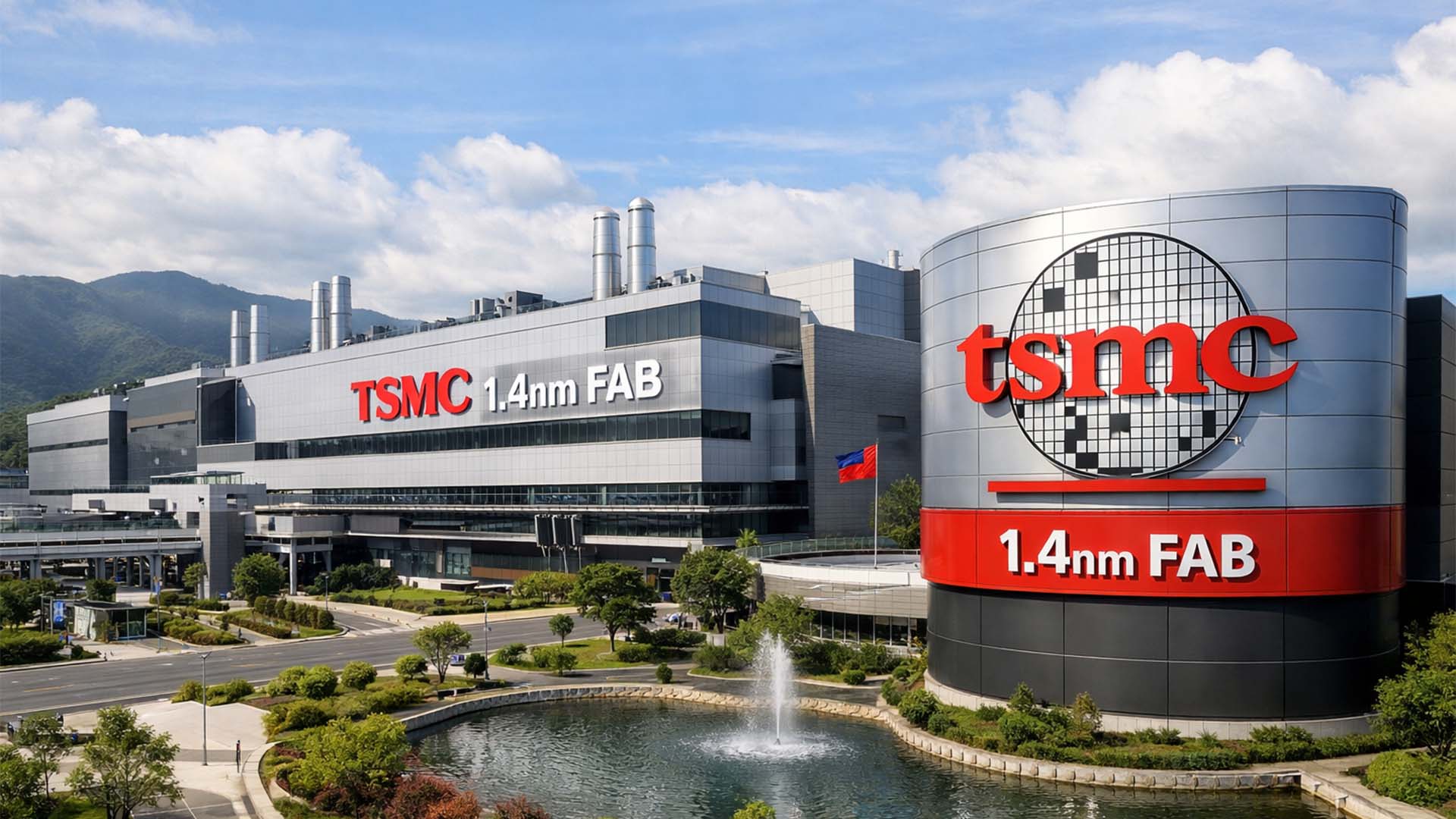
TSMC’s race to the next era of chip manufacturing is moving ahead on schedule, with the company signaling that its 2nm mass production roadmap is already underway. Demand for advanced wafers remains intense, and reports indicate supply is still tight—one reason TSMC is said to be planning three additional plants to meet customer needs. At the same time, TSMC appears to be pushing even further ahead by accelerating work on its 1.4nm technology, helped by improved early yield performance on its next-generation process.
That momentum is now taking physical shape in Taiwan. Foundation work for TSMC’s upcoming 1.4nm plant reportedly began in early November at the Central Taiwan Science Park. The site is expected to include four factory buildings along with office space, signaling a large-scale expansion designed to support the company’s post-2nm manufacturing future.
The estimated price tag is enormous. Building four facilities tied to the 1.4nm push is expected to require around NT$1.5 trillion (about $49 billion). If everything stays on track and the fabs reach their production goals, mass production is targeted for 2028. The payoff could be equally dramatic: TSMC is projected to see a first-year revenue boost of roughly $16 billion across the four locations once operations ramp in full. Beyond revenue, the project is also expected to deliver a major employment lift, with estimates pointing to 8,000 to 10,000 new jobs.
While construction progresses, equipment preparation is also moving forward. Reports say the bidding process for equipment has recently been completed, and the tendering process for the factory building is still pending—an important step that will determine how quickly the site can transition from groundwork to full-scale construction.
One detail that remains unclear is which major customers will be first in line for the 1.4nm node. No specific names are attached to the plan yet, but the broader market context offers clues. Apple has been reported to have locked in more than half of TSMC’s early 2nm capacity for future A-series chips, suggesting it could be a natural early contender for 1.4nm as well once the technology is ready. Before 1.4nm arrives, however, TSMC is also expected to ramp up its 1.6nm-class production, which may become a key stepping stone for high-performance computing and next-generation mobile processors.
There are also hints about who might lead at 1.6nm. Previous reporting suggests Apple has not yet entered talks to adopt TSMC’s 1.6nm process, potentially leaving NVIDIA as a primary customer for that node—at least early on.
As for what’s enabling TSMC to accelerate its 1.4nm expansion, improved yields appear to be the biggest driver. Some industry watchers have pointed to the role of cutting-edge EUV lithography advances, including High-NA EUV systems. However, those tools are extraordinarily expensive—reportedly around $400 million per machine—making them a major investment decision even for a manufacturing giant like TSMC. Current expectations suggest TSMC isn’t eager to absorb that cost immediately.
Early 1.4nm yield figures have not been disclosed, but given how new the node is, estimates suggest yields could still be below 20% at this stage. That’s not unusual for a brand-new process. If yields climb as development matures, demand could surge in the same way it has for 2nm—tightening supply, increasing competition for capacity, and reinforcing why TSMC is investing so aggressively in new plants and advanced manufacturing infrastructure.