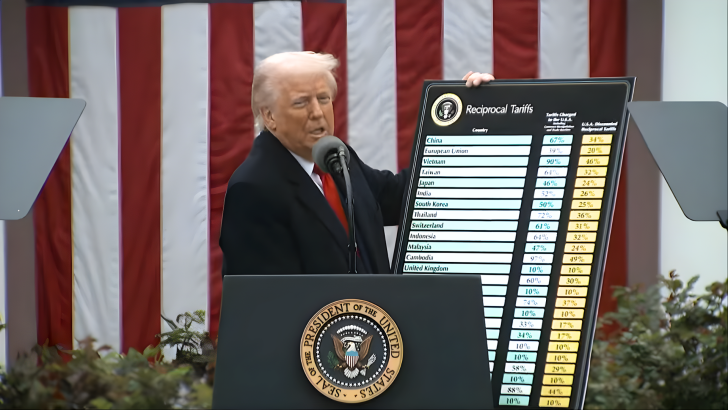
The recently implemented tariffs under President Trump are causing quite a stir, particularly among consumers who may see significant price hikes in their favorite tech hardware. Dubbed as “reciprocal tariffs,” the administration’s move is said to be an “eye-for-eye” strategy. However, the outcome seems less about balance and more about burden, especially for IT manufacturers and, eventually, consumers.
These tariffs are set to hit countries like China, Vietnam, and Indonesia hard, making the costlier exports an issue that trickles down to consumer wallets. With China facing a steep 54% tariff, analysts from Morgan Stanley predict that everything from smartphones and PCs to peripherals and wearables will face sharp price increases. Manufacturers are left to decide between absorbing the extra cost or passing it onto consumers, potentially leading to price jumps up to 50%.
Imagine the impact on some of the most coveted PC hardware on the market today, like the NVIDIA GeForce RTX 5090. With a current MSRP of $1,999, a 25% tariff hike would push its price to roughly $2,498.75, while a 50% increase could see it rise dramatically to $2,998.50. The GeForce RTX 5080 would also feel the heat, potentially jumping from its MSRP of $999 to as much as $1,498.50 with a 50% increase.
CPUs are not exempt either. The AMD Ryzen 7 9800X3D and Intel Core Ultra 9 285K could witness substantial markups, with potential jumps to $750 and $900, respectively, if a 50% hike is applied.
These estimated post-tariff prices are derived from current MSRPs, yet they don’t account for existing market prices, which are often already elevated. As a result, actual consumer costs could be even higher, adding to the burden on tech enthusiasts and everyday users alike.
To complicate matters, hardware manufacturers can’t simply shift production out of China to sidestep these tariffs. Countries like Vietnam, Thailand, India, and Taiwan are also on the tariff list, eliminating alternative manufacturing options. This leaves companies with tough choices to make regarding production and pricing in a massive US market that can’t be ignored.
According to Morgan Stanley, big-name companies such as Apple, Cricut, Dell, Garmin, GoPro, HP, Logitech, and Sonos, along with PC hardware brands like MSI, Acer, and Gigabyte, will face significant challenges as tariffs rise. The question remains how these companies will navigate these hurdles without alienating consumers with higher costs.
As the landscape of tech hardware pricing shifts, consumers are left in a difficult position, bracing for potential spikes in the cost of everything from cutting-edge graphics cards to everyday peripherals. The decision to implement these tariffs may be a move to challenge the global trade playing field, but it undeniably leaves end-users pondering the true cost of their tech passion.