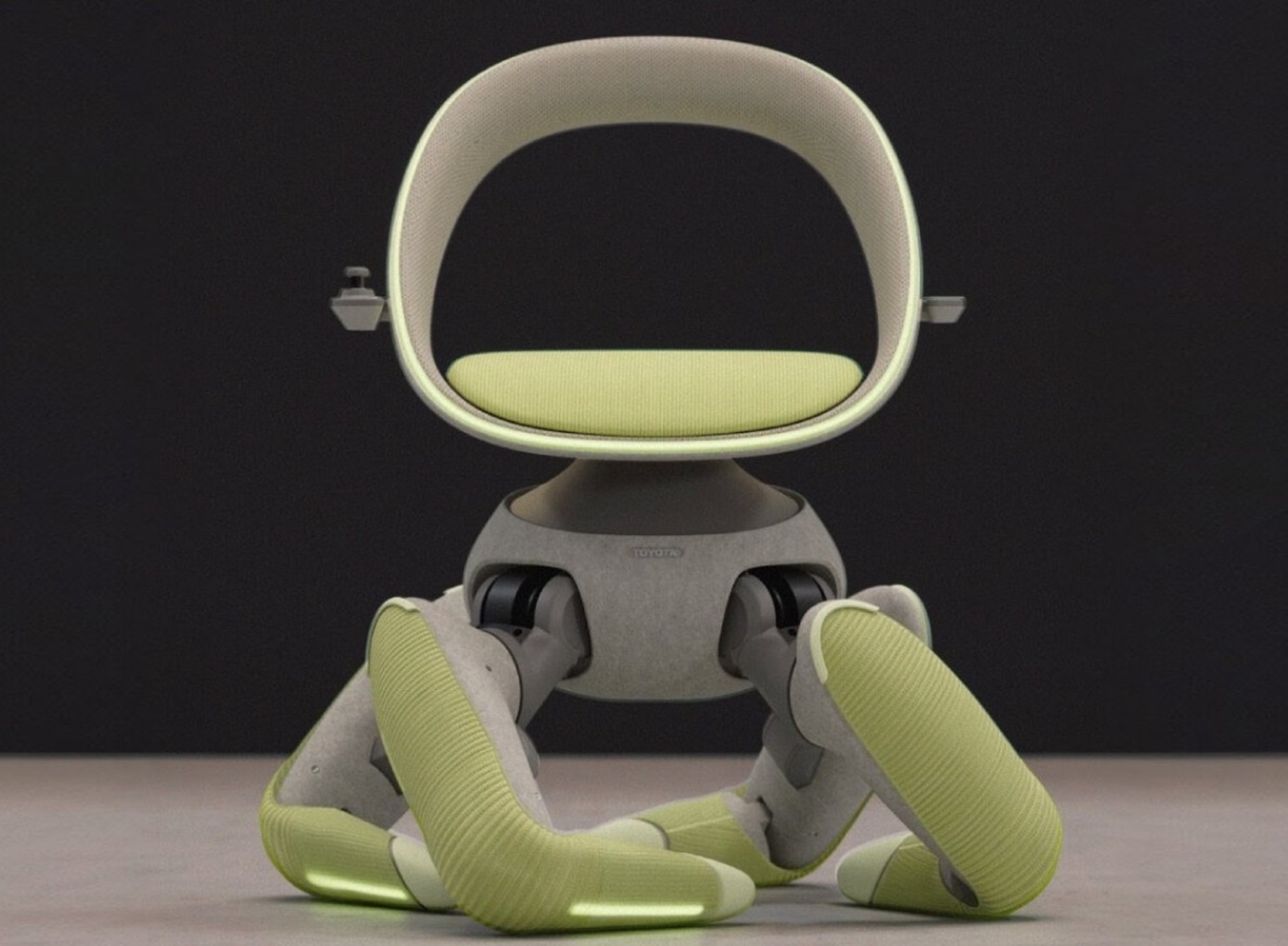
Toyota is stepping beyond cars with a bold concept unveiled at the Japan Mobility Show 2025: an AI-powered, four-legged mobility chair called Walk Me. Designed for people who find traditional wheelchairs limiting, this walking seat trades wheels for legs so it can handle stairs, slopes, and uneven ground with surprising confidence.
At first glance, Walk Me looks charming with its pastel-colored legs. Under the cute exterior, however, each limb is packed with sensors and actuators that bend, stretch, and adapt in real time. The movement is biomimetic—modeled after sure-footed animals that excel on rugged terrain. The front legs read height changes to pull the chair forward, while the rear legs provide support and propulsion, helping the occupant maintain a stable, natural ride even when the path gets tricky.
To see and understand its surroundings, the chair uses LiDAR and radar to scan for obstacles. On-board weight sensors and an automatic stabilization system help keep the rider balanced on bumpy surfaces or sloped walkways, reducing the risk of tipping and adding confidence to every step.
Comfort and control are central to the design. The seat is shaped to mold to each user’s body, and the armrests are adjustable for better ergonomics. Walk Me responds to simple voice commands—say “go faster” or tell it where to head—and there are handles for gentle manual redirection when you want to fine-tune its path.
A small display provides useful at-a-glance metrics like battery percentage and distance traveled. Power comes from a compact battery tucked under the seat, with Toyota targeting all-day use on a single charge. Recharging is intended to be as easy as plugging in a phone. For extra peace of mind, the system can pause and alert the rider if any joint overheats.
Portability is another thoughtful touch. When it’s time to stash the chair, the legs retract telescopically, shrinking the overall footprint so it’s easier to lift into a car trunk or store at home.
Walk Me remains a concept for now, with no announced timeline for retail availability. Even so, it’s a compelling vision for the future of accessibility—where AI, robotics, and smart design come together to help people navigate real-world environments that go far beyond smooth, flat floors. If brought to market, this kind of stair-climbing, terrain-aware mobility device could reshape independence for many and redefine what a wheelchair can be.