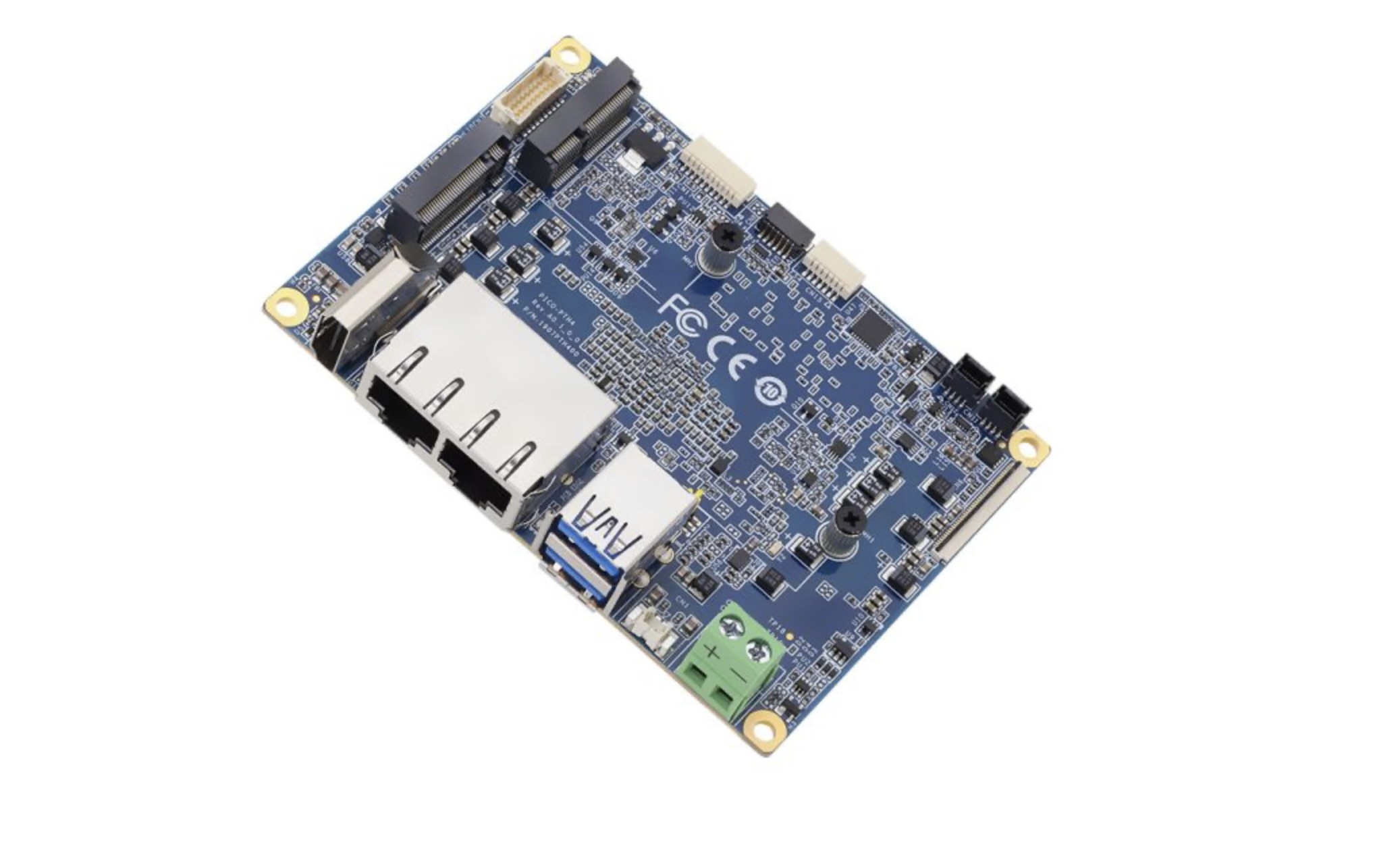
Aaeon PICO-PTH4 brings Intel Panther Lake power to a tiny Pico-ITX SBC
Aaeon has launched the PICO-PTH4, a new ultra-compact single-board computer designed for demanding embedded, industrial, edge AI, and networking applications. Despite its small Pico-ITX footprint, the board can be configured with Intel’s latest Panther Lake-based Core Ultra Series 3 processors, up to 32 GB of LPDDR5X memory, dual 2.5G Ethernet, and high-speed PCIe expansion.
The PICO-PTH4 measures just 100 x 72 mm, making it roughly 3.94 x 2.84 inches. That puts it firmly in the compact SBC category, but its hardware options are far more powerful than what is typically found in boards of this size. Aaeon is offering multiple processor choices, ranging from efficient 8-core configurations to a high-end 16-core model aimed at heavier workloads.
Available CPU options include the 8-core Intel Core Ultra 5 325, the 8-core Core Ultra 7 355, the 12-core Core Ultra 5 338H, and the 16-core Core Ultra X7 358H. The top-end Core Ultra X7 358H is the standout option, delivering a major jump in multi-core performance compared with the entry-level model. In reported Cinebench results, the Core Ultra X7 358H reaches a median multi-core score of 4,164, while the Core Ultra 5 325 sits at 2,430. Single-core performance is also strong across the lineup, with the X7 358H scoring around 504 and the Core Ultra 5 338H close behind at 501.
AI acceleration is another major selling point of the PICO-PTH4. The Core Ultra 5 chips provide up to 47 TOPS of peak NPU performance, while the Core Ultra 7 and Core Ultra X7 variants increase that figure to 49 TOPS and 50 TOPS, respectively. That makes the board suitable for edge AI tasks such as machine vision, automation, analytics, and local inference workloads where low latency and compact hardware are important.
Graphics performance also receives a notable boost. The highest-end Core Ultra X7 configuration includes Intel Arc B390 integrated graphics, giving the board enough GPU capability for moderately demanding visual and compute workloads. For embedded systems that need strong display support, AI-assisted visual processing, or GPU-accelerated applications, this makes the PICO-PTH4 far more versatile than many low-power SBC alternatives.
Connectivity is one of the board’s strongest areas. The PICO-PTH4 includes dual USB 3.2 Gen 2 Type-A ports, dual internal USB 2.0 headers, HDMI 2.1, dual RS-232/422/485 serial ports, 4-bit GPIO, and I²C/SMBus support. It also features dual 2.5G Ethernet powered by Intel I226 controllers, with PXE boot support available on one of the ports. This combination should appeal to industrial users, network appliance builders, and developers working on compact edge systems.
For storage and expansion, Aaeon has included an M.2 2280 slot with PCIe 5.0 x4 support, an M.2 2230 slot with PCIe 4.0 x1 support, and an FPC connector offering PCIe 3.0 x4. These options give the tiny SBC room for fast NVMe storage, wireless modules, and additional expansion hardware depending on the target deployment.
The board is also built with rugged environments in mind. Aaeon lists an operating temperature range of -20°C to 70°C, or -4°F to 158°F. Its rated MTBF is 1,300,259 hours, suggesting the PICO-PTH4 is being positioned for long-term embedded and industrial use rather than casual hobbyist projects.
Pricing reflects that professional focus. The Core Ultra 5 325 version is listed at $1,288, while the Core Ultra 7 355 model is priced at $1,456. Both of those configurations ship with 16 GB of RAM. The flagship Core Ultra X7 358H version includes 32 GB of LPDDR5X memory and is priced at $3,065. Pricing for the Core Ultra 5 338H configuration has not yet been clarified.
Overall, the Aaeon PICO-PTH4 is a compact but powerful SBC aimed at users who need modern Intel Core Ultra performance, AI acceleration, fast networking, and robust expansion in a very small form factor. It is not a budget board, but for industrial automation, edge AI, embedded computing, machine vision, and advanced networking projects, it offers an impressive mix of processing power and connectivity in a space-saving design.