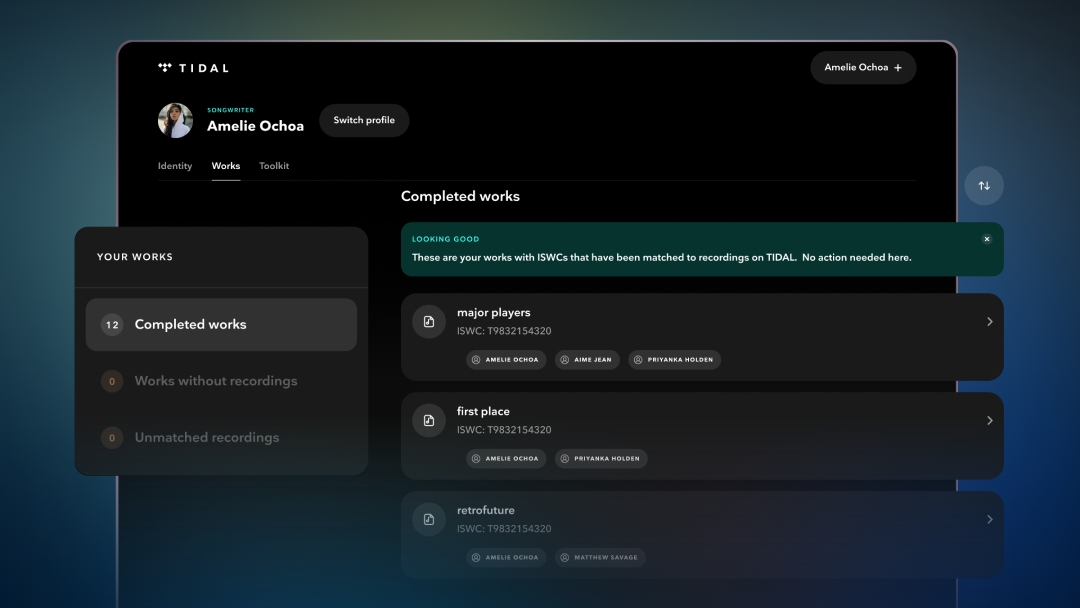
Music streaming service Tidal has introduced new features that allow artists to track royalties and manage their music that has songwriting credits on the platform.
In the United States, the process of handling music royalties is highly complex. All collaborators on a track, including composers and performers, must register with a Performing Rights Organization (PRO) and obtain an Interested Party Information (IPI) number, which identifies them as rights holders. PROs in various regions track where tracks are used and ensure royalties are paid to artists.
Artists face significant challenges in tracking royalties and monitoring where their works have been used. There are distinct royalty rights for mechanical reproduction (such as CDs, MP3s, vinyl records, film soundtracks, and streaming) and performance (such as public performances, airplay, or streaming).
Artists who already possess a PRO and IPI number can claim their profile on Tidal after verifying their documentation and begin tracking royalties. Tidal has introduced a dashboard that displays an artist’s IPI, PRO, and publisher information, as well as information about which of their recordings have comprehensive artist and royalty data registered. It also identifies tracks without a matching listing on Tidal and any tracks that may be the artist’s work but are not properly credited.
For artists who are just starting out, Tidal offers an option to sign up with AllTrack, a digital PRO that tracks data on streaming services, TV and radio stations, entertainment venues, and local businesses. There is also an option to join the Mechanical Licensing Collective (MLC), a non-profit organization that collects and distributes royalties to artists for streams and downloads in the U.S.
Additionally, Tidal’s new toolkit enables artists to check track or album metadata to ensure that royalty splits are accurately listed, with the ability to propose changes if necessary.
These tools are available to artists for free. Tidal utilizes its own catalog and third-party data to track royalty information.
Agustina Sacerdote, Tidal’s global head of product, stated that the company decided to develop this dashboard because the current tools available to artists are outdated or overly complex.
“If you want to be a truly artist-first company, you have to recognize that often, the main artist is the public-facing figure we associate with the track. But there is a whole ecosystem of collaborators and contributors that make the project happen. We believe that songwriters are a critical part of the ecosystem and tools built for them are antiqued and complex, so we decided to tackle the problem,” Sacerdote explained.
There are also several venture-backed startups attempting to address this issue. For instance, Mogul offers tools to help artists track unclaimed royalties, while Mozaic is developing a solution to facilitate easy royalty splits between collaborators.
Tidal, owned by Block, appears to be more focused on developing products for artists rather than consumers. Unlike Spotify, which is expanding its range with social features, podcasts, and an online learning service aimed at consumers, in addition to letting artists sell merchandise and tickets, Tidal is concentrating on artist-centric features.
Last year, Tidal released Collabs, which allows artists to find collaborators for tracks or live shows. The company is currently testing new features to help artists connect with fans through Square, and Block is exploring the use of Cash App to expedite artist payments.