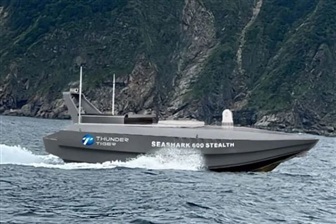
Taiwanese drone maker Thunder Tiger is set to unveil a new entrant in the unmanned maritime arena: the SeaShark 600 Stealth, a 6-meter-class unmanned surface vessel slated for its debut at next week’s 2025 Taipei Aerospace and Defense Technology Exhibition (TADTE). Positioned as a stealth-focused USV, the SeaShark 600 Stealth underscores the growing demand for low-signature platforms capable of operating closer to contested coastlines and high-traffic waterways.
While full specifications are expected at the show, the “Stealth” designation signals a design philosophy centered on reducing detectability across multiple spectrums. In practical terms, a stealth-oriented surface vessel aims to make it harder for adversaries to find, track, or target it, enhancing survivability during missions where persistence and discretion matter most. At 6 meters, the SeaShark 600 Stealth sits in a versatile size class that typically balances endurance, speed, and mission flexibility without the logistical overhead of larger craft.
USVs like the SeaShark 600 Stealth are increasingly viewed as force multipliers across a range of maritime tasks. Potential roles include coastal surveillance, reconnaissance, interdiction support, and harbor protection—missions where a low profile and autonomous operation can reduce risk to personnel while providing continuous coverage. The platform could also be leveraged for training and target services, or adapted for rapid response in complex littoral environments where agility and rapid deployment are crucial.
Thunder Tiger’s move highlights the broader momentum behind unmanned and autonomous systems in the Indo-Pacific. As maritime security challenges evolve, nations and industry leaders are prioritizing platforms that can operate with minimal signatures, integrate with existing command-and-control networks, and scale rapidly for different mission sets. The introduction of a stealth-focused USV suggests an emphasis on survivability and adaptability, both key to modern maritime operations.
Attendees at TADTE 2025 can expect Thunder Tiger to outline how the SeaShark 600 Stealth approaches navigation autonomy, sensing, communications resilience, and mission endurance—core pillars that define operational value at sea. Details to watch for include its expected range, payload capacity, sensor suite integration, and how the vessel balances speed with sea-keeping in variable conditions. Clarification around control modes—remote, semi-autonomous, or fully autonomous—will also be pivotal for understanding mission applicability.
By bringing a stealth-enabled 6-meter USV to market, Thunder Tiger is signaling intent to compete in a rapidly expanding segment where versatility and low observability are decisive advantages. With its official launch taking place at one of the region’s signature aerospace and defense showcases, the SeaShark 600 Stealth is poised to draw attention from defense planners and maritime security stakeholders seeking next-generation solutions for persistent, lower-risk operations at sea.
As the unveiling approaches, more concrete performance metrics and mission configurations should emerge, offering a clearer picture of how the SeaShark 600 Stealth fits into the evolving ecosystem of unmanned surface vessels and the future of maritime autonomy.


