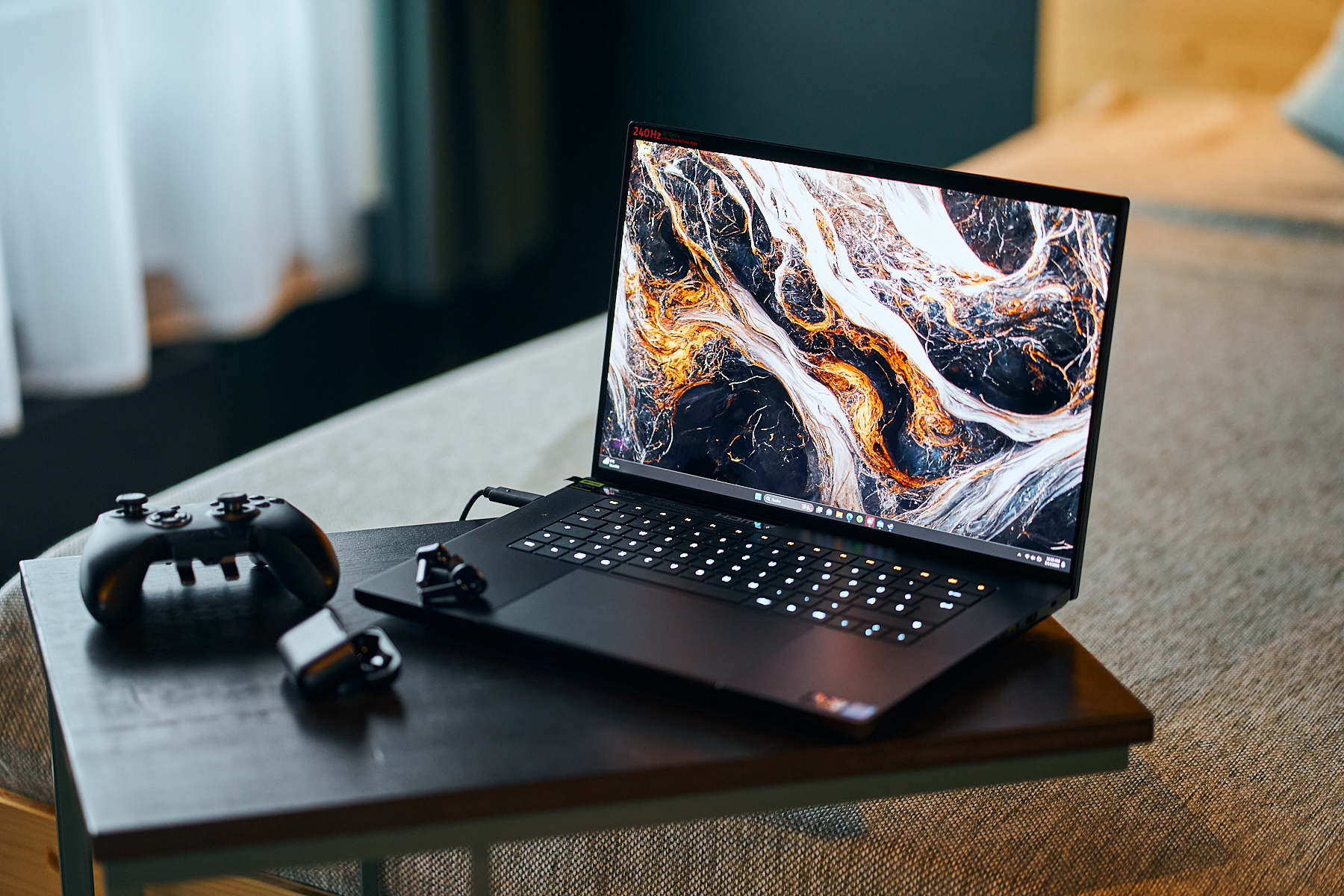
With the laptop market facing a period of homogeneity due to marginal hardware advancements, manufacturers are seeking new ways to distinguish their products. The processor and graphics card performance leap has largely plateaued with Intel’s new Gen14 CPUs offering only a slight improvement over last year’s models, and Nvidia not releasing a new generation of graphics cards.
Razer, however, is taking a different approach to differentiate its latest offering. At CES, the company unveiled the Razer Blade 16 (2024) with much fanfare, concentrating its marketing efforts on the integration of a cutting-edge Samsung OLED display. Razer aims to turn heads by focusing on display technology, posing the question as to whether OLED provides significant enhancements over the already impressive Mini-LED displays.
Our examination of the flagship Razer Blade 16 equipped with an i9-14900HX and an RTX 4090 delves into the capabilities of the new display compared to its predecessor. On paper, the OLED panel is less luminous, with a brightness of 400 nits versus the 700 nits Mini-LED display of the prior model. Nonetheless, the OLED boasts finer Delta-E values, indicative of fewer grayscale inaccuracies, and increased color space coverage, particularly in AdobeRGB. It is also completely capable of covering sRGB and DCI-P3 color gamuts. The OLED panel’s response time is remarkably quick at 1 ms, rectifying the Mini-LED’s shortcomings in black-to-white transitions.
For enthusiasts and potential buyers looking for a deep dive into the Razer Blade 16 (2024) and the impacts of the latest Intel Gen 14 processors, a comprehensive review is available that details all the performance enhancements and the overall capabilities of the laptop. Whether you prioritize display technology, processing power, or other advanced features, the Razer Blade 16 (2024) sets out to make a case for why it should be on your radar in a market craving innovation.