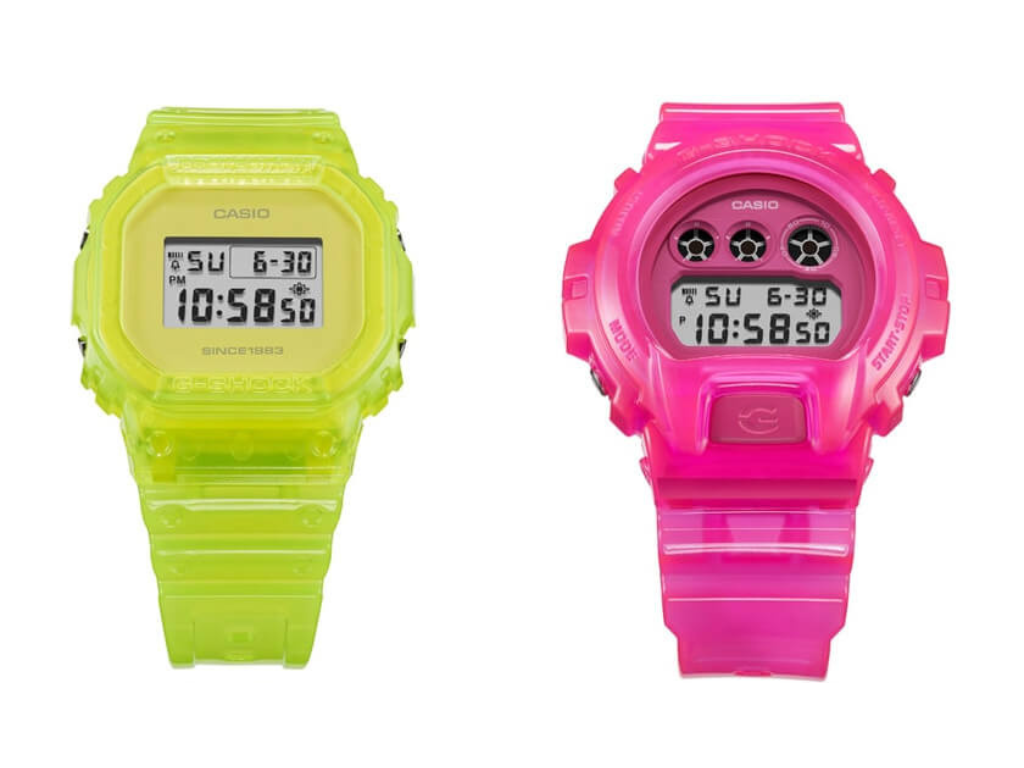
An $11,000 Casio G-Shock? That’s the reality surrounding two ultra-rare models from the 2018 NIGO x Kikuo Ibe collaboration—and the bigger story is how hard they are to authenticate.
Back in 2018, to mark G-Shock’s 35th anniversary, Japanese designer NIGO and G-Shock creator Kikuo Ibe teamed up on two translucent limited editions: the DW-6935-4 in pink and the DW-5635-9 in yellow. Casio highlighted a special coloring process that layered fluorescent dye between two resin coats and added an anti-UV finish to keep the cases from discoloring in sunlight. Retail was roughly $135, distributed via raffle, and only 35 pieces of each model were produced worldwide.
Fast-forward to today and these watches have become grails on the secondary market, with listings often exceeding $11,000—and some pushing close to $14,000. The problem? Proving a genuine watch from a high-quality fake is extremely difficult.
Unlike many Swiss luxury brands that provide robust serial-number systems and official lookups, rare G-Shock collaborations occupy a verification gray zone. Case backs can show model numbers, but consistent, traceable individual serial numbers are not always present in listings. There’s no official Casio authentication portal, and community databases offer limited tools for pieces this scarce. That leaves buyers relying on visual tells and seller reputation—hardly ideal when five figures are on the line.
This authenticity vacuum is unfolding against a market backdrop that has cooled since the 2022 peak. While most standard G-Shocks depreciate—often selling for a fraction of retail—true limited editions behave differently. Scarcity drives value, attracts counterfeiters, and creates wide price spreads. With so few legitimate sales to benchmark, establishing a fair market value for the DW-6935-4 and DW-5635-9 can vary wildly from around $6,000 to well over $11,000.
If you’re considering a purchase, proceed with extreme caution. Here are practical checks collectors use, with the caveat that none are foolproof for watches in this price range:
– Run the three-button test: Press A + C + D to display all LCD segments. Many cheap fakes fail this, though high-grade replicas may still pass.
– Verify weight and dimensions against official specs; discrepancies can signal incorrect modules or case materials.
– Inspect the buckle and case-back engravings under magnification for crispness, font accuracy, and finishing quality.
– Examine resin clarity and tint, the smoothness of mold lines, gasket fit, and the backlight color or logo behavior.
– Check module number consistency, packaging details, manuals, and warranty materials, while remembering these can be forged.
– Prioritize provenance: original raffle documentation and a verifiable ownership trail help, but should be cross-checked.
– Use trusted retailers, in-person transactions, third-party escrow, or independent watchmaker inspections before committing.
For ultra-limited G-Shocks, the safest move is to buy only from sellers with verifiable credibility and strong return policies. Until the brand or the community builds better authentication infrastructure, the $11,000 question remains: when a watch was made in a run of 35, how do you prove the one in your hand isn’t number 36?
If you love the aesthetic but not the risk, consider mainstream models like the DW-5600 series for a similar G-Shock vibe at a fraction of the price.