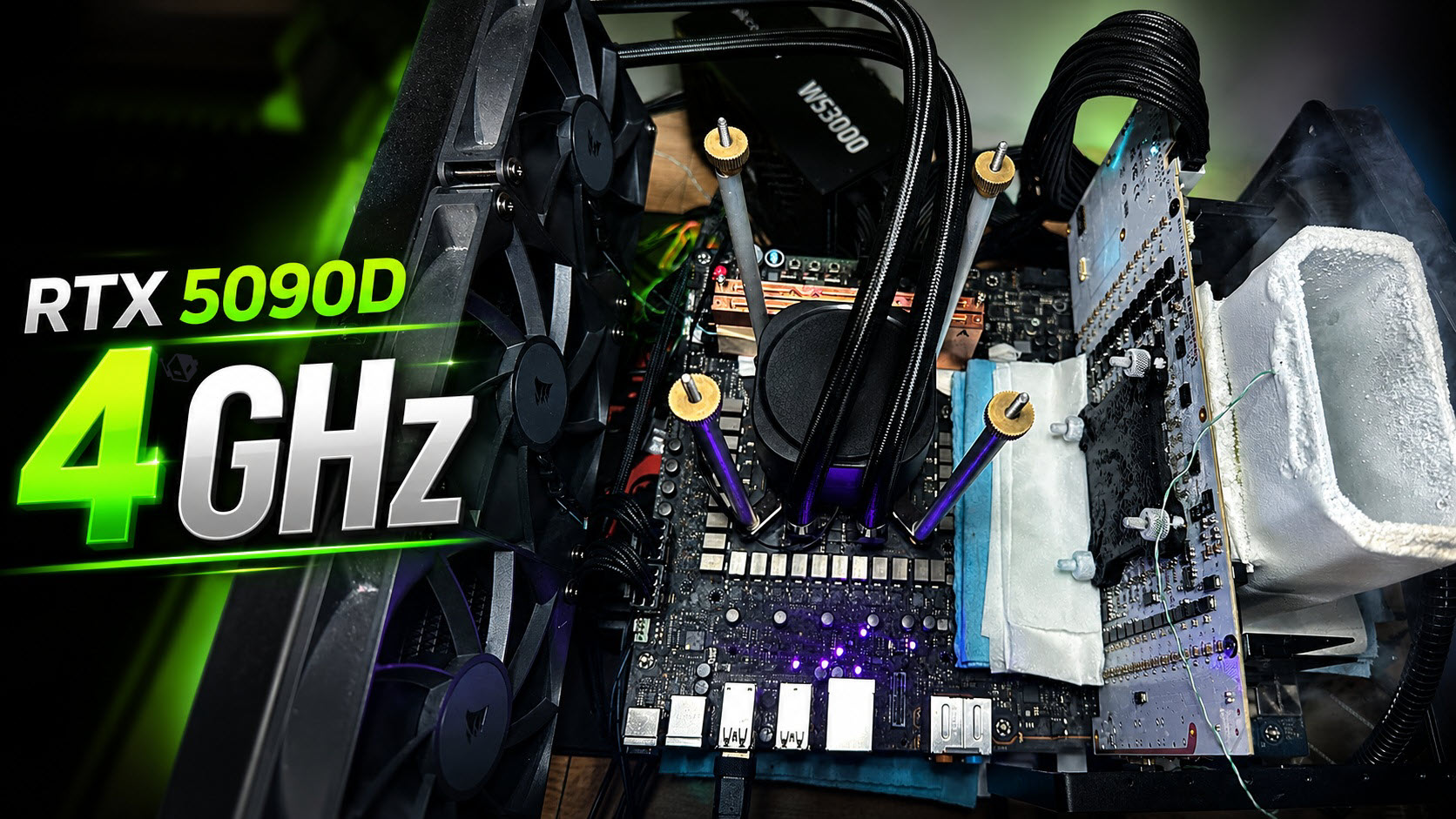
NVIDIA GeForce RTX 5090D Hits 4 GHz as GALAX HOF OC LAB Card Sets New Blackwell GPU Overclocking Record
NVIDIA’s GeForce RTX 5090D has reached a major milestone in extreme GPU overclocking, becoming the first Blackwell-based graphics card to break the 4 GHz barrier. The record was achieved using the GALAX GeForce RTX 5090D HOF OC LAB edition, a card designed for serious overclockers and built with the kind of power delivery hardware needed for liquid nitrogen sessions.
The achievement was recorded by Team OGS from Greece, who pushed the RTX 5090D to an incredible 4002 MHz core clock in a GPU-focused benchmark run. This makes it the fastest clock speed ever recorded on an NVIDIA Blackwell GPU so far.
The graphics card used for the record was not the newer RTX 5090D V2 model. Instead, Team OGS used the earlier GALAX RTX 5090D HOF OC LAB variant, which features a GPU configuration closer to the standard GeForce RTX 5090. The newer V2 version comes with a reduced core and memory setup, making the original card a more suitable choice for pushing maximum frequencies.
The GALAX HOF OC LAB series is well known in the overclocking community, and this RTX 5090D model is built specifically for extreme performance tuning. It features dual 16-pin power connectors and a massive 36-phase power delivery design, giving overclockers the electrical headroom needed for record attempts under extreme cooling.
To reach the 4 GHz milestone, Team OGS used a modified clock setup. The stock 27 MHz crystal was replaced with Elmor’s External Clock Board, often called ECB. This tool allows expert overclockers to bypass the onboard clock source and use an adjustable external reference clock instead.
With the external clock board, Team OGS increased the reference clock to 28.7 MHz. That represents a 6.3 percent increase, which raised GPU-related frequencies by the same amount. The memory also benefited from the adjustment, climbing to 1860 MHz compared to the standard 1750 MHz reference clock.
In effective terms, the memory was running close to 30 Gbps during the record run. Extreme overclockers can potentially push GDDR7 memory even further with similar hardware, with speeds of up to 38.4 Gbps possible under the right conditions. For comparison, a standard GeForce RTX 5090 memory setup operates at 28 Gbps.
The record-breaking run was performed in GPUPI v3.3 32B, a synthetic benchmark that focuses heavily on GPU compute performance. During the test, the GALAX RTX 5090D HOF OC LAB reached 4002 MHz on the GPU core while the memory operated at 1860 MHz.
With this result, Team OGS claimed the top position in the benchmark with a completion time of 35 seconds and 377 milliseconds. That was more than a full second faster than the previous best score, making the run not only a frequency milestone but also a benchmark performance record.
Before this 4 GHz result, the highest known RTX 5090D overclock stood at around 3.88 GHz, achieved by Splave. Breaking past 4 GHz is a major accomplishment for NVIDIA’s Blackwell architecture and shows how much headroom the RTX 5090D can offer when paired with specialized hardware, advanced modifications, and liquid nitrogen cooling.
While NVIDIA now has a 4 GHz Blackwell GPU record, the overall GPU frequency record still belongs to AMD hardware. A Radeon RX 9060 XT previously reached 4.769 GHz, setting the current peak for graphics card clock speed. Even so, the RTX 5090D crossing the 4 GHz mark is an important moment for the competitive overclocking scene.
This result highlights just how far modern GPUs can be pushed beyond their factory specifications. With cards like the GALAX RTX 5090D HOF OC LAB, external clock tuning, extreme cooling, and expert-level hardware modification, overclockers continue to explore the limits of next-generation graphics architectures.
Team OGS is expected to continue chasing more records, and this 4 GHz Blackwell GPU achievement may be only the beginning of what the RTX 5090D can deliver under extreme conditions.