South Korea’s Ambitious Honam Chip Hub Faces a Critical Supplier Challenge
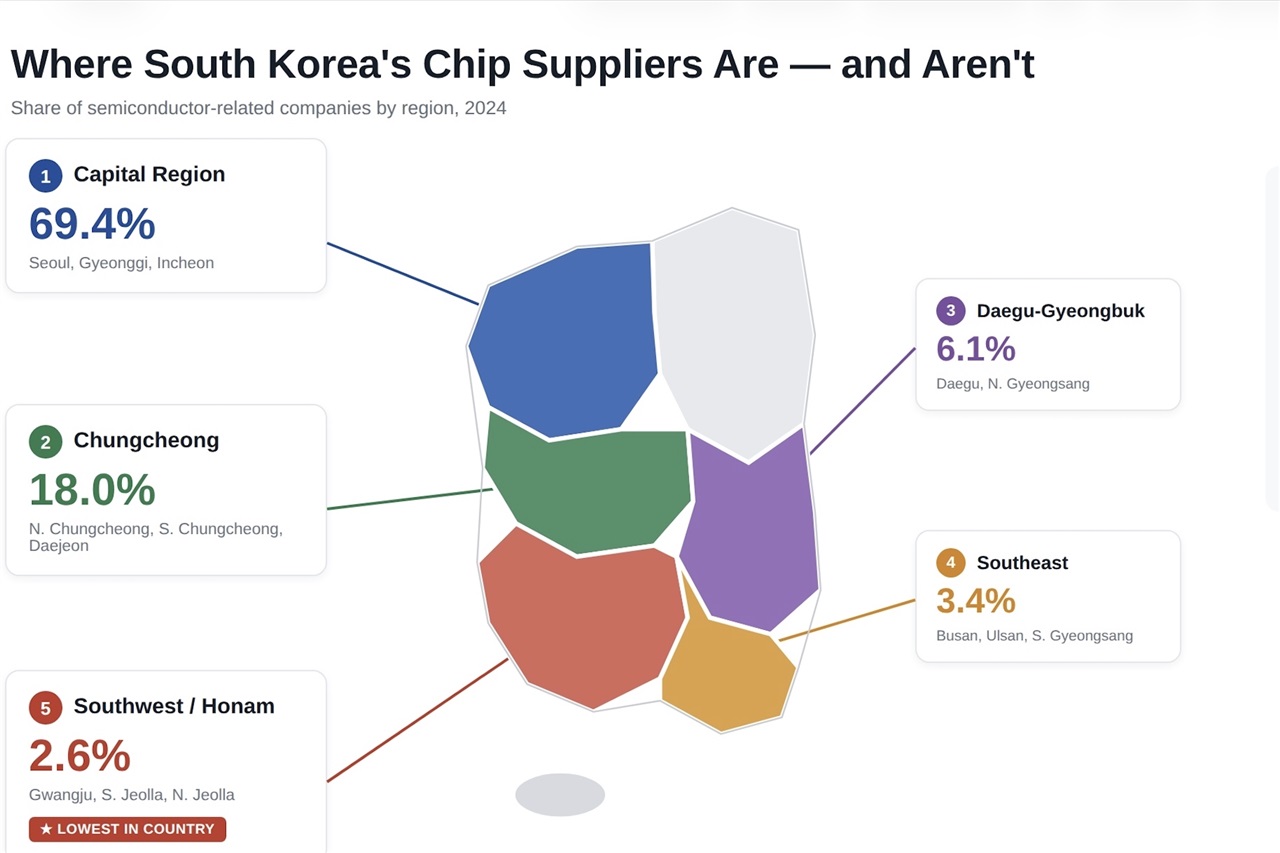
South Korea’s plan to develop a massive memory semiconductor manufacturing cluster in the southwestern Honam region is facing an early obstacle: the area currently has the weakest semiconductor supply chain base in the country.
The project, valued at KRW800 trillion, or roughly US$51 billion, is intended to strengthen South Korea’s position in the global memory chip market by expanding advanced semiconductor production beyond the country’s traditional technology centers. However, the success of the Honam chip cluster may depend on whether the region can quickly attract suppliers of semiconductor materials, components, and equipment.
A memory fab cluster does not rely only on large chipmakers. It requires a dense network of specialized companies that provide everything from chemicals and wafers to precision machinery, testing tools, parts, maintenance services, and logistics support. Without that ecosystem nearby, production costs can rise, construction timelines may stretch, and the region may struggle to compete with established semiconductor hubs.
The Honam region has long been viewed as a candidate for broader industrial development, and the chip cluster plan could bring major economic benefits, including new jobs, infrastructure investment, and opportunities for local businesses. But the current shortage of semiconductor-related suppliers highlights a major gap between the government’s vision and the region’s industrial readiness.
South Korea’s semiconductor industry is already one of the most important pillars of its economy, especially in memory chips such as DRAM and NAND flash. As demand grows for artificial intelligence, data centers, high-performance computing, smartphones, and electric vehicles, countries around the world are racing to secure chip production capacity and reduce dependence on overseas supply chains.
For South Korea, building a new chip hub in Honam could help spread semiconductor investment more evenly across the country while improving long-term manufacturing resilience. Yet experts and policymakers may need to focus not only on constructing fabs, but also on building the supplier network required to support them.
This could involve incentives for materials and equipment companies, support for local workforce training, faster infrastructure development, and closer cooperation between government agencies, chip manufacturers, universities, and small and mid-sized suppliers. The region may also need improved transportation, reliable power supply, water resources, and advanced industrial facilities to meet the demanding requirements of semiconductor production.
The challenge is not unusual. Semiconductor clusters take years to mature, and the strongest hubs in the world are built around deep supplier ecosystems. Once established, these ecosystems create a powerful advantage, allowing manufacturers to solve problems faster, reduce downtime, and accelerate production ramp-up.
The Honam project therefore represents both a major opportunity and a significant test. If South Korea can successfully develop a local supplier base alongside the planned memory fabs, the region could become a new engine for the country’s semiconductor growth. If not, the cluster may face delays and added costs that could weaken its competitiveness.
As global competition in chip manufacturing intensifies, South Korea’s ability to turn the Honam region into a complete semiconductor ecosystem will be closely watched. The plan has the scale and ambition to reshape the country’s chip industry, but its future may depend on one essential factor: whether the supply chain can grow fast enough to match the size of the investment.