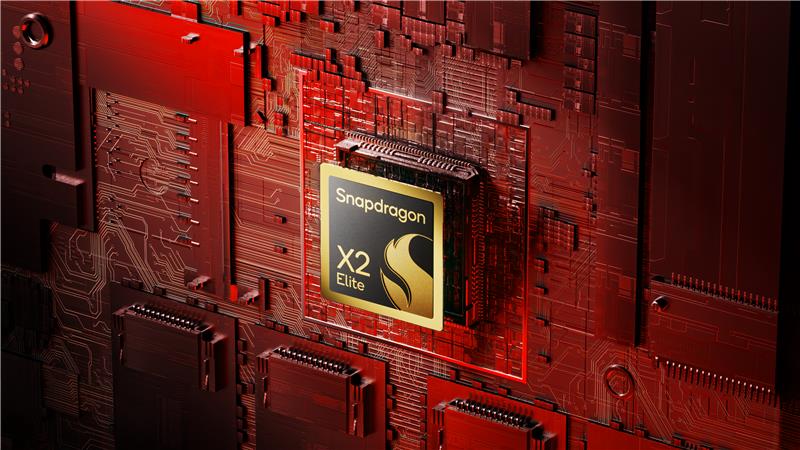
Qualcomm is wasting no time in the laptop chip race. The first wave of laptops powered by the company’s second-generation Snapdragon X Elite processors has already arrived, and early testing shows a clear step forward in both speed and efficiency. In short: Snapdragon X2 Elite is shaping up to be one of the most compelling laptop CPU upgrades we’ve seen in a while, especially for people who care about quiet, cool machines that still feel fast.
Two new ASUS laptops highlight what these chips can do in the real world. One system pairs the Snapdragon X2 Elite with an updated ASUS Zenbook A14, while another uses the higher-tier Snapdragon X2 Elite Extreme in the new ASUS Zenbook A16. Across both machines, Qualcomm’s newest laptop processors deliver stronger single-core and multi-core performance than the latest competing designs from AMD’s Zen 5 lineup and Intel’s Panther Lake generation.
What stands out most isn’t just the top-end benchmark numbers. The more interesting story is how well the Snapdragon X2 Elite maintains performance at low power limits. In everyday use, many laptops spend most of their time operating under tighter power and thermal constraints, especially in quieter profiles designed for comfort. On the Zenbooks, using Whisper mode keeps fan noise extremely low—around 30 dB(A) even under load—yet multi-core performance remains impressively high. In fact, even when the long-term power limit sits under 20W, the performance in this quiet mode can still outperform rival AMD and Intel laptops running in high-performance profiles.
For users, that translates into a practical benefit: you can get a laptop that stays very quiet (and often feels close to silent during normal tasks), without sacrificing responsiveness for multitasking, productivity, and heavier workloads. And when you do need maximum output, the system can still ramp up and make full use of the processor’s capabilities.
Graphics performance is also getting a meaningful boost. The first generation of Qualcomm’s integrated Adreno graphics was often seen as a weak point compared to integrated solutions from AMD and Intel. With the Snapdragon X2 Elite generation, Qualcomm has significantly improved the iGPU, making it far more competitive than before. That improvement shows up in stronger gaming results and better overall graphics performance, helping these laptops feel more well-rounded for casual gaming and GPU-accelerated tasks.
That said, there are still some limitations versus traditional x86 laptops. Certain apps and games can behave differently depending on compatibility and optimization, but the overall situation has improved a lot over the last two years. As software support continues to mature, these Snapdragon-powered laptops are increasingly positioned as realistic everyday alternatives, not just niche experiments.
Overall, Snapdragon X2 Elite and Snapdragon X2 Elite Extreme raise the pressure on both AMD and Intel in a big way—especially in the areas that matter most to laptop buyers today: performance per watt, sustained speed at low power, and quieter operation. If this pace continues, the next phase of the laptop CPU competition may be defined as much by efficiency and real-world usability as by raw peak benchmarks.