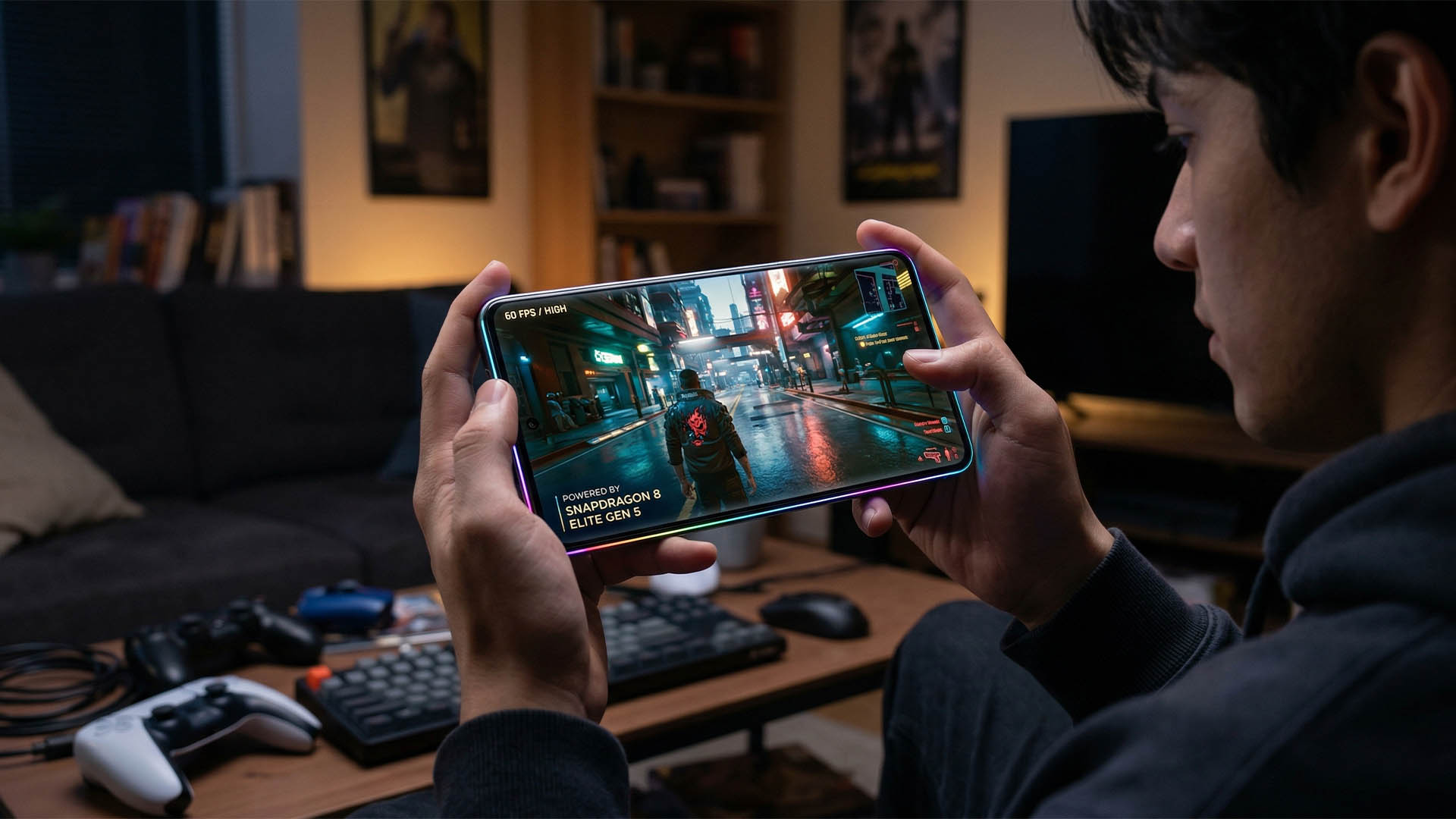
Qualcomm’s Snapdragon 8 Elite Gen 5 is proving that Android hardware has more than enough raw power to handle modern AAA gaming—even if many of these titles aren’t available as native Android releases. With the right setup, the chip can push demanding, visually rich games at impressively high frame rates through emulation. The problem is that this performance comes with a major downside: extremely high power consumption that can spike to nearly 50W, raising serious concerns about efficiency, heat, and long-term practicality in a smartphone form factor.
A recent round of testing shows just how capable the Snapdragon 8 Elite Gen 5 can be when paired with high-end specs and strong cooling. One showcased device, the REDMAGIC 11 Pro Golden Saga, combines the chipset with 24GB of RAM and an aggressive cooling design that includes liquid and vapor chamber elements. It’s also priced firmly in ultra-premium territory at €1,499 (around $1,726), signaling that this kind of “desktop-like” mobile gaming performance isn’t arriving cheaply.
Using emulation software, the Snapdragon 8 Elite Gen 5 reportedly ran heavy hitters like Cyberpunk 2077, Red Dead Redemption 2, and Resident Evil Requiem smoothly. In the case of Resident Evil Requiem, performance reached roughly 80–90 FPS, an eye-catching result for a smartphone-class processor trying to reproduce the experience of high-end gaming hardware.
But there’s a catch that’s hard to ignore. During Resident Evil Requiem, peak power draw hit about 48.3W. For a smartphone chip, that number is alarming. Even with advanced cooling, dumping close to 50W of heat from a compact 7-inch device chassis is a steep challenge. Heat buildup doesn’t just make a device uncomfortable to hold—it can force throttling that reduces performance, strain the battery, and potentially impact long-term durability.
What this really highlights is the growing gap between performance and efficiency. Qualcomm appears to be pushing mobile silicon harder to achieve higher frame rates in demanding games, but the power costs are climbing into territory that simply isn’t sustainable for phones. A chip that can hit near-console visuals and frame rates is exciting, but not if it behaves like a small space heater while doing it.
Looking ahead, Qualcomm is expected to introduce Snapdragon 8 Elite Gen 6 and Snapdragon 8 Elite Gen 6 Pro models, and there are claims that Samsung’s Heat Pass Technology could be used to help manage temperatures—particularly on the Pro version. However, better thermal transfer and cooling solutions only address the symptom (heat), not the root cause (efficiency). If power draw remains uncontrolled, improved cooling may help devices survive longer sessions, but the underlying issue will still affect battery life, sustained performance, and overall user experience.
The Snapdragon 8 Elite Gen 5 demonstrates that Android gaming performance is no longer the limiting factor. The bigger question now is whether the next generation can deliver similar results without pushing power consumption to extremes. If Qualcomm can rein in wattage while keeping frame rates high, Snapdragon 8 Elite Gen 6 could be a major leap forward. If not, the industry may be headed toward an uncomfortable trend where flagship smartphone gaming performance keeps rising, but efficiency falls behind.