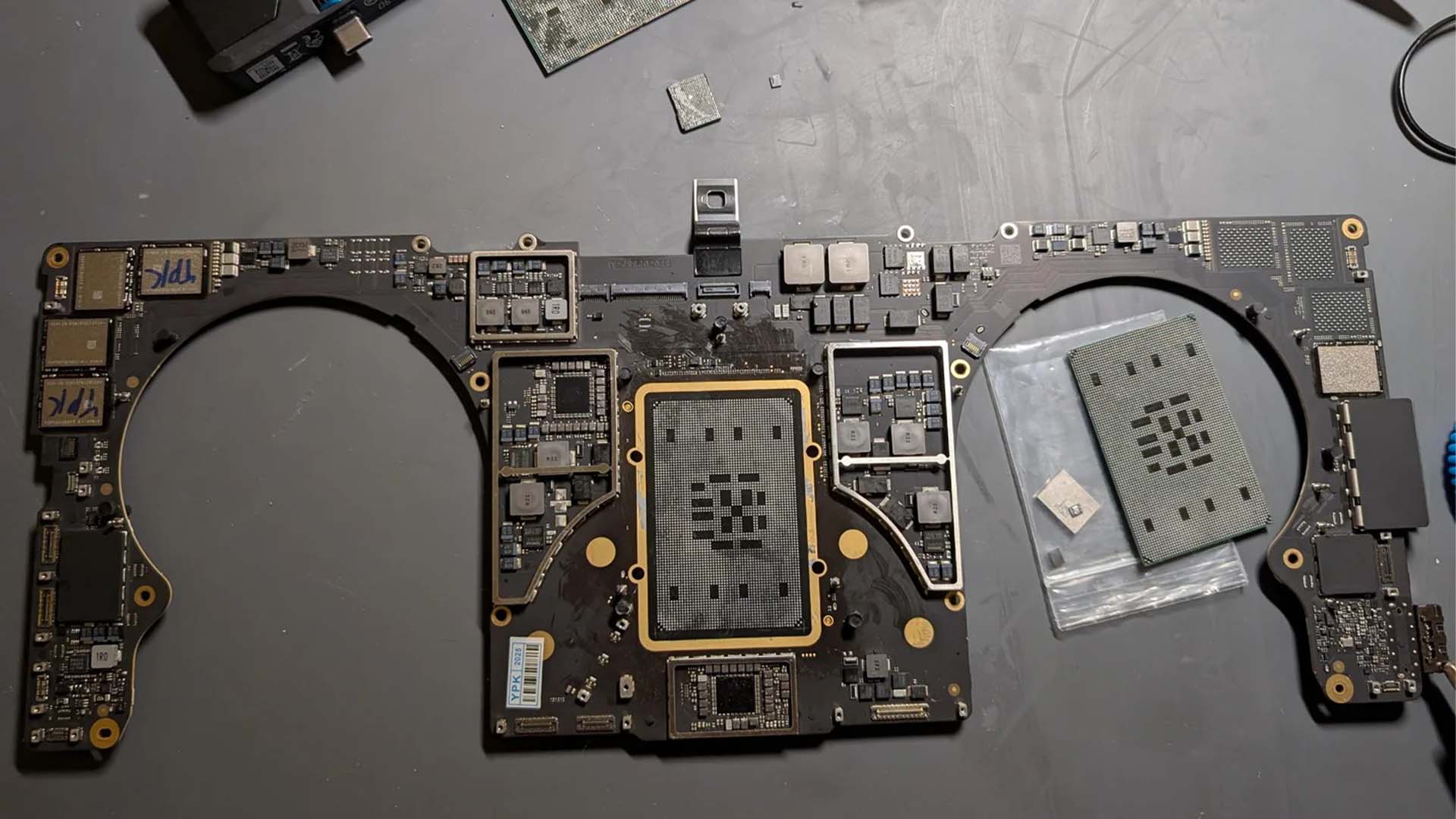
Water-Damaged M1 Max MacBook Pro Logic Board Revived After Impressive Apple Silicon Transplant
A water-damaged logic board is usually a death sentence for a laptop. Once internal layers short out, corrosion spreads, or a burn hole appears, most boards are written off as electronic waste unless a skilled technician can recover valuable components. But one determined MacBook Pro owner proved that even a badly damaged M1 Max motherboard can sometimes be brought back to life with the right tools, patience, and a very steady hand.
A Reddit user known as “zerogpk” shared an impressive repair involving an M1 Max MacBook Pro logic board that had suffered severe water damage near the trackpad connector. The damage was not minor. According to the repair summary, the internal board layers shorted and burned a hole through the logic board, making a normal repair impossible.
Instead of giving up on the machine, the owner attempted something far more complex: moving the M1 Max chip and its paired components onto a donor motherboard.
This is not a simple chip swap. Apple Silicon systems are tightly integrated, and the M1 Max is not designed to be freely moved from one board to another. The chip is paired with specific components on the original logic board, which means a donor board will not automatically recognize it after installation.
To make the transplant work, the repairer had to move several important components from the damaged board to the replacement board. These included the SEP EEPROM, Wi-Fi components, and Touch ID hardware. Without transferring these paired parts, the MacBook Pro would likely fail to authenticate key hardware or boot correctly.
Finding a suitable donor board was already a challenge. M1 Max logic boards are not common spare parts, especially for a machine that is now several years old. The Reddit user managed to source a compatible donor board through AliExpress, which made the repair possible.
The cost of these parts also shows why this kind of repair is not always practical for everyday users. An M1 Max board with the A2485 part number was listed at around AU$600, or roughly $430. A full used MacBook Pro configuration could cost around AU$1,500, or about $1,073. That makes the repair financially tempting for someone with advanced micro-soldering skills, but risky and expensive for anyone without the right experience.
The M1 Max itself is a large and complex package. Unlike many traditional laptop designs where memory is placed separately on the motherboard, Apple’s M-series chips use unified memory integrated closely with the system-on-chip. This design helps deliver strong performance and efficiency, but it also makes board-level repair much more difficult.
After the transplant, the repaired MacBook Pro was put through eight hours of stress testing. The CPU, GPU, and memory were pushed hard to confirm that the system was stable and ready for regular use. That final step was important because a successful boot does not always mean a repair is fully reliable. Under heavy workloads, hidden issues can appear if a solder joint, component, or power rail is not functioning correctly.
The repairer summarized the process by explaining that the water damage near the trackpad connector caused a short and burned a hole in the board. Since the original logic board could not be saved, the only realistic option was to find a suitable host board for the M1 Max SoC and its paired components. After the transplant, the chip was successfully revived and the MacBook Pro returned to working condition.
This repair highlights both the durability and the difficulty of modern Apple Silicon machines. On one hand, the M1 Max chip itself survived even after the logic board was badly damaged. On the other hand, the level of component pairing and integration means that advanced repairs require far more than replacing a single part.
For most MacBook Pro owners, this kind of repair is not something to attempt at home. It requires professional equipment, expert soldering skills, a deep understanding of Apple board architecture, and access to compatible donor hardware. One wrong move could destroy the chip, damage the replacement board, or make the system unusable.
Still, the story is a fascinating example of what expert repair technicians can accomplish. It also shows why board-level repair can be valuable, especially when high-end MacBook Pro models remain expensive to replace. A premium MacBook Pro with a Max-series chip can cost thousands of dollars, so saving a damaged machine through component-level repair can make financial sense when done by someone with the right skill set.
In an era where many damaged electronics are quickly discarded, this M1 Max MacBook Pro repair stands out as a reminder that not every broken logic board has to become e-waste. With creativity, technical knowledge, and precision micro-soldering, even a MacBook Pro with a burned logic board can sometimes get a second life.