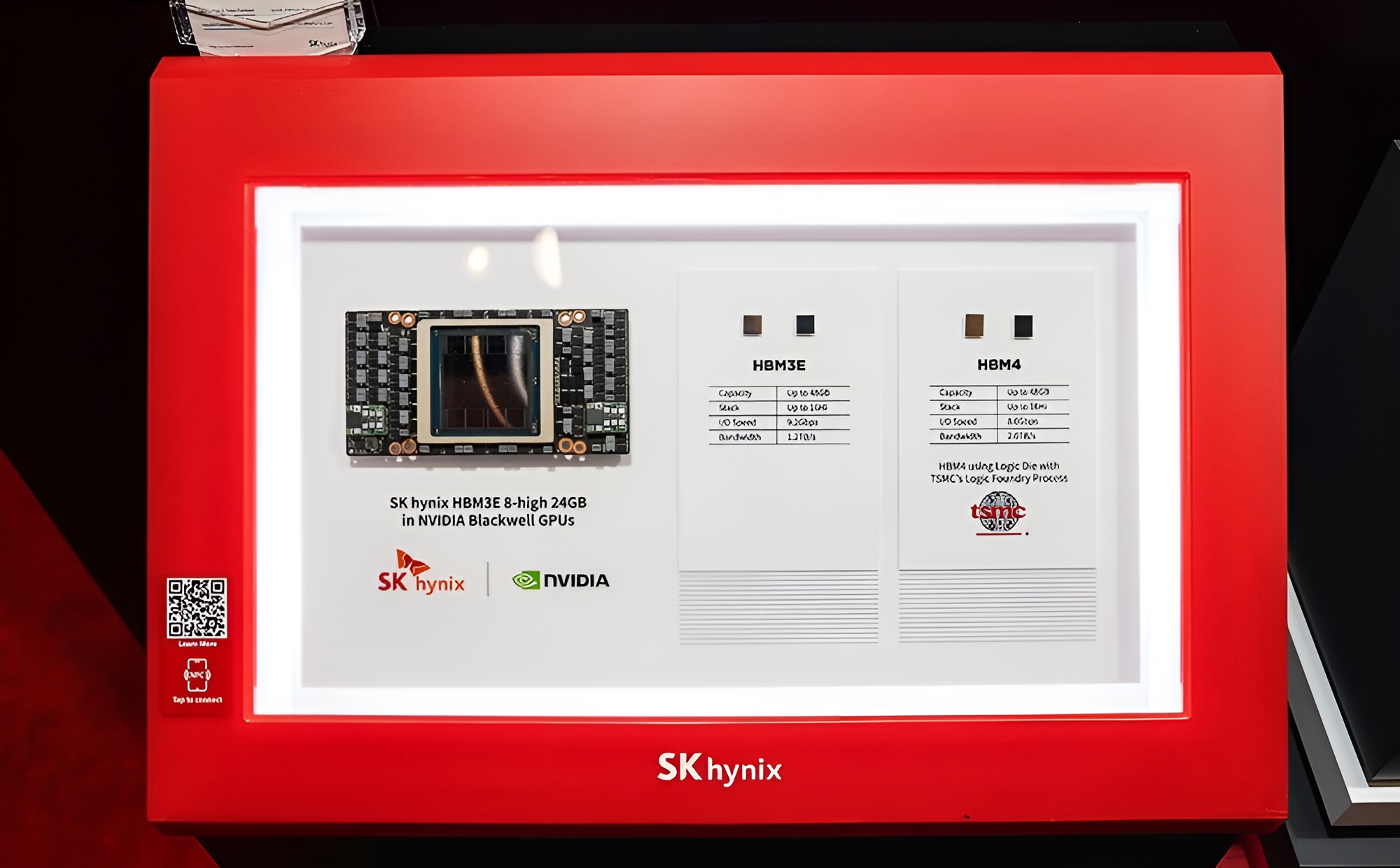
SK Hynix recently made waves at TSMC’s North America Technology Symposium by unveiling its groundbreaking HBM4 technology alongside other cutting-edge memory products. This event marked a significant milestone as SK Hynix showcased its dominance in the HBM market, particularly with its advanced HBM4 capabilities.
Currently, SK Hynix appears to be leading the pack, having already developed a commercial version of HBM4 while competitors such as Micron and Samsung are still in the sampling phases. The company’s display at the symposium highlighted its “AI memory” leadership, featuring several innovative products.
The HBM4 technology is impressive, boasting a capacity of up to 48 GB, a 2.0 TB/s bandwidth, and an I/O speed of 8.0 Gbps. SK Hynix announced plans for mass production by the second half of 2025, hinting at potential integrations into products as early as the end of this year. This move positions SK Hynix uniquely, as they are the only company to publicly unveil HBM4 technology so far.
In addition to HBM4, SK Hynix introduced a 16-layer HBM3E, another pioneering effort with a bandwidth of 1.2 TB/s. This standard is expected to pair with NVIDIA’s GB300 “Blackwell Ultra” AI clusters, as NVIDIA plans to transition to HBM4 with Vera Rubin. SK Hynix’s innovations in connecting layers through Advanced MR-MUF and TSV technologies underscore its leadership in this field.
SK Hynix also showcased an impressive lineup of server memory modules, including RDIMMs and MRDIMMs. These modules, built on the newer 1c DRAM standard, are achieving speeds up to 12,500 MB/s. The lineup aims to enhance AI and data center performance while minimizing power consumption. Highlights include MRDIMMs with speeds of 12.8 Gbps and capacities ranging from 64 GB to 256 GB, as well as RDIMM modules up to 256 GB featuring similar speed enhancements.
SK Hynix’s strategic push into both HBM and DRAM markets demonstrates a clear competitive edge over traditional players like Samsung, driven by robust innovation and strategic partnerships with industry leaders such as NVIDIA.