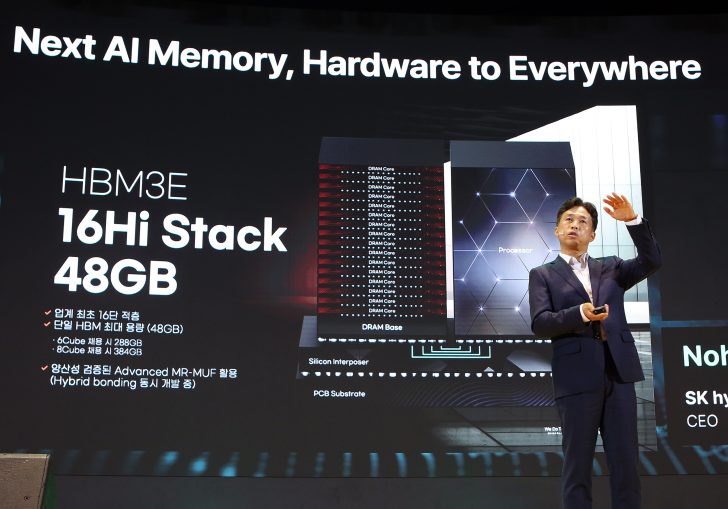
In a groundbreaking move, SK hynix has announced the world’s first 16-Hi HBM3E memory solution, boasting an impressive capacity of up to 48 GB per stack. This pioneering memory advancement was unveiled by CEO Kwak Noh-Jung at the SK AI Summit 2024, signaling a significant leap forward in the industry.
During his keynote address, Kwak highlighted the technological feat of achieving the highest number of layers in an HBM product, surpassing previous limits. The 16-Hi HBM3E solution sets a new standard with its immense capacity, ready to be sampled by early 2025.
The innovative technology backing this development includes the Advanced MR-MUF process, initially used for the mass production of 12-high products. This process, alongside new hybrid bonding technology, has paved the way for the 16-high HBM3E’s conception.
The introduction of these 16-high stacks heralds substantial performance improvements—an 18% boost in training capabilities and a remarkable 32% enhancement in inference tasks compared to their 12-high counterparts. With the growing demand for AI accelerators, these advancements are set to reinforce SK hynix’s leadership in AI memory solutions.
Additionally, SK hynix is exploring further innovations for the future, such as LPCAMM2 modules tailored for PCs and data centers, alongside 1cnm-based LPDDR5 and LPDDR6 technologies. The company’s commitment to advancing low-power, high-performance memory products is evident in their ongoing developments in PCIe 6th generation SSDs, high-capacity QLC-based eSSDs, and UFS 5.0.
Looking ahead, SK hynix is collaborating with a premier logic foundry to incorporate logic processing in upcoming HBM4 generations. This integration aims to deliver even more optimized products, catering to varied customer needs.
SK hynix is also venturing into revolutionizing AI memory through technologies like Processing Near Memory (PNM), Processing in Memory (PIM), and Computational Storage. These innovations are set to overcome the “memory wall,” transforming AI systems and shaping the future of the AI industry. This ambitious pursuit promises to redefine memory performance, capacity, and functionality, setting a new paradigm in the world of AI and beyond.