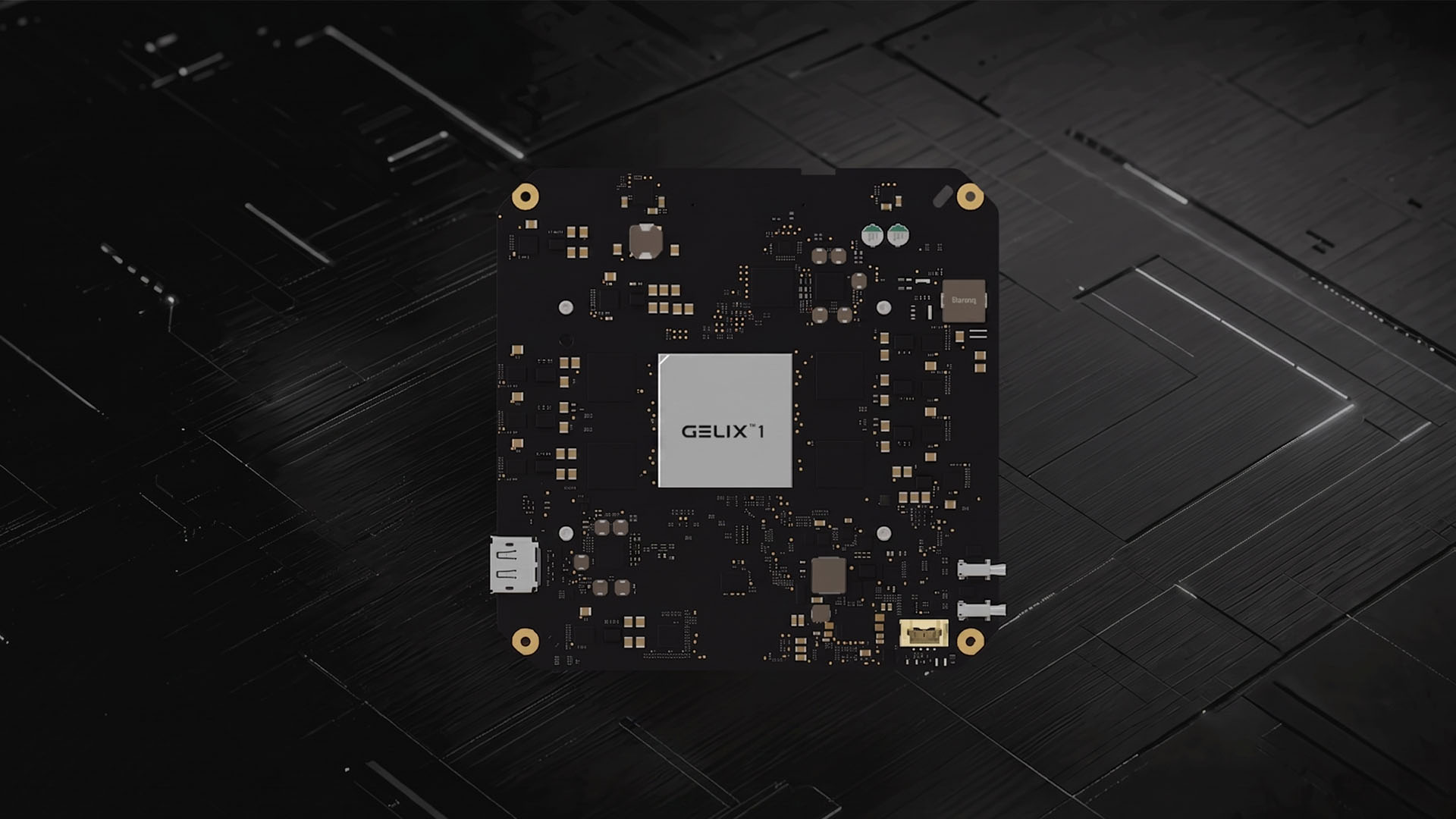
Acrab Gelix 1 AI Chip Aims to Challenge the Mac mini for Local AI Workloads
The Mac mini has become one of the most popular compact machines for running local AI agents, largely because of Apple’s powerful silicon, efficient design, and unified memory architecture. Now, Singapore-based startup Acrab wants to enter that same space with a new AI-focused chip called Gelix 1, a compact computing solution designed for local artificial intelligence workloads.
According to Acrab, the Gelix 1 is built around a 20-core ARM CPU and manufactured on a 5nm process. The company says its chip can outperform Apple’s older M4 Pro in AI inference tasks and is capable of running models with up to 100 billion parameters. If accurate, that would make Gelix 1 a serious option for developers, businesses, and privacy-focused users who want to run large AI models locally instead of relying on cloud servers.
A major part of Gelix 1’s appeal is its unified memory design. Acrab claims the chip can deliver 273GB/s of memory bandwidth, which puts it in the same range as Apple’s M4 Pro. Unified memory is especially important for AI workloads because large language models need fast access to massive amounts of data. Higher memory bandwidth can help reduce bottlenecks and improve inference performance, especially when working with larger models and extended context windows.
The Gelix 1 also includes a multi-core neural processing unit, which is designed to accelerate AI inference. This makes the chip more than just a traditional ARM processor. Instead, Acrab appears to be positioning it as a dedicated local AI platform that can fit inside a compact desktop-style enclosure while keeping performance and thermals under control.
Acrab’s internal benchmark results are drawing attention. The company claims the Gelix 1 reached a pre-fill rate of 1,416 tokens per second while running the Gemma 26B model with a 40,000-token context window. For comparison, the M4 Pro Mac mini reportedly reached 188 tokens per second in the same test.
That is a massive difference on paper, but there is an important catch: these results have not yet been independently verified. Until third-party testing confirms Acrab’s numbers, the performance claims should be treated carefully. AI benchmark results can vary depending on software optimization, memory configuration, model quantization, thermal limits, and testing methodology.
One of the biggest unanswered questions is how Gelix 1 would handle 100-billion-parameter AI models in real-world use. Apple’s M4 Pro Mac mini currently tops out at 48GB of unified memory, which is generally more suitable for smaller and mid-sized large language models, such as 30B to 35B-class models depending on optimization. A 100B model typically demands far more memory, potentially around 128GB or more depending on precision and compression.
That suggests the highest-end Gelix 1 configuration may need a much larger unified memory pool than Apple’s compact desktop currently offers. If Acrab can deliver that in a small and efficient device, it could become attractive for users who need serious local AI performance without a bulky workstation.
The 20-core ARM CPU is also noteworthy, as similar core counts have appeared in other compact AI workstation concepts. It remains to be seen what exact CPU architecture Acrab is using and how the full platform performs once it reaches reviewers and developers.
The main audience for Gelix 1 could include AI developers, small businesses, research teams, enterprise users, and anyone concerned about data privacy or cloud latency. Running AI models locally can reduce dependence on online services, improve response times, and keep sensitive information on-device. For industries dealing with private documents, customer data, code, legal files, healthcare information, or internal business intelligence, local AI hardware could become increasingly valuable.
However, affordability may be a major challenge. Hardware capable of running 100B models locally is unlikely to be cheap, especially if it requires a large unified memory configuration and specialized AI acceleration. Acrab has not yet revealed pricing, launch timing, or retail availability for Gelix 1, so it is unclear whether the chip will target mainstream consumers, professional users, or enterprise buyers.
For now, Gelix 1 is an ambitious new entry in the growing market for compact AI computers. If Acrab’s performance claims hold up under independent testing, the chip could become a strong alternative to Apple’s compact desktop systems for local AI inference. But until real-world benchmarks, pricing, and memory configurations are confirmed, Gelix 1 remains a promising product to watch rather than a proven Mac mini rival.