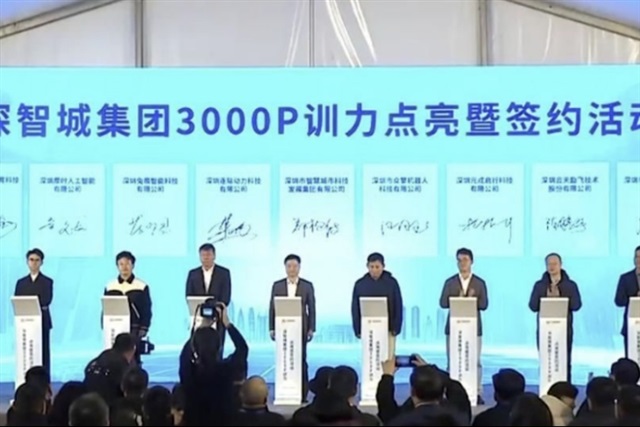
Shenzhen has just switched on a major new piece of AI infrastructure that project materials describe as China’s first “full-stack domestic” AI computing cluster at the 14,000P level. Built around roughly 10,000 accelerator cards, the facility is being positioned as a milestone in China’s drive to strengthen homegrown computing capabilities and reduce dependence on overseas hardware and supply chains.
At a time when AI development is increasingly limited by access to high-end chips and large-scale compute, the launch is notable not only for its size, but for its stated focus on an entirely domestic technology stack. In practical terms, that means the cluster is designed to rely on locally developed components and software across the core layers that make modern AI training and inference possible—helping local organizations build, test, and deploy advanced models without leaning heavily on imported platforms.
The “14,000P” figure signals the cluster’s performance class, indicating a high-throughput system intended for demanding AI workloads. Combined with the reported 10,000-card scale, Shenzhen’s new cluster is aimed at handling the kind of parallel processing required for training large language models, running massive simulations, analyzing complex datasets, and supporting multi-tenant AI services for research labs and enterprises.
Beyond raw performance, the project underscores a bigger strategic direction: building resilient domestic AI infrastructure at city and regional levels. For Shenzhen, a long-time hub for hardware manufacturing and high-tech innovation, bringing such a cluster online can strengthen its competitiveness in AI R&D, attract companies that need reliable compute access, and support local startups that often struggle with the high cost of large-scale training resources.
If the domestic-stack approach performs as intended, it could also serve as a template for similar deployments across China—expanding the pool of available AI compute while reinforcing a self-sustaining ecosystem spanning chips, servers, networking, system software, and AI tooling.
In short, Shenzhen’s new 14,000P, 10,000-card AI cluster is being framed as more than a big computing installation. It’s a signal of momentum in China’s push toward domestically sourced AI hardware and infrastructure, and a sign that large-scale, locally built compute is becoming a central part of the country’s next phase of AI growth.