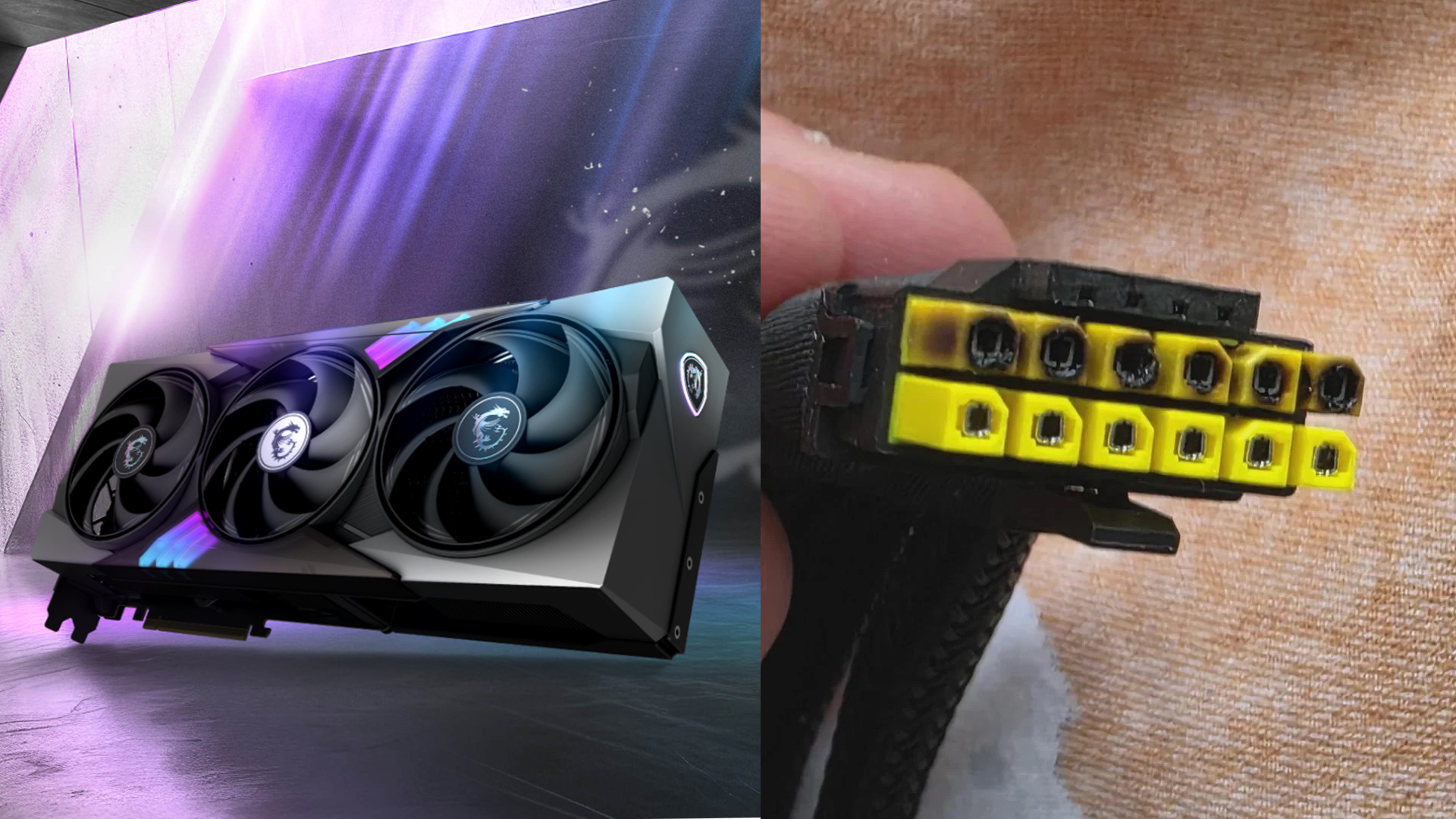
Another melted 16-pin power connector has been reported on an MSI GeForce RTX 5090—and for one owner, it happened twice in just a few weeks. The repeated failure has reignited debate around adapter design, cable choice, and the tricky mix of factors that can lead to overheating on high-end GPUs.
According to a Reddit post, the user was running an MSI GeForce RTX 5090 Gaming Trio powered by a Corsair SF1000, a compact ATX 3.1–compliant power supply listed as shipping with a 12VHPWR cable. Instead of using the PSU’s native 16-pin cable, the user opted for MSI’s yellow-tip adapter that comes with the graphics card. The first connector melted in July; after receiving a warranty replacement in August, the replacement suffered the same fate in under two months.
Another Redditor has reported a nearly identical case, adding weight to concerns around certain adapter setups. The MSI yellow-tip accessory is a 4×8-pin to 16-pin adapter, a style often criticized for poor load balancing under heavy draw. Even when fully seated—something the original poster says was double-checked—uneven current distribution can still occur, potentially leading to overheating and deformation at the connector.
While some chalk these failures up to user error, others point to a broader mix of risks: the physical design constraints of high-current 16-pin connectors, the variability of adapters, and the specific power delivery characteristics of a given PSU. In this instance, commenters also speculated whether the power supply could be a contributing factor, though the repeating pattern with the same adapter is hard to ignore.
For now, the takeaway for RTX 5090 owners is caution. Melting 16-pin connectors on this GPU line have been reported frequently, and repeated incidents suggest there isn’t a single cause. Cable choice, connector seating, adapter quality, and overall load distribution can all play a role—and any weak link can have costly consequences.
Sources: Reddit, @unikoshardware


