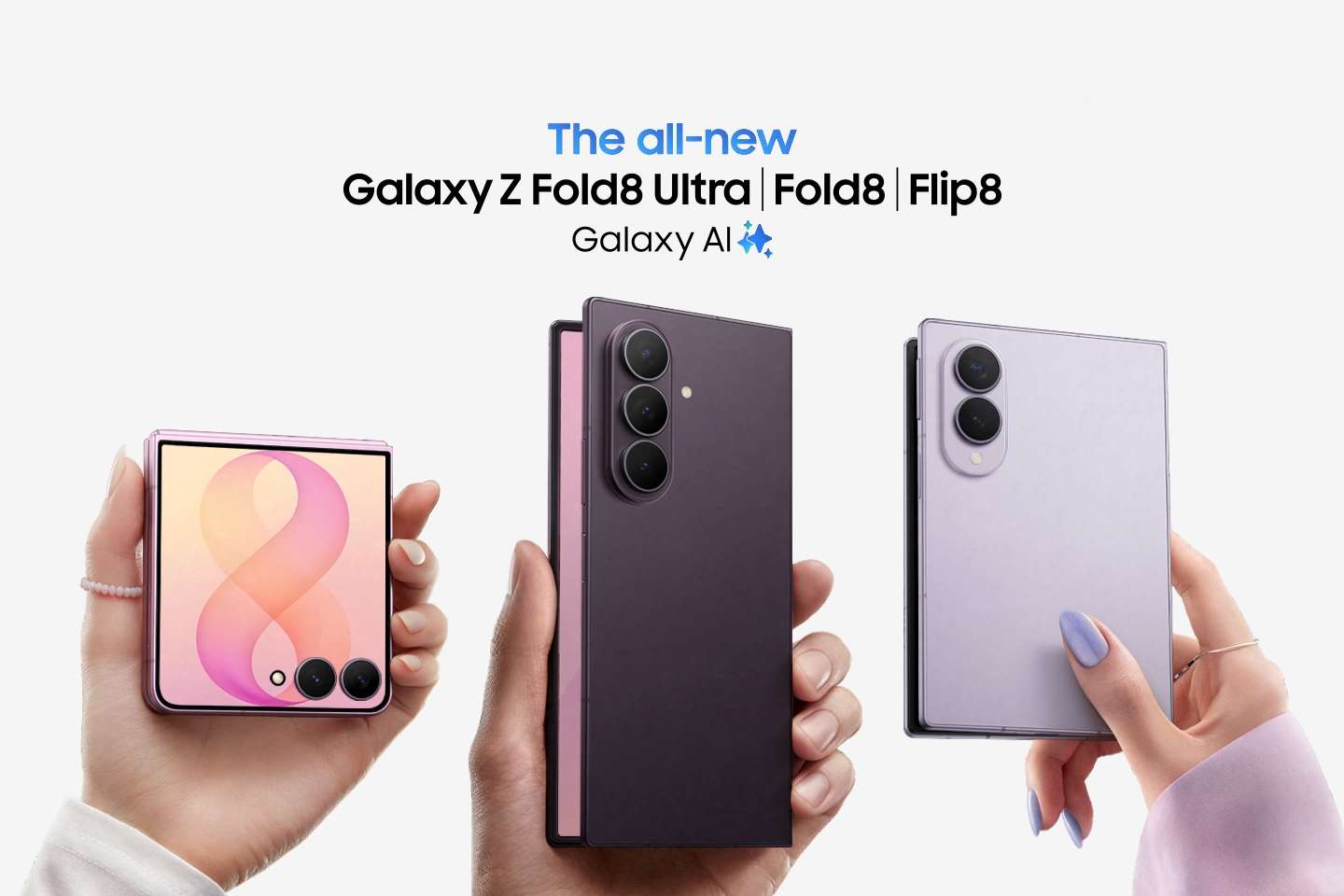
Samsung Galaxy Z Fold8, Z Fold8 Ultra, and Z Flip8 Unveiled With Thinner Designs, Titanium Flex Displays, and Major Hardware Upgrades
Samsung has refreshed its foldable smartphone lineup with three new models: the Galaxy Z Fold8, Galaxy Z Fold8 Ultra, and Galaxy Z Flip8. This year’s devices move beyond the familiar foldable formula with slimmer bodies, upgraded displays, stronger performance, improved cameras, and a new hinge/display structure designed to reduce the visible crease.
The biggest theme across the lineup is refinement. Samsung is focusing on thinner profiles, lighter builds, brighter low-reflection screens, and more practical cover displays. The Galaxy Z Fold8 introduces a new passport-style form factor, the Galaxy Z Fold8 Ultra pushes thinness even further, and the Galaxy Z Flip8 brings a more useful FlexWindow experience for quick access to apps and AI-powered features.
Samsung Galaxy Z Fold8 gets a new passport-like design
The Galaxy Z Fold8 appears to be one of Samsung’s most distinctive book-style foldables yet. Instead of sticking closely to the shape of previous generations, Samsung has introduced a more compact passport-like design that should make the device easier to carry while still offering a large inner screen when unfolded.
The main display measures 7.6 inches and uses a QXGA+ Dynamic AMOLED 2X panel with a resolution of 1,848 x 2,448 pixels. It delivers 403 pixels per inch and supports an adaptive 120Hz refresh rate that can scale from 1Hz to 120Hz depending on what is on the screen. Samsung has also included a low-reflection finish to improve outdoor visibility and reduce glare.
On the outside, the Galaxy Z Fold8 features a 5.5-inch WUXGA+ Dynamic AMOLED 2X cover screen with a 1,248 x 1,972 resolution, 428 pixels per inch, and the same 1Hz to 120Hz adaptive refresh rate. Like the main display, the cover screen also uses low-reflection technology.
A major improvement comes from Samsung’s new Titanium Flex display structure, which is designed to substantially reduce the display crease. Foldable phones have improved greatly in durability and usability over the years, but the crease remains one of the most noticeable trade-offs. With Titanium Flex, Samsung is aiming to make the folding screen feel and look more seamless.
The Galaxy Z Fold8 measures 81.9 x 123.9 x 9.7 mm when folded and 161.4 x 123.9 x 4.5 mm when unfolded. It weighs 201 grams, making it relatively light for a large foldable phone.
For photography, the device includes a 10MP selfie camera on the cover screen, a 10MP main camera, and dual 50MP rear cameras for wide-angle and ultra-wide shots. Performance is handled by Qualcomm’s Snapdragon 8 Elite Gen 5 chip, giving the Fold8 flagship-level power for multitasking, gaming, productivity, and AI features.
Memory and storage options include 12GB of RAM with either 256GB or 512GB of internal storage. The top-end 1TB model comes with 16GB of RAM.
The Galaxy Z Fold8 also includes IP48 dust and water resistance, a 4,800mAh battery, 45W wired charging, and 20W wireless charging.
Samsung Galaxy Z Fold8 Ultra is the thinnest foldable in the lineup
The Galaxy Z Fold8 Ultra is positioned as the premium model for users who want the largest display, best camera setup, and thinnest foldable design Samsung is offering in this generation.
Its inner display measures 8.0 inches, making it larger than the standard Fold8. The QXGA+ Dynamic AMOLED 2X panel has a resolution of 2,504 x 2,256 pixels, 422 pixels per inch, and an adaptive 120Hz refresh rate from 1Hz to 120Hz. The display also includes a low-reflection coating for better visibility in bright environments.
The cover display is also larger than the one on the standard Fold8. It measures 6.5 inches and uses an FHD+ Dynamic AMOLED 2X panel with a 1,080 x 2,520 resolution, 422 pixels per inch, and a 1Hz to 120Hz adaptive refresh rate. This should make the Fold8 Ultra feel more like a regular flagship smartphone when closed, while still offering tablet-like functionality when opened.
Samsung has also equipped the Fold8 Ultra with Titanium Flex to reduce the crease on the folding screen. Combined with the thinner body, this could make the device feel more polished and premium in daily use.
In terms of dimensions, the Galaxy Z Fold8 Ultra measures 72.8 x 158.4 x 8.9 mm when folded and 143.2 x 158.4 x 4.1 mm when unfolded. At just 4.1 mm open, it is Samsung’s thinnest foldable yet. Despite its larger display and upgraded camera system, it weighs 215 grams.
The camera setup is one of the biggest upgrades. The Fold8 Ultra features 10MP cover and selfie cameras, along with a triple rear camera system. This includes a 200MP wide-angle camera, a 50MP ultra-wide camera, and a 10MP telephoto camera with 3x optical zoom. This makes the Ultra model the clear choice for users who want the strongest photography hardware in Samsung’s new foldable lineup.
Like the Galaxy Z Fold8, the Ultra model is powered by Qualcomm’s Snapdragon 8 Elite Gen 5 chip. It comes with 12GB of RAM and either 256GB or 512GB of storage, while the 1TB version includes 16GB of RAM.
The device also includes IP48 dust and water resistance, a 5,000mAh battery, 45W wired charging, and 20W wireless charging.
Samsung Galaxy Z Flip8 adds a smarter FlexWindow
The Galaxy Z Flip8 continues Samsung’s compact clamshell foldable series, but this generation places a stronger focus on the cover display experience. Samsung’s new FlexWindow is designed to bring apps, notifications, insights, actions, and AI-powered tools directly to the outside screen, reducing the need to open the phone for quick tasks.
The main display is a 6.9-inch FHD+ Dynamic AMOLED 2X panel with a resolution of 1,080 x 2,520 pixels. It offers 400 pixels per inch and supports an adaptive 120Hz refresh rate from 1Hz to 120Hz. The screen also features a low-reflection finish.
The cover display measures 4.1 inches and uses a Super AMOLED panel with a 948 x 1,048 resolution, 342 pixels per inch, and a 60Hz/120Hz refresh rate. With the upgraded FlexWindow experience, users should be able to interact with more features directly from the cover screen, including connected tasks and AI-assisted functions.
Samsung has also brought Titanium Flex to the Galaxy Z Flip8, helping reduce the display crease on the foldable panel. For a flip-style phone, this improvement could be especially noticeable because the main screen is frequently opened and closed throughout the day.
The Galaxy Z Flip8 measures 75.4 x 85.7 x 13.1 mm when folded and 75.4 x 166.9 x 6.1 mm when unfolded. It weighs 180 grams, keeping it light and pocket-friendly.
For cameras, the Flip8 includes a 10MP selfie camera and a dual rear camera system with a 50MP wide-angle lens and a 12MP ultra-wide lens.
Unlike the Fold8 models, the Galaxy Z Flip8 is powered by Samsung’s Exynos 2600 chip. It comes with 12GB of RAM and is available with either 256GB or 512GB of internal storage.
The device also includes IP48 dust and water resistance, a 4,300mAh battery, 25W wired charging, and 15W wireless charging.
A stronger foldable lineup with clearer differences
Samsung’s latest foldable phones appear to be more clearly separated than before. The Galaxy Z Fold8 is aimed at users who want a lighter book-style foldable with a fresh new shape. The Galaxy Z Fold8 Ultra targets power users who want a larger screen, thinner build, stronger cameras, and a bigger battery. The Galaxy Z Flip8 is designed for those who prefer a compact foldable with a more useful cover screen and stylish everyday portability.
Across all three models, Samsung is emphasizing crease reduction, premium AMOLED displays, adaptive refresh rates, dust and water resistance, and better usability when the phone is closed. The addition of Titanium Flex could be one of the most important upgrades if it meaningfully improves the look and feel of the folding screen.
With the Galaxy Z Fold8, Galaxy Z Fold8 Ultra, and Galaxy Z Flip8, Samsung is signaling that foldable phones are no longer just about novelty. The focus is now on making them thinner, more durable, more powerful, and more convenient for everyday use.