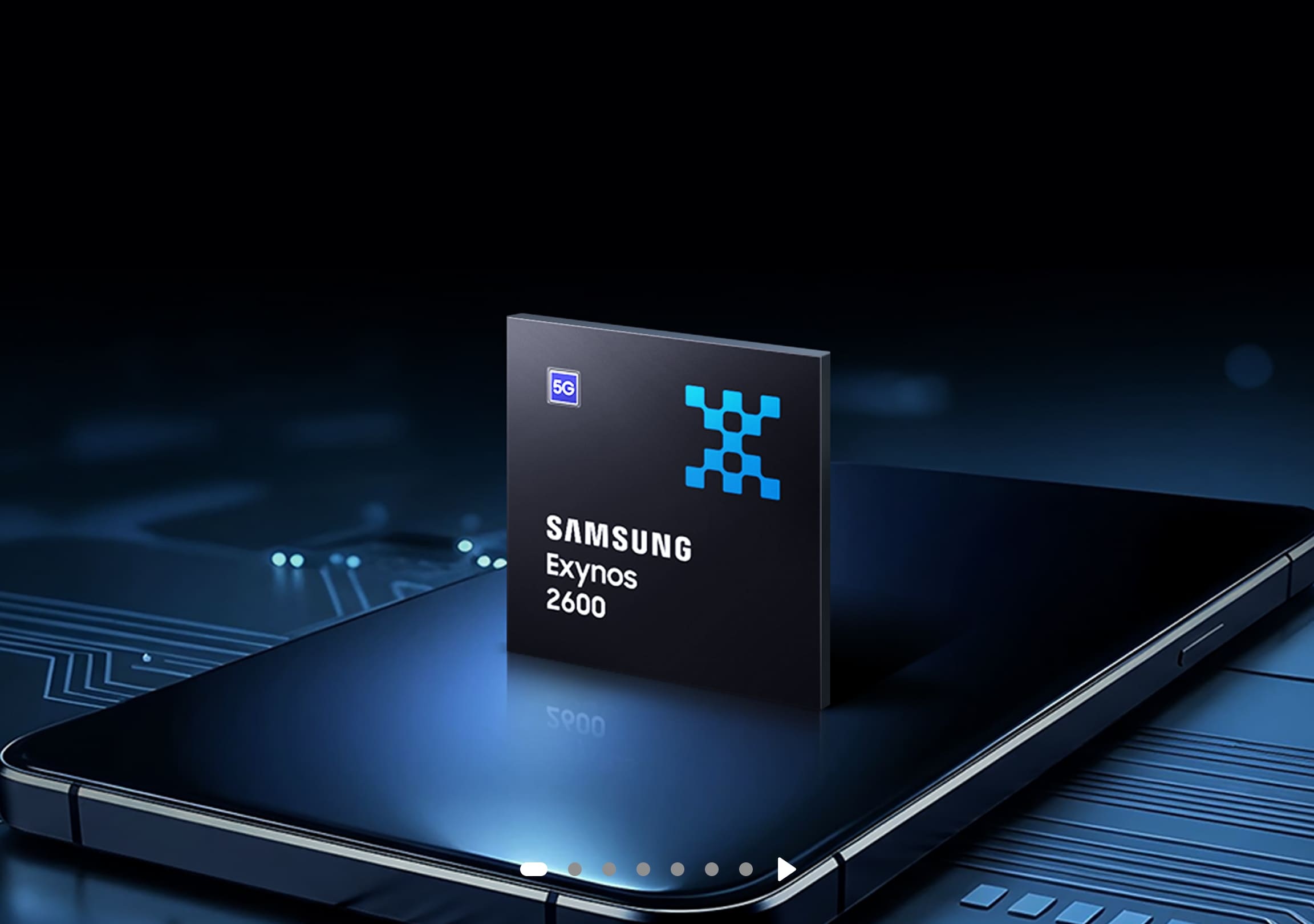
Samsung has fully unveiled the Exynos 2600, positioning it as the world’s first 2nm GAA (Gate-All-Around) mobile chipset and a major leap forward for performance, graphics, AI, and efficiency. After partial specs appeared recently, Samsung moved quickly to confirm the full configuration—including a 10-core CPU, the Xclipse 960 GPU, and a significantly upgraded AI engine—while emphasizing tighter thermal control thanks to the new manufacturing process and additional heat-management technology.
At the heart of the Exynos 2600 is a 1 + 3 + 6 CPU layout built on ARM’s latest core lineup. Samsung is using ARM v9.3 architecture, which enables newer instructions designed to accelerate modern workloads and improve compute efficiency. The CPU cluster is configured as follows:
One C1-Ultra core clocked at 3.80GHz
Three C1-Pro cores clocked at 3.25GHz
Six C1-Pro cores clocked at 2.75GHz
Samsung says these architectural upgrades, including support for the Scalable Matrix Extension 2 (SME2) instruction set, can deliver up to a 39 percent improvement in overall CPU computing performance. In practical terms, that’s aimed at boosting both single-core responsiveness and multi-core throughput for demanding apps, multitasking, and heavy workloads—placing the Exynos 2600 in direct competition with the next wave of flagship smartphone processors.
AI is another headline feature. The Exynos 2600 integrates an AI Engine with a 32K Mac Neural Processing Unit, and Samsung is claiming generative AI performance gains of up to 113 percent compared to the Exynos 2500. Alongside raw AI speed, Samsung is also highlighting upgraded on-device security, including virtualization-based protections and hardware-backed hybrid post-quantum cryptography (PQC). The company describes this as a first for mobile SoCs, intended to build longer-term protection against future security threats.
On the graphics side, the Exynos 2600 includes the Xclipse 960 GPU (Samsung hasn’t disclosed clock speeds). According to Samsung, GPU computing performance is up to 2x faster than the previous generation, with ray tracing performance improved by up to 50 percent. For mobile gaming, Samsung is also introducing Exynos Neural Super Sampling (ENSS), its own upscaling technology that parallels the industry’s push toward AI-assisted rendering. Samsung says ENSS supports frame generation as well, which can significantly increase framerates in supported titles—an important advantage as more phones target high refresh rate gaming.
Camera and video capabilities also receive a substantial boost thanks to AI-powered imaging features. Samsung is introducing an AI-based Visual Perception System (VPS) designed to help the image signal processor recognize finer details in real time—even subtle movements like blinking in photos and videos. The company claims this AI approach can reduce power consumption by up to 50 percent while improving processing intelligence. Additional features include Deep Learning Video Noise Reduction (DVNR) to enhance low-light video quality while maintaining low power operation. The Exynos 2600 is also listed as supporting camera sensors up to 320MP and includes support for the APV codec.
Thermals have been a frequent point of discussion for modern flagship chips, and Samsung is directly addressing that. The Exynos 2600 will use Heat Pass Block (HPB) technology, which is designed to improve heat flow and keep temperatures under control during sustained performance. While earlier commentary suggested a sizable temperature drop versus older chips, Samsung’s latest statement focuses on improved heat flow that reduces thermal resistance by 16 percent—another indicator that sustained performance and stability are key priorities for this generation.
Of course, impressive specs don’t tell the entire story until real devices arrive. The true test will be how the Exynos 2600 performs in consumer phones, particularly if it appears in the Galaxy S26 and Galaxy S26+ as expected. Samsung is also expected to keep the Galaxy S26 Ultra exclusive to a competing flagship chipset again, which will inevitably keep the spotlight on how the Exynos 2600 compares in day-to-day speed, gaming, camera quality, battery life, and long-duration thermal behavior.
Even so, the Exynos 2600 is shaping up to be Samsung’s most ambitious mobile chipset in years. With a 2nm GAA process, a modern 10-core CPU design, major AI acceleration, faster ray-traced graphics, gaming-focused upscaling and frame generation, and a stronger emphasis on on-device security, Samsung is clearly signaling it wants to fight at the very top of the flagship SoC market again.