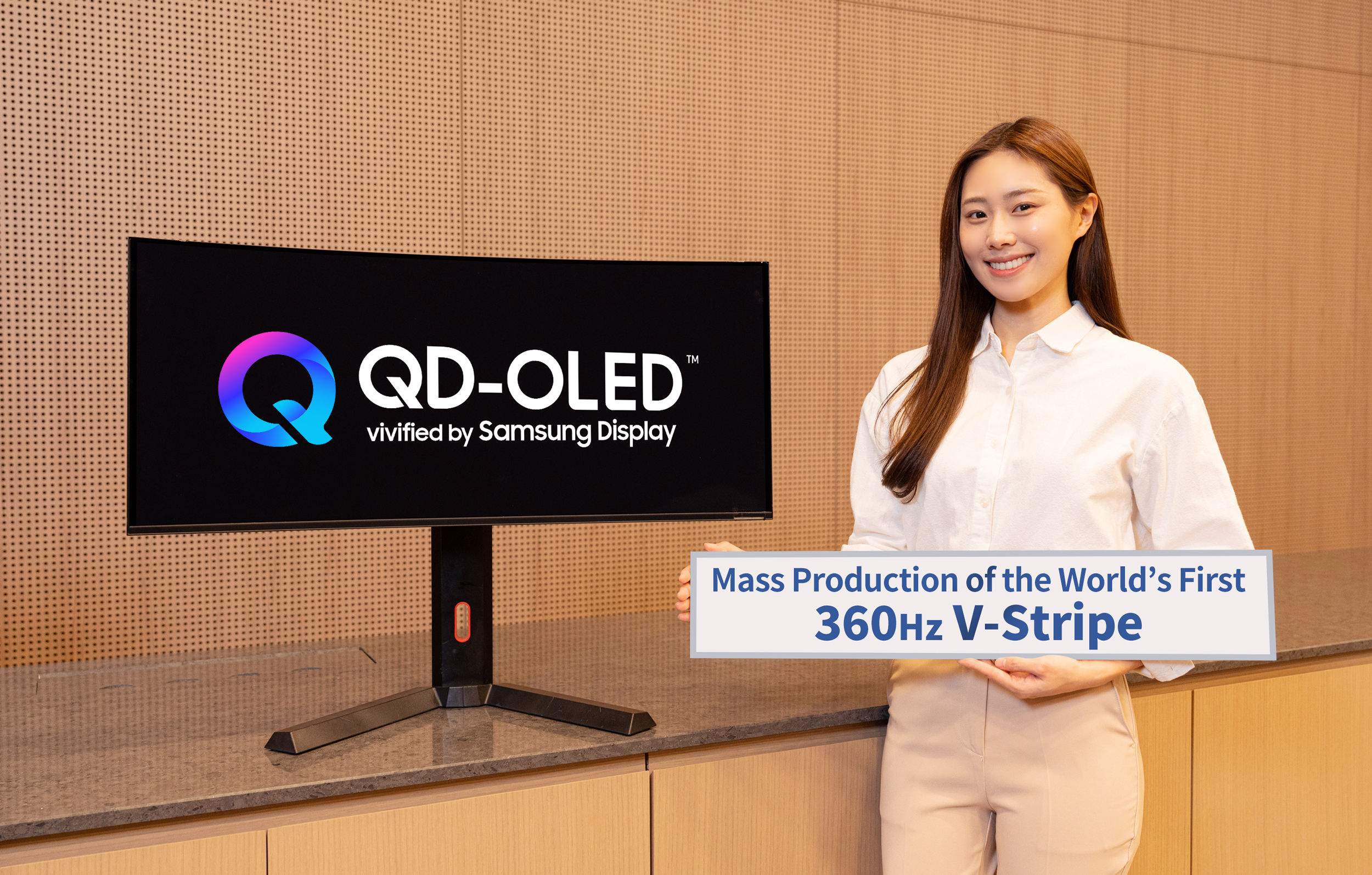
Samsung is gearing up to make 2026 a major year for high-end gaming monitors with the start of mass production for what it calls the world’s first 34-inch 360Hz QD-OLED panel. These new panels use a “V-Stripe” (vertical stripe) pixel structure and are already being shipped to seven global monitor makers, including ASUS, MSI, and Gigabyte, with supplies beginning in December 2025. Expect to see several 360Hz QD-OLED gaming monitor launches rolling out through 2026.
What makes this panel especially interesting isn’t just the ultra-fast 360Hz refresh rate. It’s the new V-Stripe pixel layout. Instead of the more common triangular sub-pixel arrangement seen in many current QD-OLED displays, this design aligns the red, green, and blue (RGB) sub-pixels vertically. The goal is better clarity around fine details—particularly text. That means this isn’t only a “pure gaming” upgrade; it’s also aimed at people who spend long hours reading, writing, coding, editing documents, or creating content and want sharper text edges and improved overall readability on an OLED monitor.
On the gaming side, the specs target the enthusiast crowd. The panel features a 21:9 ultrawide aspect ratio for a wider field of view and a more immersive experience in genres like racing and sports games. It also hits a peak brightness level of 1,300 nits, paired with the smooth motion and responsiveness that a 360Hz refresh rate is designed to deliver. For competitive and fast-paced titles, that combination—ultrawide immersion, high brightness, and extreme refresh rate—checks a lot of boxes for players who prioritize speed and clarity.
Reaching 360Hz on an ultrawide OLED panel isn’t easy, and Samsung Display is openly calling out why. Compared to a standard 16:9 screen, a 21:9 monitor generally involves more horizontal pixels and more data being processed, which can increase power use and heat output even at the same refresh rate. There’s also the technical difficulty of maintaining consistent signal timing across the entire width of the panel. In short, ultrawide plus very high refresh rates pushes engineering limits.
Samsung Display says the key challenges to mass-producing this kind of high-refresh OLED panel—especially with a new pixel structure—include shorter organic material lifespan, heat generation, and brightness degradation. According to the company, it addressed those hurdles by taking advantage of QD-OLED’s top emission structure (which helps with brightness), improving organic material efficiency, and optimizing the overall design. The end result, it claims, is a mass-producible, high-performance monitor panel combining four major features at once: the V-Stripe pixel structure, a 21:9 ultrawide format, 360Hz refresh rate, and enhanced brightness.
The first public showcase is set for CES 2026 in Las Vegas, starting January 6. ASUS and MSI are expected to introduce new gaming monitor models built around these panels, while Samsung Display will also demonstrate the technology during the event.
This launch also lines up with accelerating momentum behind OLED in premium monitors. Market research firm Omdia forecasts that self-emissive panels (a category that includes OLED) will grow their share of premium monitors priced above $500—from 14% in 2024 to 23% in 2025, and up to 27% in 2026—highlighting a continued shift away from LCD. Within that trend, Samsung Display’s QD-OLED monitor panel shipments for 2025 are projected to reach 2.5 million units, with an estimated 75% market share.
For shoppers considering a high-end gaming monitor in 2026, the arrival of 34-inch 360Hz QD-OLED ultrawide options could become one of the year’s biggest upgrades—especially for those who want elite motion clarity without giving up OLED-level contrast, plus improved text sharpness for everyday productivity.


