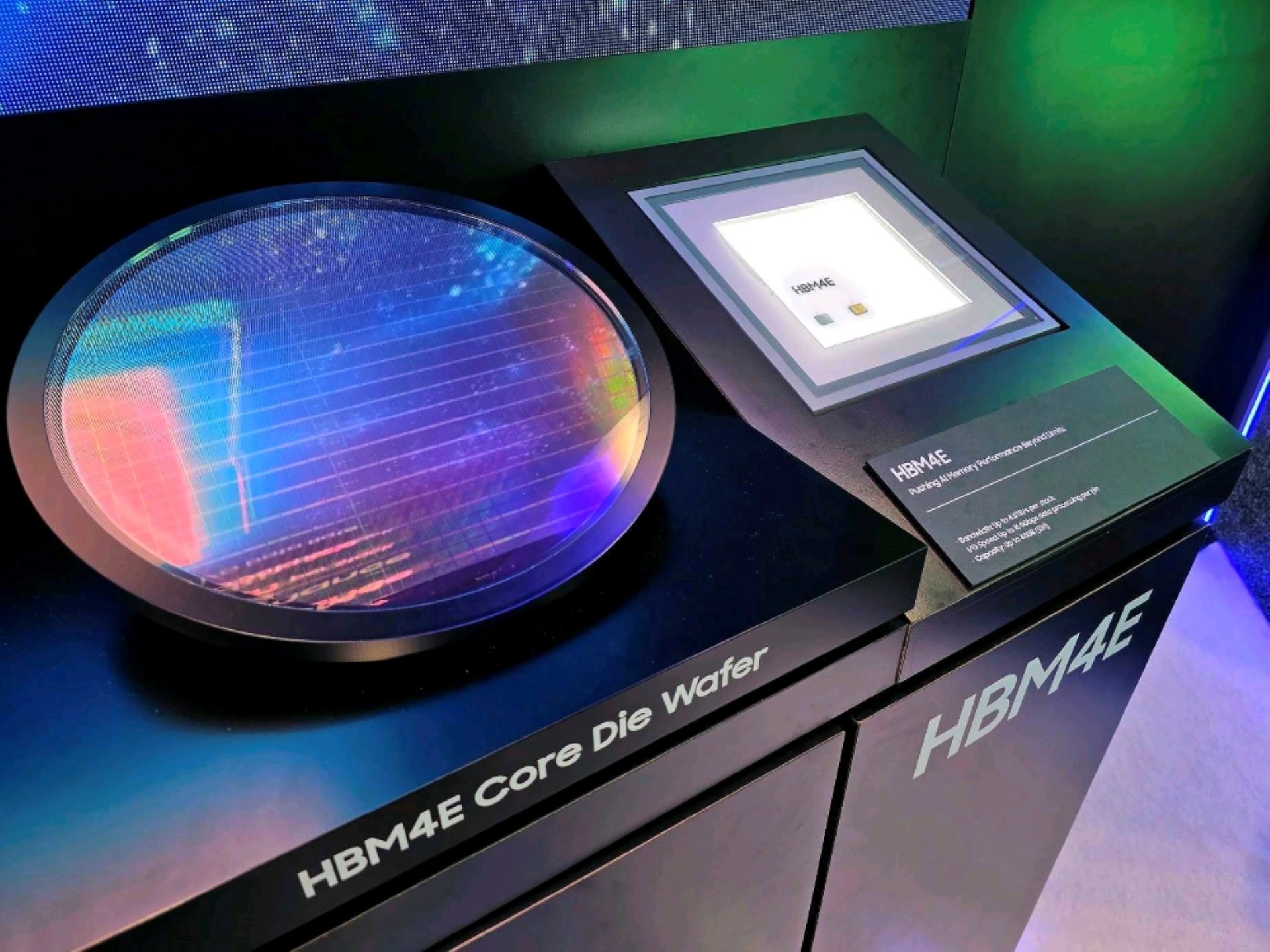
Samsung is reportedly preparing for a major expansion in HBM4 memory production as demand for AI hardware continues to accelerate across the global data center market. The company is said to be increasing orders for key manufacturing components, signaling that it expects high-bandwidth memory demand to remain strong through the next several years.
According to information from Korean media, Samsung’s procurement of glass carriers used in HBM production is expected to rise sharply. These components play an important role in the assembly process for high-bandwidth memory, helping hold DRAM wafers in place as they are prepared for advanced packaging. Because HBM chips require stacked DRAM layers and extremely precise manufacturing, even supporting materials such as carriers can offer clues about future production plans.
Samsung is reportedly using around 10,000 glass carrier units per month in 2025. That figure is expected to double to roughly 20,000 units per month in 2026, before climbing again to about 50,000 units per month in 2027. If accurate, that would represent a 2.5x increase from 2026 levels and a fivefold jump compared with 2025.
The production ramp comes as the artificial intelligence boom places intense pressure on the memory industry. AI servers and accelerators require enormous memory bandwidth to process large models efficiently, and HBM has become one of the most critical components in modern AI computing systems. As cloud providers, hyperscalers, and enterprise customers continue building AI data centers, demand for HBM products has outpaced supply from the world’s major memory manufacturers.
HBM4 is expected to play a central role in the next phase of AI hardware. The technology is designed to offer higher bandwidth, improved efficiency, and better performance compared with previous generations. These improvements are especially important for next-generation AI GPUs, where memory speed and capacity can directly affect training and inference performance.
Samsung has been working to strengthen its position in the HBM market after facing intense competition from other leading memory suppliers. The company’s next-generation HBM4 products are expected to target premium AI accelerators, including future NVIDIA GPU platforms. Reports have indicated that Samsung has already provided HBM samples to NVIDIA as part of the qualification process, a crucial step for any memory supplier hoping to secure orders for high-end AI hardware.
One of the most important parts of Samsung’s HBM4 strategy is the base die used in the HBM stack. In an HBM module, multiple DRAM dies are stacked vertically, while the base die sits at the bottom and manages communication between the memory stack and the processor. As HBM becomes more advanced, the base die has become increasingly complex, pushing manufacturers to use more advanced production technologies.
Samsung is reportedly planning to produce HBM4 base dies using its 4-nanometer process technology. This is notable because 4nm nodes are typically associated with logic chips such as CPUs, GPUs, and mobile processors rather than standard memory products. By using a more advanced manufacturing process, Samsung may be aiming to improve performance, power efficiency, and integration for next-generation HBM products.
The company’s foundry business could also become a strategic advantage. Unlike some memory competitors, Samsung has both large-scale DRAM production and advanced logic manufacturing capabilities. This gives it the ability to combine memory expertise with cutting-edge foundry technology, potentially allowing it to develop more sophisticated HBM designs for AI customers.
There are also reports that Samsung is evaluating the use of its 2-nanometer process technology for future HBM base dies. If the company moves in that direction, it would represent another step toward blending advanced logic manufacturing with high-performance memory production. Such a move could help Samsung compete more aggressively in the AI memory market as demand shifts toward faster and more efficient HBM solutions.
The reported increase in glass carrier procurement suggests that Samsung is not simply preparing for modest growth. A jump from 20,000 units per month in 2026 to 50,000 units per month in 2027 points to a substantial production expansion. Some industry expectations also suggest Samsung’s HBM output could rise significantly by 2028, potentially strengthening its role in the global AI supply chain.
For the broader semiconductor industry, Samsung’s ramp-up highlights how important HBM has become. In previous technology cycles, processors often attracted most of the attention. In the AI era, however, memory bandwidth is just as critical. Without enough high-performance HBM, even the most powerful AI accelerators can face bottlenecks.
This is why HBM4 is being watched so closely. AI workloads are growing larger and more complex, and next-generation data centers will require faster memory to keep GPUs operating at peak efficiency. Companies that can reliably produce advanced HBM at scale are likely to benefit from one of the strongest demand trends in the chip industry.
Samsung’s reported expansion also reflects the urgency among memory makers to secure long-term AI customers. With supply remaining tight and qualification standards extremely high, winning approval from major GPU vendors could translate into large and stable revenue opportunities. At the same time, scaling HBM production is technically challenging, requiring advanced packaging, precise assembly, and tight coordination across the supply chain.
If Samsung can execute its HBM4 roadmap successfully, the company could improve its competitive standing in one of the semiconductor industry’s fastest-growing segments. The combination of rising glass carrier orders, advanced base die manufacturing, and possible future use of 2nm technology suggests Samsung is preparing for a much larger role in the AI memory race.
As AI data center investment continues to surge, Samsung’s HBM4 production plans will remain a key development to watch. The company’s ability to scale high-bandwidth memory output could influence not only its own growth, but also the pace at which next-generation AI hardware reaches the market.