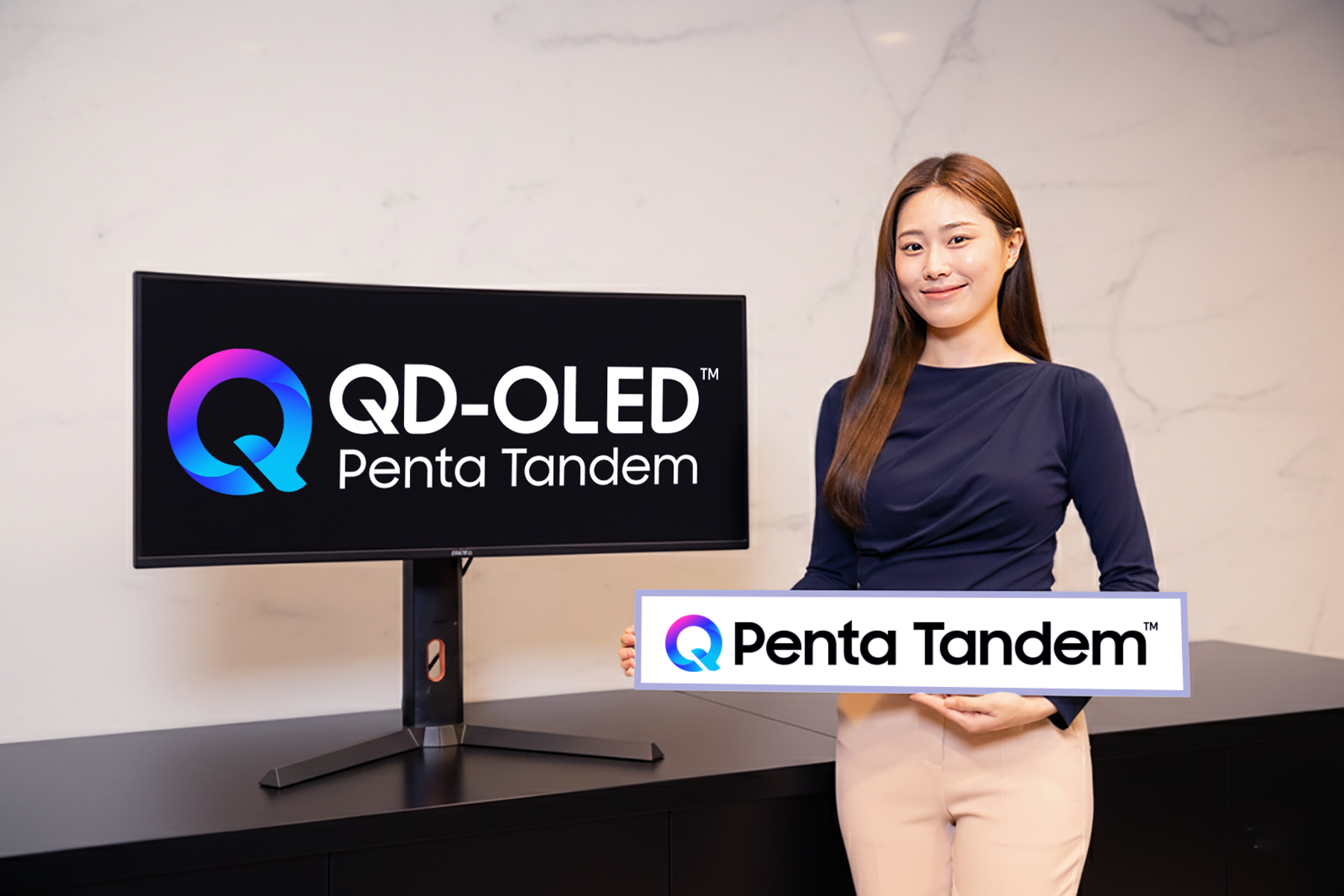
Samsung Display has introduced a new premium technology brand called QD-OLED Penta-Tandem, built around the company’s proprietary five-layer organic light-emitting structure for its QD-OLED panels. The branding is designed to spotlight what Samsung Display sees as a key next step for premium TVs and high-end monitors, especially as competition heats up in the high-resolution display market.
The “Penta” name comes from the Greek word for five, reflecting the panel’s upgraded five-layer blue-emitting stack. In QD-OLED, quantum dots are used to produce color by responding to light, and the blue-emitting layer acts as the primary light source thanks to its high energy in the visible spectrum. Samsung Display says it moved from a four-layer stack to a five-layer structure beginning last year, along with new organic materials, to deliver improved picture quality, better efficiency, and higher peak brightness.
This kind of multi-layer OLED stacking is becoming more important as monitor resolutions climb. Higher resolution in the same screen size increases pixel density, which shrinks the light-emitting area of each pixel. With less emitting area available, managing energy effectively inside the organic materials becomes critical for sustaining bright, stable performance without sacrificing reliability.
Samsung Display points to its 27-inch UHD (3840×2160) QD-OLED monitor panel, launched last year, as a major example of what the Penta-Tandem structure enables. That panel reaches 160 pixels per inch (PPI), which the company describes as the highest pixel density among self-emissive gaming monitors. Samsung Display also says it is currently the only manufacturer mass-producing 27-inch UHD self-emissive displays at 160 PPI.
By adding another organic layer, the panel can improve luminous efficiency—meaning it can either get brighter at the same power level or maintain the same brightness while using less power. Samsung Display compares it to adding a fifth person to carry a load previously carried by four: you can either carry more or last longer. According to the company, the five-layer approach improves luminous efficiency by 1.3 times compared to last year’s four-layer QD-OLED, while doubling lifespan.
Those gains translate into high peak brightness figures under specific measurement conditions. Samsung Display says QD-OLED Penta-Tandem panels can reach up to 4,500 nits peak brightness for TVs and up to 1,300 nits for monitors, based on a 3% On Pixel Ratio (OPR), which refers to the proportion of active pixels on the screen.
The company also highlights HDR performance and certification. Panels using QD-OLED Penta-Tandem can enable products to meet the VESA DisplayHDR True Black 500 standard, which evaluates HDR capability including deep black reproduction. To qualify for True Black 500, a display must keep black levels at 0.0005 nits or lower while also hitting 500 nits peak luminance at 10% OPR. Samsung Display notes that the only 31.5-inch UHD monitor currently certified with DisplayHDR True Black 500 is based on its QD-OLED Penta-Tandem panel.
Looking ahead, Samsung Display plans to roll out QD-OLED Penta-Tandem across its full range of panel sizes this year, positioning it for flagship monitors and TVs from major customers. After the 27-inch UHD panel and the 31.5-inch UHD and 34-inch WQHD models introduced earlier this year, the company says the technology will also be applied to a 49-inch Dual QHD (5120×1440) version. On the TV side, Samsung Display says Penta-Tandem has been featured in top-tier self-emissive TV display lineups from key customers since 2025.