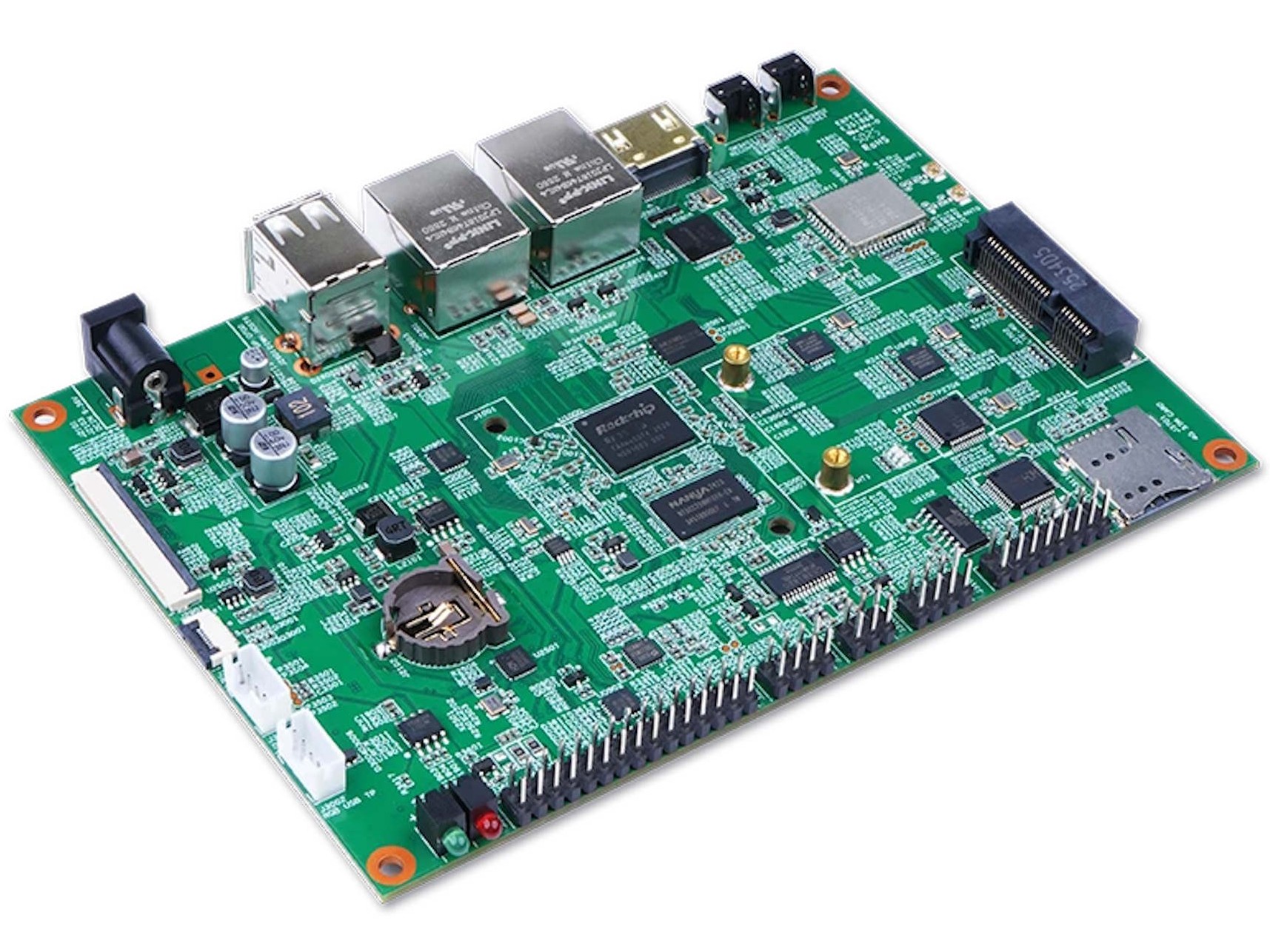
Geniatech is back with a new compact single-board computer aimed less at hobby projects and more at rugged, real-world deployments. Called the DB3506, this development board is positioned as a potential Raspberry Pi 5 alternative on paper thanks to its rich connectivity and display options. In practice, it’s built for a different audience: industrial users who need reliability, legacy interfaces, and stable operation in harsh environments.
At the heart of the Geniatech DB3506 is the Rockchip RK3506. Instead of focusing purely on raw computing power, this chip is designed with industrial-style workloads in mind. It combines four cores in total: three Arm Cortex-A7 cores for general processing and one Cortex-M0 core dedicated to handling communication with external hardware. That extra Cortex-M0 core isn’t meant to make the board “faster” in the usual sense. Its role is to manage interactions with sensors, actuators, and other connected equipment—exactly the kind of job that matters in automation, monitoring, and machine control.
Where the DB3506 really separates itself from maker-focused boards is its built-in support for industrial and embedded communication standards. It includes RS-232/RS-485, UART, and CAN, which are commonly found in equipment control systems, factory devices, and instrumentation setups. This makes it a strong fit for integrators who need a small embedded computer that can talk to existing machinery without a pile of adapters.
Another standout feature is its operating temperature range. The DB3506 is intended to function in environments from -40° to 185°F. That’s the kind of spec that targets outdoor installations in freezing conditions, as well as deployments near hot-running equipment—places where typical consumer-grade single-board computers may struggle without extra protection.
In terms of physical size, the board measures about 5.75 x 4.02 inches, giving it more room for ports and connectors than many ultra-compact SBCs. Memory is listed at 512MB of LPDDR3 by default, with configuration options that include 256MB or up to 1GB RAM. Storage varies by configuration as well, using NAND flash in 256MB or 512MB capacities—another reminder that this is designed for embedded tasks rather than large desktop-like installations.
Connectivity is well covered. The DB3506 supports networking through dual Ethernet and dual-band Wi-Fi, and it can be expanded with an optional 4G modem through a mini PCIe slot. This flexibility helps in scenarios where wired networking isn’t available or where remote monitoring is needed.
For display and interface use, HDMI is onboard, and there are also connectors intended for touchscreen setups. That opens the door to practical industrial applications such as mounting a local status display directly on machinery—showing key metrics, alerts, or system dashboards right where operators need them instead of restricting visibility to a separate control room.
On the USB side, there are two USB Type-A ports, though they’re limited to USB 2.0 speeds. GPIO pins are available too, supporting additional hardware expansion and custom integrations.
Geniatech has not shared public pricing or availability details, which is common for business-to-business hardware that’s often sold through industrial channels or custom procurement.
For most everyday users, students, and DIY builders who want broad community support, strong performance, and easy access to accessories, a mainstream option like the Raspberry Pi 5 will often make more sense. The Geniatech DB3506, however, is clearly built for a different mission: compact embedded computing with industrial ports, specialized communications support, and a temperature tolerance suited for demanding environments.