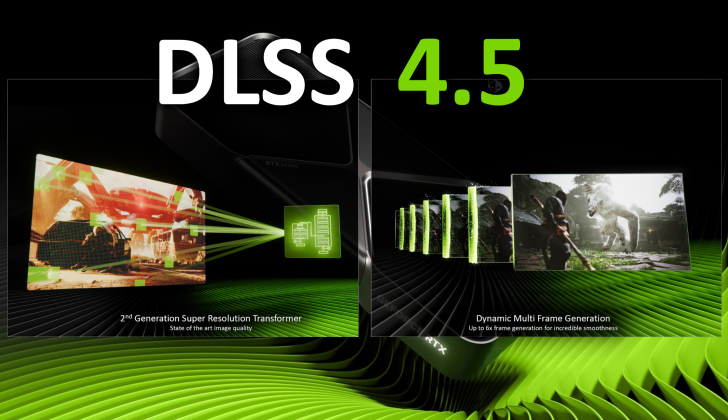
NVIDIA has officially unveiled DLSS 4.5, the next evolution of its AI-powered upscaling and frame generation tech for GeForce RTX graphics cards. The big headline features are a new 2nd-generation Transformer model for Super Resolution that targets better image quality, plus a new 6x Multi-Frame Generation (MFG) option designed to push frame rates dramatically higher for ultra-smooth gameplay.
DLSS has been moving fast in terms of adoption. DLSS 4 launched with around 75 supported titles and reportedly grew to roughly 250 games by the end of 2025. With DLSS 4.5, NVIDIA is claiming an even bigger jump: 400+ games supported from the start through its app-based enablement options, giving PC players a much faster on-ramp to the new features.
What’s new in DLSS 4.5: two major upgrades
1) DLSS 4.5 Super Resolution (2nd Gen Transformer model)
Super Resolution is the upscaling part of DLSS, where the game renders at a lower internal resolution and DLSS reconstructs a sharper image for higher performance while aiming to keep visual quality high.
NVIDIA says the DLSS 4.5 Super Resolution update is powered by a 2nd-generation Transformer model trained using large datasets on advanced infrastructure using Blackwell GPUs. The company’s focus this time is on common upscaling “failure points” that can break immersion, including motion handling, geometry detail, lighting behavior, and disocclusion (when objects become newly visible and reconstruction can struggle).
Compared to the Transformer model introduced with DLSS 4, this new 2nd-gen model is said to bring significantly more compute capability (NVIDIA cites 5x computational prowess) and improved contextual awareness through smarter pixel sampling, leveraging features such as FP8 capabilities on newer hardware.
The visible improvements NVIDIA is targeting include:
– Better temporal stability: More consistent detail from frame to frame, reducing flicker or instability that can make scenes look less coherent during movement.
– Reduced ghosting: Less of the “trail behind objects” effect that can happen with fast motion (cars, quick camera turns, weapon animations), especially when higher frame generation modes are used.
– Improved edge quality and anti-aliasing: Smoother edges and less jagged shimmer on moving characters and fine geometric detail.
Importantly, NVIDIA says DLSS 4.5 Super Resolution will work across all RTX GPUs, including older RTX 20-series cards, meaning image-quality benefits aren’t limited to the newest generation.
2) DLSS 4.5 Multi-Frame Generation (MFG) up to 6x
DLSS 4 introduced Multi-Frame Generation, expanding beyond earlier frame generation approaches by increasing the number of AI-generated frames to boost perceived smoothness substantially. DLSS 4.5 pushes this further with a new 6x MFG mode, adding two additional generated frames compared to the previous 4x ceiling.
The goal here is clear: much higher FPS and smoother motion, especially on high refresh rate monitors. NVIDIA also points to improvements in frame pacing and image quality within the MFG experience itself.
In an example scenario, NVIDIA indicates that using 6x MFG can deliver up to a 33% additional boost at 4K in demanding settings (including path tracing) in a title like Black Myth: Wukong. There is a trade-off: NVIDIA notes a latency increase in the neighborhood of around 10–15%, but the pitch is that the overall experience feels noticeably smoother and more responsive-looking, particularly at very high frame rates.
Dynamic Multi-Frame Generation: built for 240Hz+ displays
Alongside the 6x mode, NVIDIA is also introducing DLSS 4.5 Dynamic Multi-Frame Generation. This feature is meant for players using high-refresh panels (240Hz and beyond) who want the game to better match their monitor’s refresh rate.
With Dynamic MFG, you can set a target FPS and the system will automatically shift MFG levels from 1x through 6x as needed to maintain that target. NVIDIA suggests many modern AAA games may rely on 3x or 4x MFG to hold 240Hz, while 6x is positioned more for extreme setups—such as 360Hz-class monitors, including at 4K.
Release timing and availability
– DLSS 4.5 Super Resolution is available now via the latest GeForce Game Ready Drivers and a current NVIDIA App update, where users can toggle Dynamic or Fixed DLSS override options.
– DLSS 4.5 6x MFG and Dynamic MFG are planned for Spring 2026, and NVIDIA indicates the Dynamic 6x frame generation functionality is tied to RTX 50 series GPUs.
With DLSS 4.5, NVIDIA is clearly aiming at two audiences at once: players who want cleaner, more stable image reconstruction on any RTX card, and competitive or high-end enthusiasts chasing extremely high frame rates on 240Hz, 360Hz, and faster displays. Between broader game support, a stronger Super Resolution model, and more aggressive frame generation options, DLSS 4.5 is positioned as a major step forward for PC gaming performance and perceived smoothness in 2026.


