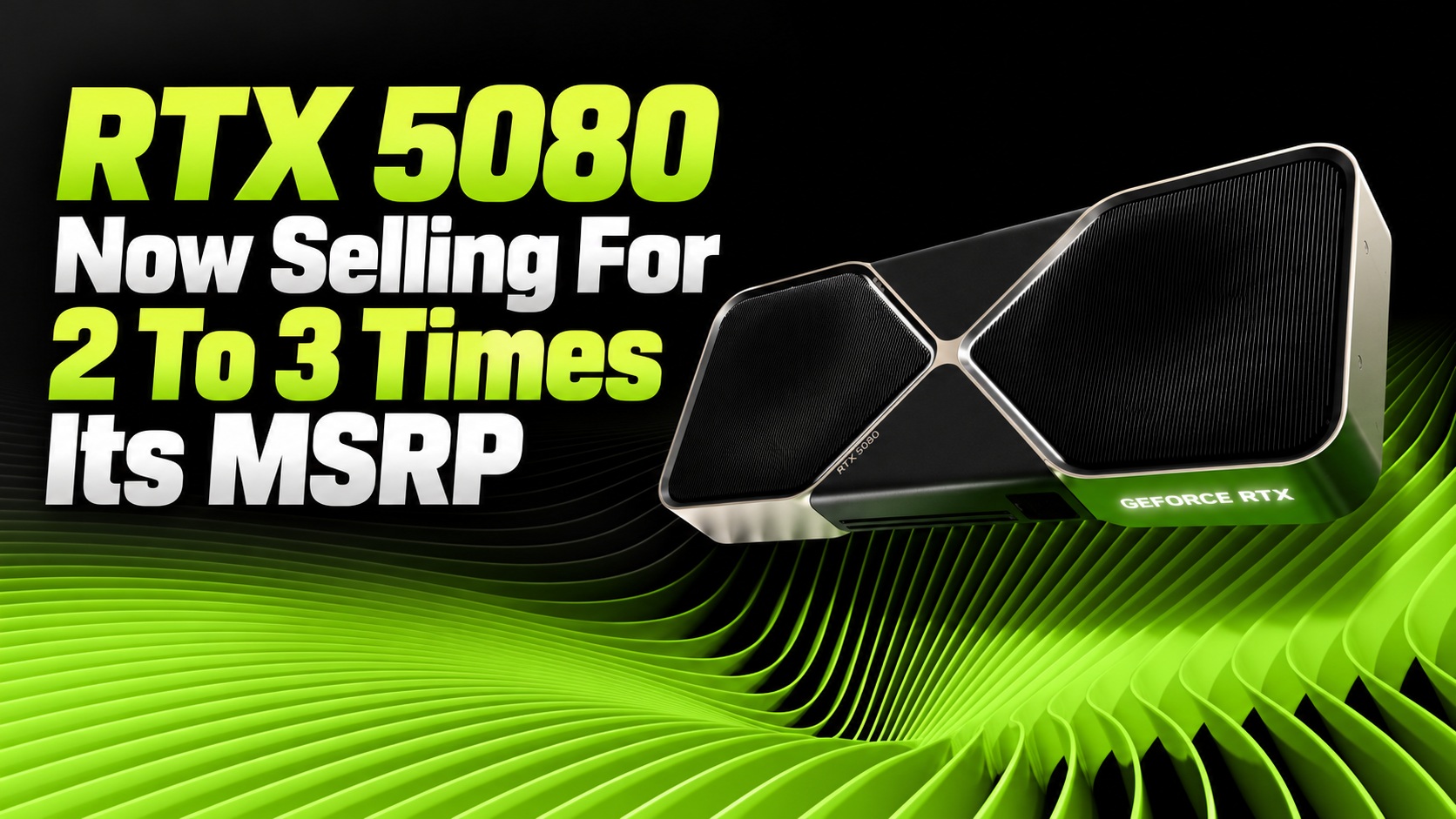
NVIDIA GeForce RTX 5080 prices have climbed far beyond MSRP as stock dries up
The NVIDIA GeForce RTX 5080 launched in January 2025 with a suggested retail price of $999, but finding the graphics card anywhere near that price has become extremely difficult. A recent check of major U.S. retailers shows that available RTX 5080 models are now commonly selling for around $1,800 to more than $2,300, while lower-priced listings are often sold out or marked as coming soon.
The situation has become frustrating for PC gamers and hardware enthusiasts who expected the RTX 5080 to sit below the flagship RTX 5090 in both performance and pricing. Instead, the card is now being listed at prices that are close to, or even higher than, what many buyers originally expected to pay for NVIDIA’s top-tier model.
Some online discussions have pointed to unusually high RTX 5080 listings that approach nearly three times NVIDIA’s original MSRP. However, many of the most extreme examples appear to come from third-party marketplace sellers rather than direct listings from major retailers.
A closer look at Newegg’s RTX 5080 inventory shows just how limited availability has become. When filtering for new products sold directly by the retailer, the available models are either out of stock, sold out, or listed as coming soon. In other words, while some cheaper RTX 5080 prices may still appear on product pages, actually buying one directly at those prices is not currently realistic.
Third-party sellers are still offering RTX 5080 cards, but the prices are steep. One example is a PNY RTX 5080 ARGB OC model listed at $2,299 by a marketplace seller, which represents a massive 130% increase over NVIDIA’s $999 reference price.
A spot check of major U.S. retailers on October 28 showed the following RTX 5080 prices and availability:
Micro Center listed the Gigabyte GeForce RTX 5080 Windforce SFF OC at $1,829.99, making it the lowest-priced option found in the comparison. However, the card was available for in-store pickup only, limiting access depending on location.
Best Buy listed the PNY GeForce RTX 5080 Triple Fan OC at $1,999.99 with online ordering available. That makes it one of the cheapest RTX 5080 cards currently available for online purchase, but it is still double NVIDIA’s original MSRP.
B&H Photo had the ASUS ROG Astral GeForce RTX 5080 OC in stock at $2,199.00, placing it firmly in premium pricing territory.
Newegg’s available third-party listing for the PNY GeForce RTX 5080 ARGB OC reached $2,299.00, making it one of the most expensive examples found during the check.
Micro Center’s $1,829.99 Gigabyte model stands out as the lowest price in the comparison, with more than 25 units reportedly available at one store location. Even so, the in-store-only restriction means many buyers across the U.S. may not be able to take advantage of that price.
Best Buy’s $1,999.99 PNY RTX 5080 is also notable because that figure matches the original MSRP of the much faster GeForce RTX 5090. For many PC gamers, paying flagship-level launch pricing for a lower-tier card makes the current GPU market feel especially difficult to justify.
The price surge appears to be tied to several market pressures. RTX 5080 supply remains tight, and rising GDDR7 memory costs are adding more pressure to graphics card pricing. Broader memory shortages are also affecting the industry, with demand from AI infrastructure continuing to consume large amounts of advanced memory production.
It is not yet clear how much each factor is contributing to current U.S. retail prices. Supply constraints, higher component costs, reseller activity, and strong demand may all be playing a role. What is clear, however, is that the GeForce RTX 5080 is currently far more expensive than NVIDIA’s launch pricing suggested.
For PC gamers looking to upgrade, the RTX 5080 market is now a tough choice. The card offers next-generation performance, but current pricing puts it well outside the range many buyers expected. Unless availability improves or retail prices begin to fall, shoppers may need to wait, consider alternative GPUs, or prepare to pay a significant premium for NVIDIA’s latest high-end graphics card.