Robots and drones are getting smarter, but their “eyes” still have a problem: many of today’s 3D vision systems are bulky, expensive, and slow to react when the real world gets messy. Fast-moving people, sudden turns, shifting lighting, and unpredictable motion can overwhelm sensors that aren’t built to keep up. Now, researchers have introduced a compact 4D imaging sensor that could change how autonomous machines see and navigate, all by packing advanced depth-and-motion sensing into a single silicon chip.
This new 4D imaging technology goes beyond standard 3D mapping. In addition to producing highly accurate digital maps of surrounding environments, it can also measure the exact speed of moving objects at the same time. That mix of distance plus velocity data is what makes the system “4D,” and it could be especially valuable for robots, drones, and other autonomous systems that must make instant decisions in dynamic spaces.
One of the biggest breakthroughs is how the sensor works. Traditional depth sensors often rely on rapid pulses of light and typically need separate components to transmit and receive signals, which adds size, complexity, and cost. The new chip takes a different approach by using a continuous laser beam instead of pulsed light. That laser is guided through a physical grid made up of nearly 62,000 microscopic, stationary pixels.
Here’s the clever part: every one of those tiny pixels acts as both a transmitter and a receiver. By combining both roles in the same pixel array, the system stays remarkably compact while still gathering rich environmental data. When the laser light bounces back from objects, the chip reads subtle shifts in the frequency of the returning waves. Those shifts allow it to calculate two crucial details immediately: how far away something is and how fast it’s moving.
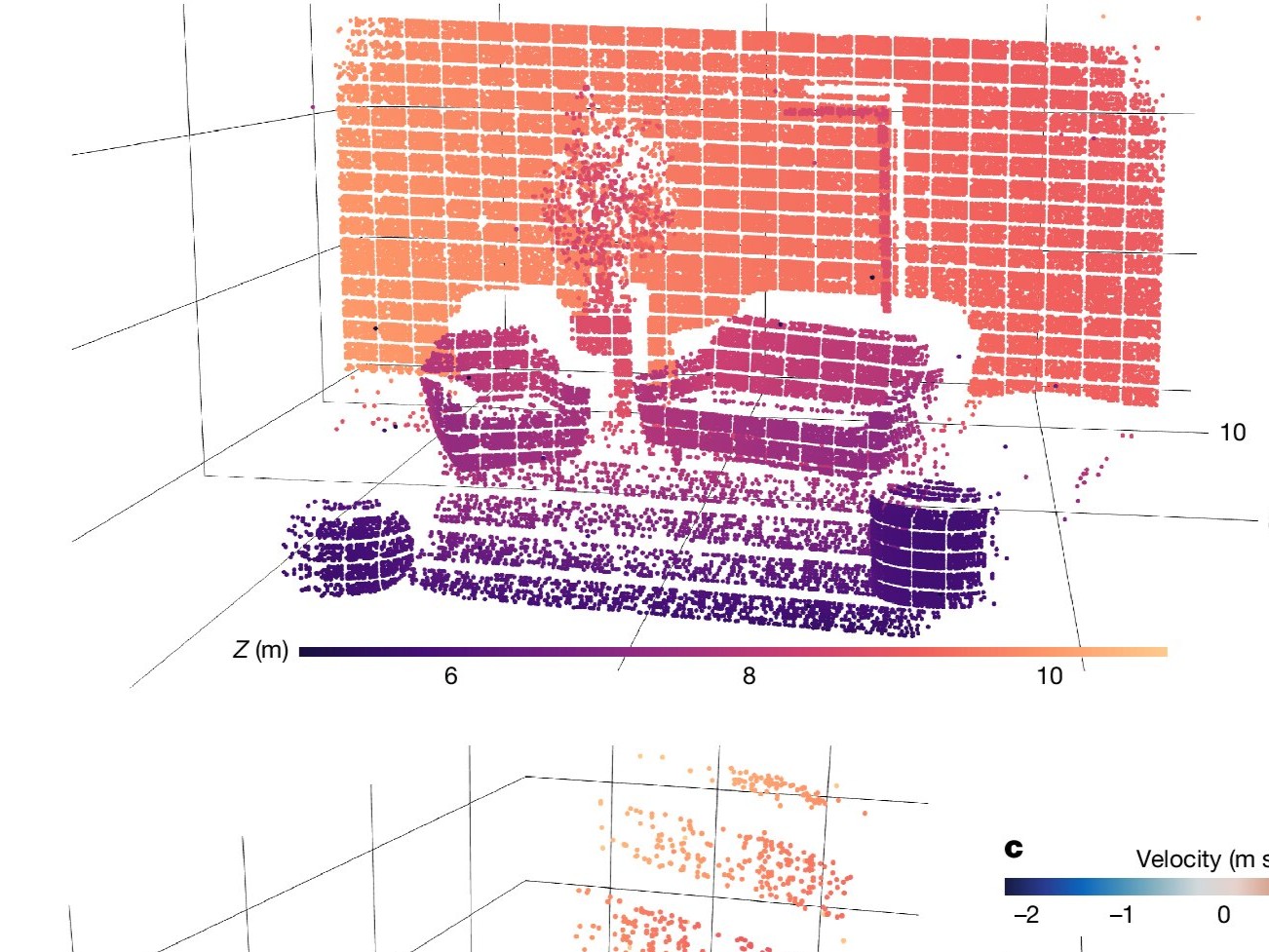
In testing, the research team demonstrated that the sensor could handle a wide range of real-world tasks. It successfully mapped indoor rooms and quickly measured the velocity of a spinning disk. Outdoors, it showed impressive long-distance detail too, capturing features like windows and balconies on a building from 65 meters away.
Because the electronics and optical components are integrated directly onto one chip, the design is both compact and scalable—an important step toward making advanced depth-and-motion sensing more practical for widespread use. The technology still needs improvements, especially in resolution and overall range, but the concept points to a future where autonomous machines can “see” with greater accuracy and respond faster to movement around them.
If the sensor continues to evolve, it could significantly improve navigation and safety for drones and robots operating in unpredictable environments. And over time, this kind of compact 4D imaging could also influence everyday devices, potentially bringing smarter depth sensing and motion tracking to digital cameras and even smartphones.