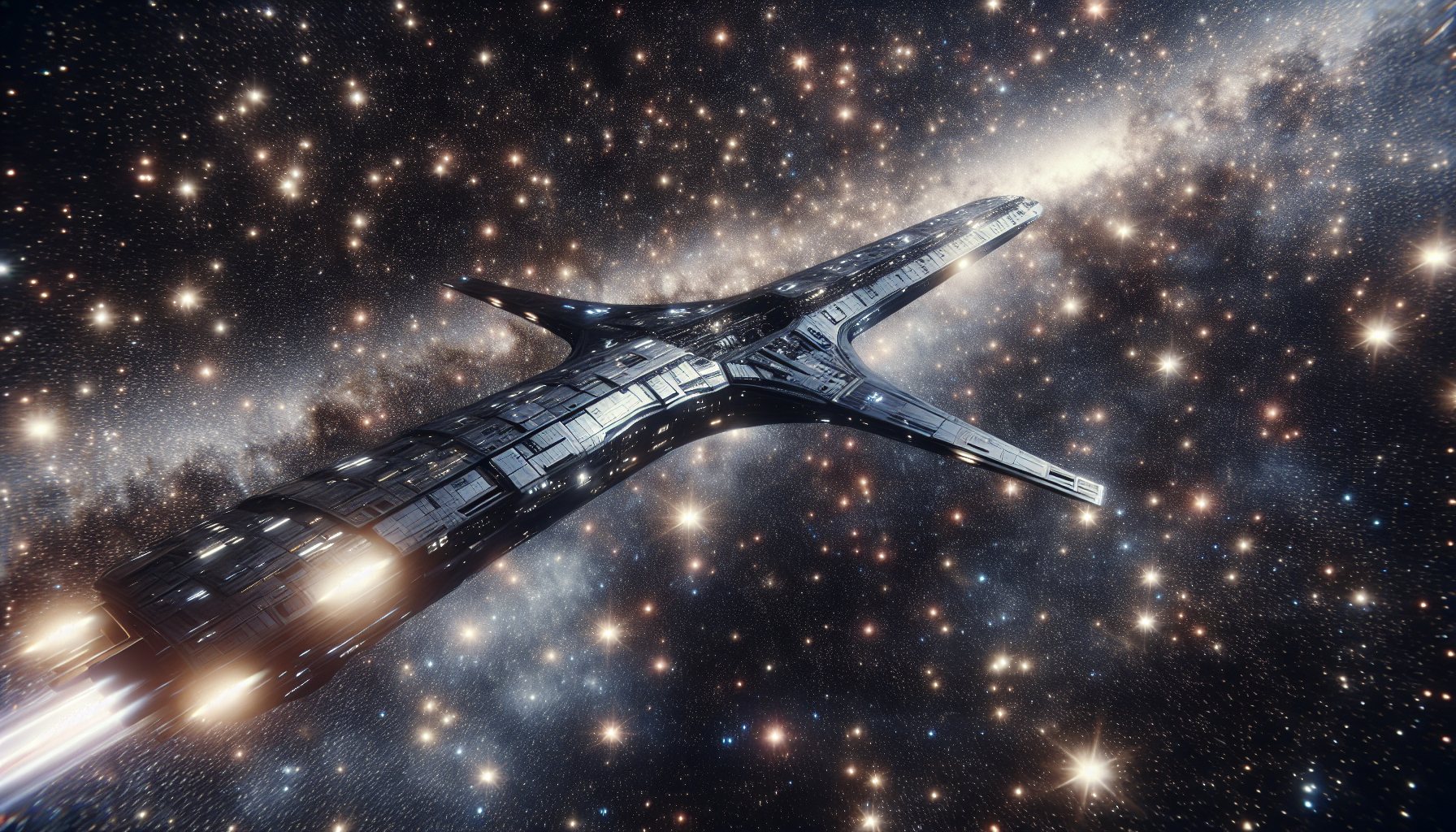
Antimatter spacecraft propulsion could be the game-changer that makes interstellar travel within a human lifetime a reality, as highlighted by a groundbreaking study. This research has revealed that a mere gram of antihydrogen could generate an astonishing amount of energy—enough to power 23 space shuttles—making it a whopping 10 billion times more potent than existing rocket fuels.
Conducted by the forward-thinking minds at UAE University and published in the International Journal of Thermofluids, this study delves into the potential of antimatter to significantly alter the landscape of space exploration. The idea that antimatter-powered engines could transform what currently seems like a sci-fi fantasy—traveling to neighboring stars within a lifetime—into reality is truly revolutionary.
The energy potential of antimatter is mind-boggling; when it encounters regular matter, an astounding 9 × 10¹⁶ joules per kilogram is released with full efficiency. Even more impressive is that around 70% of that energy can be utilized for spacecraft propulsion, offering far superior efficiency compared to current propulsion technologies.
To put this into perspective, just one gram of antihydrogen, upon reacting with conventional hydrogen, would produce energy that could power 23 space shuttles. This is not just a comparison; it’s a quantum leap—the energy unleashed is about 10 billion times stronger than traditional rocket fuel combustion and roughly 300 times greater than the Sun’s core fusion reactions.
However, the path to harnessing this incredible power isn’t without its challenges. The production and storage of antimatter pose significant hurdles. Take CERN’s particle accelerators, for instance—they currently produce only about 10 nanograms of antimatter annually, at a steep financial cost.
Storage is an even greater dilemma. Antimatter annihilates upon contact with normal matter, necessitating storage in a vacuum with the aid of sophisticated electromagnetic traps. Presently, these setups can only contain antimatter for a limited period of about 16 minutes—not exactly suitable for long-duration space endeavors.
The study also contemplates various potential engine designs utilizing antimatter:
– Beam Core Systems: Capable of achieving striking velocities with specific impulses reaching up to 10 million meters per second by directing charged particles through magnetic nozzles.
– Plasma Core Systems: These promise a formidable blend of power and efficiency, potentially revolutionizing solar system travel by reducing journey times from years to mere days or weeks.
– Gas Core and Solid Core Systems: Offering higher thrust, these systems might be more applicable for shorter distances.
Beyond their immense power, antimatter engines could offer a substantial environmental advantage. Unlike traditional rockets and nuclear power sources, these engines wouldn’t emit carbon or create radioactive byproducts. Despite this, scaling up the technology remains a formidable task to achieve.
The researchers express optimism that with time and dedicated effort, these production and storage challenges can be overcome. Although we are currently on the outskirts of practical application, the future of antimatter propulsion has the potential to unlock entirely new vistas of space travel, enabling us to reach distant stars that are currently beyond the grasp of existing technologies.
This study not only fuels our imaginations but also underscores the vast potential of antimatter in transforming our approach to space exploration and fundamentally broadening humanity’s reach into the cosmos.