Rebellions AI Chips Now Power Four SK Telecom Services, Handling 4 Billion Tokens Daily
South Korean AI chipmaker Rebellions is gaining momentum in the commercial AI hardware market as its neural processing units are now being used across four live SK Telecom services. The deployment highlights the growing demand for dedicated AI accelerators capable of handling massive real-time workloads more efficiently than traditional computing systems.
According to the latest update, Rebellions’ NPU infrastructure is now processing around 14 million real-time requests every day. Even more notably, the system is handling more than 4 billion tokens daily, showing how rapidly AI-powered services are scaling in real-world telecom environments.
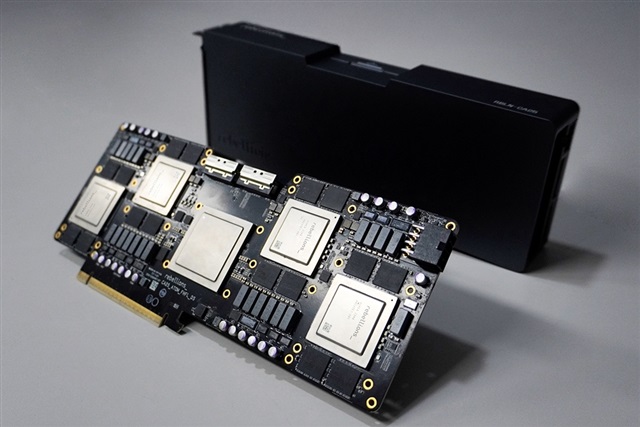
At the center of this expansion is Rebellions’ ATOM-Max accelerator, an AI chip designed to support high-performance inference workloads. NPUs, or neural processing units, are specialized processors built to run artificial intelligence tasks such as language models, recommendation systems, voice recognition, chatbots, and other real-time AI services.
The partnership with SK Telecom gives Rebellions a strong commercial proving ground for its AI semiconductor technology. Telecom operators are increasingly adopting AI to improve customer service, automate operations, enhance search and recommendation features, and support personalized digital experiences. These services require chips that can process large volumes of data quickly while keeping power consumption and operating costs under control.
Handling 4 billion tokens per day is a significant milestone because tokens are the basic units processed by AI language models. A higher token volume generally means the system is supporting a large number of AI interactions, text-based queries, or automated responses. For SK Telecom, this suggests that AI is becoming a core part of its commercial services rather than a limited test project.
For Rebellions, the deployment strengthens its position in the competitive AI chip industry. As demand for AI inference grows, companies are looking for alternatives to general-purpose processors and expensive data center hardware. Purpose-built AI accelerators like the ATOM-Max are becoming increasingly important for businesses that need fast, scalable, and cost-efficient AI processing.
The expansion also reflects South Korea’s broader push to develop domestic AI semiconductor capabilities. With companies like Rebellions moving from development into large-scale commercial deployment, the country is positioning itself as a serious player in the global AI hardware market.
As artificial intelligence continues to spread across telecom, cloud, enterprise, and consumer services, efficient AI chips will play a crucial role in supporting the next generation of digital products. Rebellions’ latest deployment with SK Telecom shows that its NPU technology is already handling demanding real-world workloads at scale.