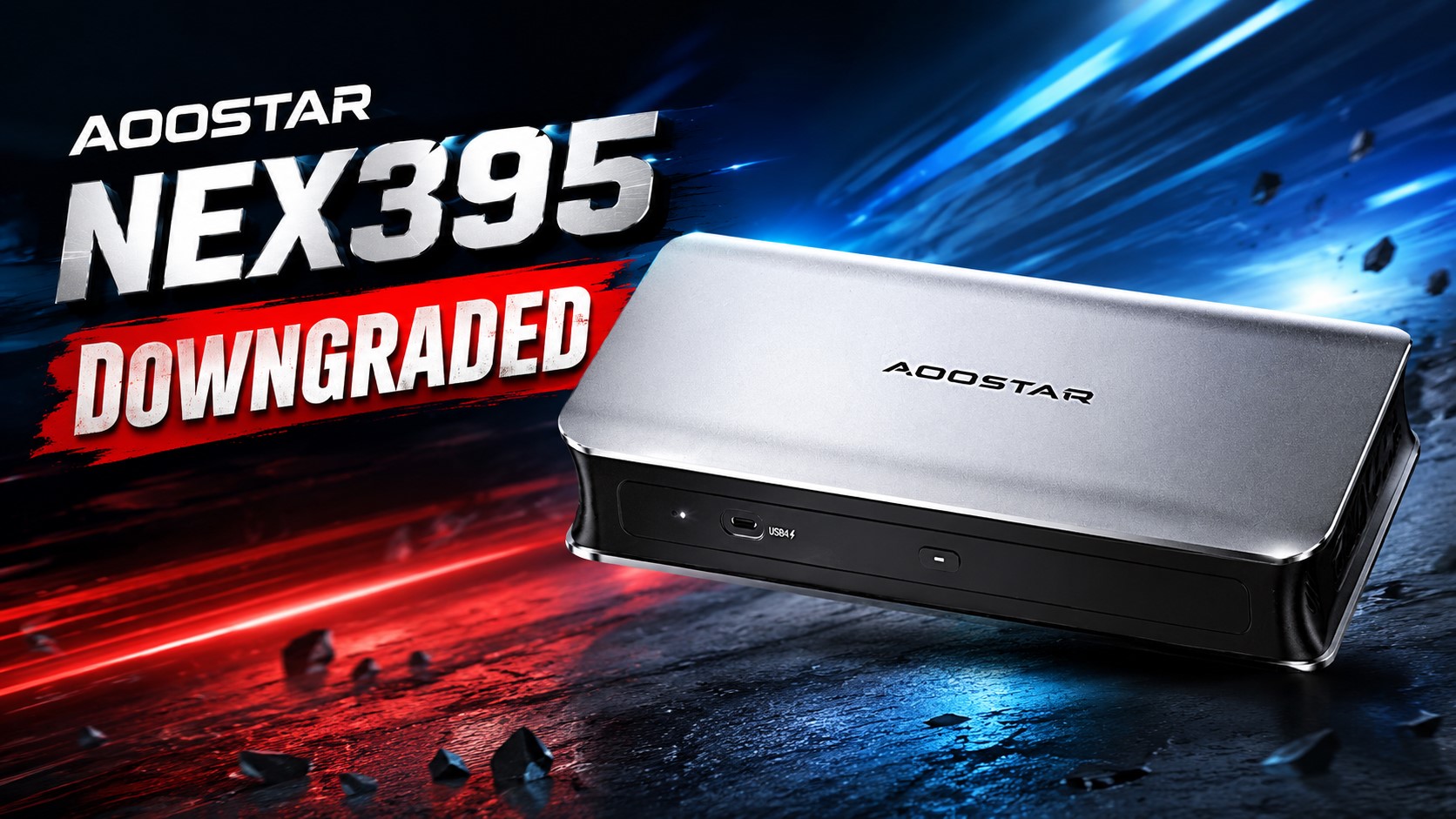
AOOSTAR NEX395 Returns With 64GB RAM and 1TB SSD as Memory Prices Keep Rising
The global AI boom is starting to reshape more than just the data center market. Its effects are now being felt by everyday PC buyers, hardware enthusiasts, and anyone shopping for high-performance devices. As demand for memory and storage surges, manufacturers are being forced to rethink product configurations, and AOOSTAR’s NEX395 mini PC appears to be one of the latest examples.
AOOSTAR has re-launched its powerful NEX395 mini PC with a reduced hardware configuration. Instead of the original 128GB RAM and 2TB SSD setup, the system is now being offered with 64GB of RAM and 1TB of storage. While that is still a strong specification for a compact desktop, it marks a major step down from the premium model introduced last year.
The AOOSTAR NEX395 made waves when it first arrived because it packed serious workstation-class performance into a compact 2 kg chassis. At the heart of the machine is AMD’s Ryzen AI Max+ 395 processor, a high-end chip featuring 16 Zen 5 cores and Radeon 8060S integrated graphics. This combination makes the mini PC suitable for demanding workloads such as content creation, productivity, development, multitasking, and local AI processing.
One of the biggest selling points of the original model was its massive 128GB of LPDDR5X memory running at 8533 MT/s. That amount of fast unified memory helped position the NEX395 as one of the most capable mini PCs available for mainstream buyers, especially for users interested in AI workloads, heavy multitasking, or GPU-accelerated tasks that benefit from a larger memory pool.
Storage was also generous in the initial version, with a 2TB SSD included as standard. AOOSTAR also provided an additional M.2 slot, giving users room to expand capacity if needed. For a mini PC, that made the NEX395 a highly flexible system for power users who wanted desktop-level performance without a full-sized tower.
The new version cuts both memory and storage in half, moving to 64GB RAM and a 1TB SSD. AOOSTAR has not officially explained the reason for the change, but the timing strongly suggests that rising DRAM and SSD prices are playing a major role. The current market has been affected by intense demand from AI infrastructure, where enormous amounts of memory and storage are required for training, inference, and large-scale server deployments.
This situation has created pressure across the broader hardware industry. DDR5 memory, LPDDR5X memory, SSDs, GPUs, and even mobile devices are all being affected by higher component costs. Some companies have responded by increasing prices, while others appear to be reducing specifications to keep retail prices from climbing too high.
The revised AOOSTAR NEX395 configuration is reportedly priced at 12,999 yuan, which is roughly $1,926. However, listings at major Chinese retailers are said to place the system closer to 13,599 yuan, or about $2,015. That still makes it an expensive mini PC, but it is far cheaper than the original 128GB RAM and 2TB SSD model, which launched at 19,999 yuan, or around $2,963.
Given how much memory and storage prices have increased recently, the original top-end configuration could likely cost significantly more if it were released today. A similar 128GB and 2TB version might push much closer to the $4,000 range under current market conditions.
Even with the downgrade, the NEX395 remains a powerful compact workstation. A 64GB RAM configuration is still more than enough for many creators, developers, professionals, and enthusiasts. Combined with the Ryzen AI Max+ 395 and Radeon 8060S graphics, it continues to offer strong performance for users who need a small but capable machine.
Still, the change highlights a broader trend that buyers may see more often in the coming months. As AI demand continues to absorb large amounts of global memory and storage supply, consumer devices could become more expensive, or manufacturers may ship them with reduced RAM and SSD capacities to keep prices under control.
For enthusiasts, the AOOSTAR NEX395 relaunch is a clear reminder that the high-performance PC market is entering a more challenging period. Mini PCs, laptops, gaming systems, and workstations may all feel the impact if memory and storage shortages continue.
The NEX395 is still an impressive machine, but its new configuration shows how quickly the hardware landscape is changing. What was once a premium mainstream mini PC with 128GB of fast memory has now been reintroduced with half the RAM and half the storage, not because the platform lacks capability, but because the market around it has become much more expensive.