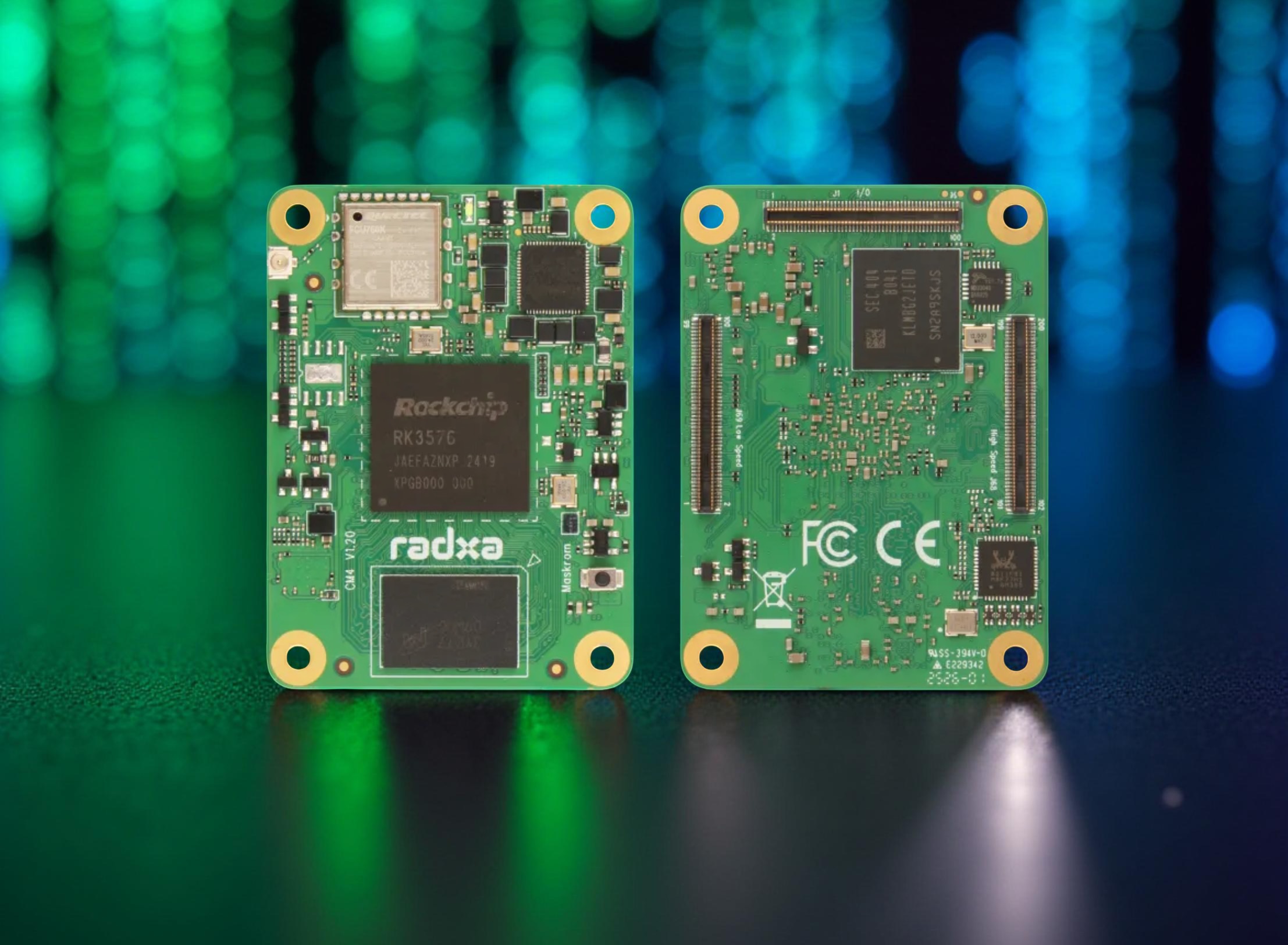
Radxa is gearing up to launch the CM4, a compact single-board computer designed to bridge the gap between the CM3 and the more premium CM5. While pricing and release dates are still under wraps, the company has shared enough hardware details to get makers, tinkerers, and embedded developers excited—especially those eyeing edge AI, NAS builds, and 4K display projects.
At the heart of the CM4 is Rockchip’s RK3576, an octa-core SoC combining four Cortex-A72 performance cores with four Cortex-A53 efficiency cores. Graphics are handled by a Mali-G52 MC3 GPU, with support for modern APIs including OpenGL ES 1.1 through 3.2, Vulkan 1.2, and OpenCL 2.1. For on-device machine learning, the board integrates an NPU delivering up to 6 TOPS of INT8 inferencing—plenty for light-to-moderate AI workloads at the edge.
Memory options go up to 16 GB of LPDDR4X, giving the CM4 ample headroom for multitasking, containers, and AI models. Storage is equally flexible: up to 256 GB of onboard eMMC, plus support for SD/MMC and UFS 2.0 for faster flash-based solutions.
The CM4 is designed to drop into popular ecosystems. It’s compatible with a wide range of third-party carrier boards, including the Raspberry Pi CM4 I/O board, the WaveShare CM4-Nano-B, and others—so you can reuse existing cases and accessories. Built-in Wi‑Fi 6 and Bluetooth 5.4 cover wireless needs, while USB, Ethernet, and additional interfaces are available through supported I/O boards.
Display and camera connectivity is a standout. The CM4 supports 4-lane or dual 2-lane MIPI CSI for camera input, plus a rich set of display outputs: 4-lane eDP, DisplayPort with up to 4K at 120 Hz, 4-lane MIPI DSI, and HDMI with up to 4K at 120 Hz. That makes it a strong candidate for digital signage, high-refresh dashboards, and vision-driven projects.
For storage-heavy builds, there’s dual SATA 3.1 support—a rare perk in this class—alongside a single-lane PCIe Gen2 for add-ons. A Gigabit Ethernet physical layer is onboard; pair it with a compatible carrier board to expose an RJ45 port and wired networking.
Key specs at a glance:
– SoC: Rockchip RK3576 with 8-core CPU (4x Cortex-A72 + 4x Cortex-A53)
– GPU: Mali-G52 MC3 with OpenGL ES 1.1–3.2, Vulkan 1.2, OpenCL 2.1
– NPU: Up to 6 TOPS (INT8)
– Memory: Up to 16 GB LPDDR4X
– Storage: Up to 256 GB eMMC, plus SD/MMC and UFS 2.0
– Wireless: Wi‑Fi 6 and Bluetooth 5.4
– Camera: 4-lane or 2×2-lane MIPI CSI
– Displays: 4-lane eDP, DP up to 4K120, 4-lane MIPI DSI, HDMI up to 4K120
– Expansion: Dual SATA 3.1, PCIe Gen2 (x1), Gigabit Ethernet PHY
– Ecosystem: Compatible with popular CM4-format carrier boards
Pricing hasn’t been announced, but it’s expected to undercut the CM5. For context, the RK3588-powered CM5 with 4 GB RAM and 32 GB storage has been listed around $106.99, positioning the CM4 as a more affordable alternative for makers who still want strong CPU performance, a capable GPU, edge AI acceleration, and robust I/O options.
If you’re planning an embedded project, a compact media hub, a lightweight AI edge device, or a DIY NAS with dual SATA, the Radxa CM4 looks like a compelling, budget-friendly SBC worth keeping on your radar.