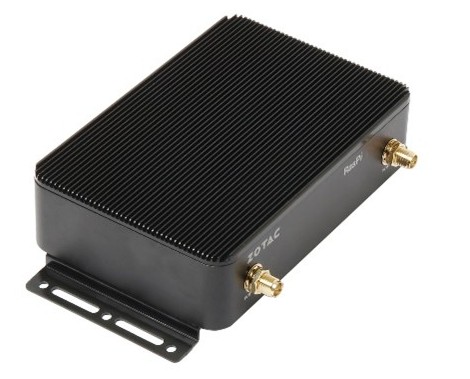
Zotac is gearing up to make a splash at Integrated Systems Europe (ISE) 2026 in Barcelona with a tiny new single-board computer built for big jobs in tight spaces. Called the Zotac CM5-PICO, it’s designed around the Raspberry Pi Compute Module 5 (CM5) and is being positioned as the world’s smallest and most feature-dense CM5-based SBC. In practical terms, that means a compact, industrial-ready system that still packs the ports and expansion options developers and system integrators actually need.
One of the headline goals for the CM5-PICO is longevity. Zotac says the platform is intended to offer industrial-grade durability and long-term availability through January 2036, which is a major selling point for commercial deployments that can’t afford frequent redesigns or parts shortages.
At the heart of the CM5-PICO is the Raspberry Pi Compute Module 5, a system-on-module powered by the Broadcom BCM2712 quad-core Cortex-A76 CPU running at up to 2.4 GHz. Depending on the CM5 configuration, it can be paired with up to 16 GB of LPDDR4x-4267 memory. The module also supports Vulkan 1.2, offers up to 30 GPIO signals for hardware projects and automation, and includes USB-C power delivery support—useful for cleaner, more modern installs.
Zotac packages the CM5-PICO in a passively cooled aluminum chassis measuring 114.8 x 76 x 31 mm, making it a strong fit for space-constrained environments where active cooling is undesirable. Despite its small footprint, connectivity is a clear focus. The system includes two full-size HDMI ports capable of 4K output, Gigabit Ethernet, two USB 3.2 ports, and a USB Type-C port for additional flexibility.
For expansion and embedded use cases, Zotac adds several developer-friendly options: a 40-pin Raspberry Pi HAT header, an RS232 header for legacy and industrial equipment integration, dual CSI-2 camera interfaces for imaging and vision workloads, and a PWM fan header.
Storage and add-on capabilities are another highlight. The CM5-PICO includes one Key-M 2280 slot and one Key-B 3024 slot for PCIe modules. This opens the door to NVMe SSD storage, 4G/5G modem connectivity, and even dedicated neural processing units (NPUs) for AI inference—features that can turn this small box into a serious edge computing node.
Zotac is pitching the CM5-PICO for a wide range of real-world deployments, including kiosks, digital signage, industrial IoT gateways, edge AI inferencing, and computer vision projects. With compact dimensions, multiple display outputs, camera support, and PCIe expansion, it’s clearly aimed at integrators who want Raspberry Pi CM5 flexibility in a more deployment-ready design.
In addition to the CM5-PICO, Zotac plans to showcase a broader edge-focused lineup at ISE 2026, including Edge AI mini PCs and embedded MXM modules built around Nvidia RTX Pro Blackwell GPUs—signaling a bigger push into AI-powered systems designed for on-site processing rather than cloud dependency.