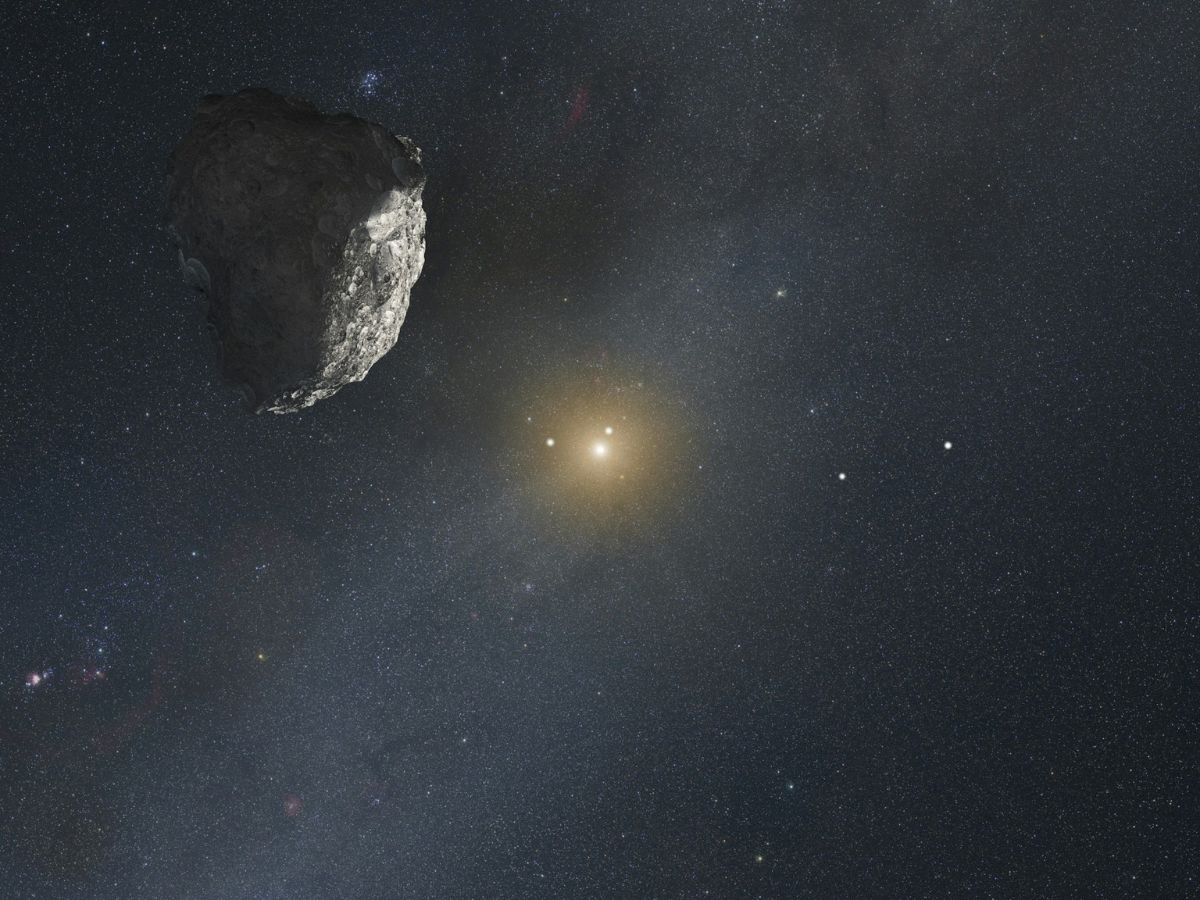
Asteroid Psyche isn’t like most space rocks drifting through the solar system. Located in the main asteroid belt between Mars and Jupiter, Psyche measures about 140 miles wide and stands out because it appears to be packed with metal. While many asteroids are rich in silicates or carbon-based material, Psyche is considered the largest known metal-rich asteroid ever found, making it one of the most intriguing targets for planetary science.
That unusual makeup has fueled a big question: is Psyche actually a piece of a planetary core?
If Psyche turns out to be an exposed core from a once-larger world, it could offer a rare look at the kind of material that normally sits hidden deep inside planets. On Earth, the core is impossible to sample directly, so a metal-heavy asteroid like Psyche could become a natural window into how planetary interiors are built.
How Psyche formed is still up for debate, and several competing ideas are in play. One possibility is that Psyche was once part of a larger body whose outer rocky layers were stripped away during violent collisions, leaving behind the metallic interior. Another hypothesis suggests the asteroid was shattered by massive impacts, then reassembled into a jumbled mix of metal and rock rather than remaining a clean, exposed core. There’s also the idea that Psyche could be a partially formed, metal-rich protoplanet—an object that never fully became a planet but still holds clues to the solar system’s earliest construction phase.
To finally move from speculation to evidence, NASA launched the Psyche mission in 2023. The spacecraft is expected to reach the asteroid in 2029, where it will gather detailed measurements of Psyche’s surface composition, gravity, magnetic field, and density variations. Those data points matter because they can help scientists tell whether Psyche is mostly metal, a metal-rock mixture, or something even more complicated.
While waiting for the spacecraft to arrive, researchers have been working to predict what Psyche’s surface should look like under different origin stories. To do that, they built a 3D model of the asteroid and ran simulations of impacts under a wide range of conditions, changing the speed of collisions and the size of incoming objects. One factor turned out to be especially important: porosity. If Psyche is more porous—filled with tiny voids like a cosmic sponge—it would absorb impact energy differently, potentially allowing collisions to carve deeper craters than you’d expect from a solid metal body.
In these simulations, scientists tested impacts on two primary versions of Psyche: one model representing a metallic core and another representing a mixed rock–metal body. The results suggest that an impactor about 3 miles wide could create the crater researchers are trying to explain. Beyond crater size, the simulations also forecast smaller but meaningful differences depending on Psyche’s true structure, including slight changes in crater shape, the way debris would be thrown outward, variations in density beneath the surface, and how metal might be distributed across the asteroid.
When the Psyche spacecraft arrives in 2029, the real test begins. Scientists will compare what the spacecraft actually sees—crater details, surface patterns, and internal signals inferred from gravity and magnetism—against the simulation predictions. Matching the observations to the right scenario could reveal whether Psyche is a stripped planetary core, a scrambled remnant of repeated collisions, or an unfinished metal-rich world.
Either way, Psyche has the potential to answer some of the biggest questions in planetary science: how early planets differentiated into layers, what the solar system’s most violent collisions were like, and how the building blocks of planetary interiors evolved long before Earth became the world we know today.