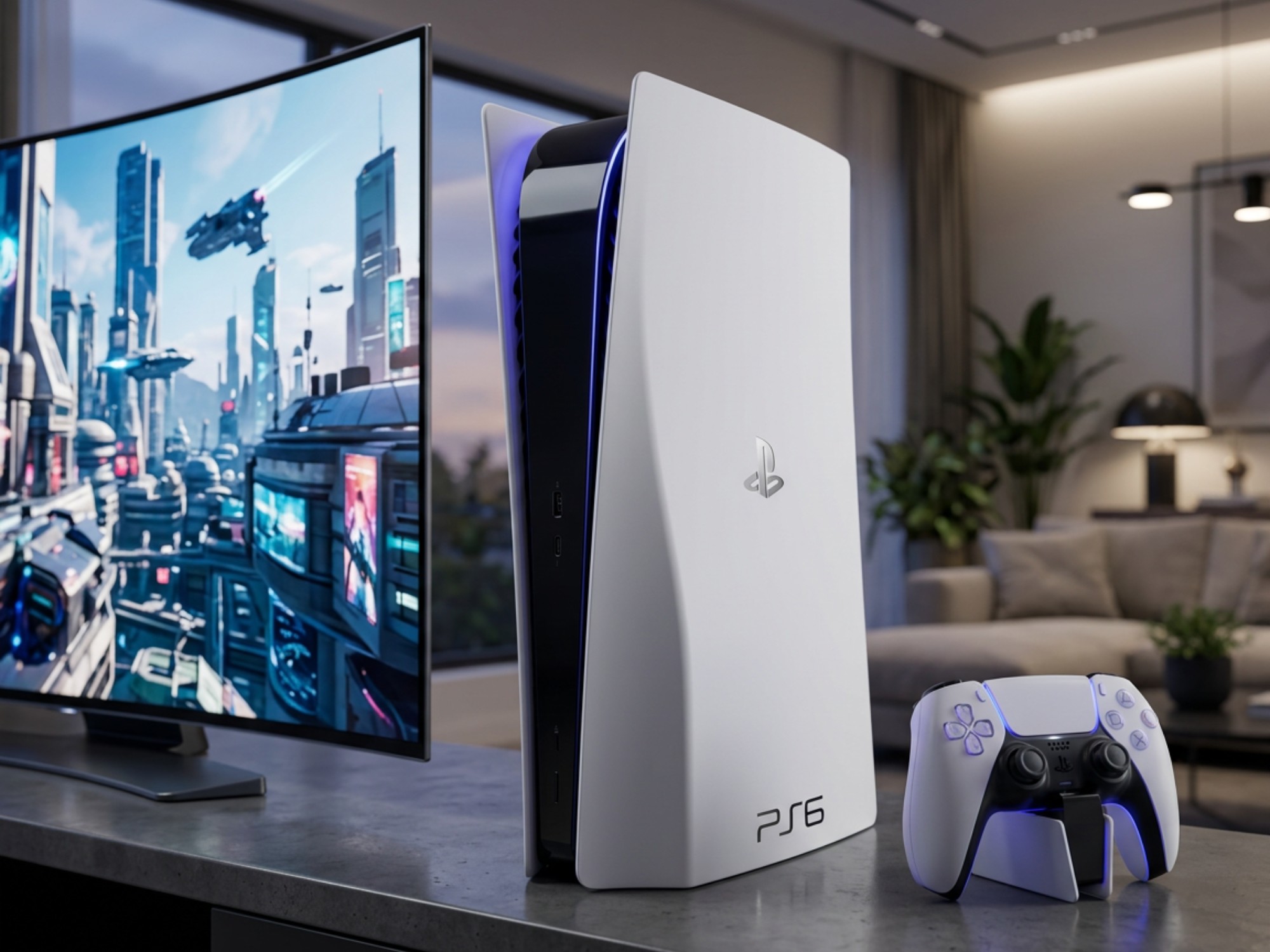
An Adobe Firefly concept image for the PS6 is making the rounds again, and it’s a good reminder of where we are right now with next-gen console chatter: everyone’s eager for big leaps, but the performance math behind the leaks isn’t always agreed on.
With Sony’s next console era widely expected to arrive around late 2027, talk has centered on the PlayStation 6 and a rumored PS6 handheld. Many reports have painted a picture of a massive upgrade over the current generation, with ray tracing often highlighted as the biggest jump. But a new back-and-forth between two well-known hardware insiders suggests the real-world gains may be more modest than some headlines have implied, at least in certain types of games.
KeplerL2, posting on NeoGaf, pushed back on claims attributed to another leaker, MLID (Moore’s Law is Dead), saying AMD’s internal performance figures are being misread. The disagreement specifically targets the idea that PS6 ray tracing performance could be “10x” better than PS5. According to KeplerL2, seeing a figure such as “10x RT performance” in a slide doesn’t automatically translate into a simple, across-the-board 10x frame rate increase in actual gameplay.
To explain why, KeplerL2 pointed to what they described as performance data tied to Assassin’s Creed Shadows, breaking down frame times for different ray tracing components. Using that as a reference point alongside AMD’s internal estimates, they argued that a more realistic uplift in many real-world scenarios could land closer to about 3x (around 3.10x in their example) rather than 10x. In other words, if a game uses ray tracing lightly, you may not see anything close to a 10x improvement—because the “ray tracing” portion simply isn’t the dominant performance bottleneck.
That said, KeplerL2 also noted an important nuance: the gap could widen in games that lean heavily into ray tracing, and especially in more demanding approaches like path tracing. So while the “10x” interpretation may be too optimistic for typical ray-traced workloads, bigger gains aren’t impossible in the most extreme lighting and reflection scenarios—where ray tracing becomes a much larger chunk of the total rendering cost.
On the other side, MLID has responded that they’ve been repeating figures as stated by AMD rather than spinning them into a guaranteed frames-per-second multiplier. That distinction matters, because “ray tracing performance” can refer to a range of internal measurements, and those don’t always map cleanly to how fast a full game will run.
It’s also worth putting this in context with the current generation’s mid-cycle upgrade. The PS5 Pro has been positioned as delivering roughly 2x to 3x ray tracing performance compared to the base PS5, and that range already hints at the core reality here: ray tracing gains depend heavily on how a specific game uses the technology. If that trend holds, PS6 could certainly be multiple times faster than PS5 for ray tracing—but the number you get could vary widely from one title to the next.
For anyone tracking PS6 specs, next-gen console leaks, and future PlayStation performance expectations, the takeaway is straightforward: the biggest-sounding multiplier isn’t always the most accurate way to predict real gameplay. The PS6 should deliver a meaningful leap, especially for ray tracing, but the difference between “marketing-style performance slides” and “what you feel in a game” is where most of the confusion starts.


