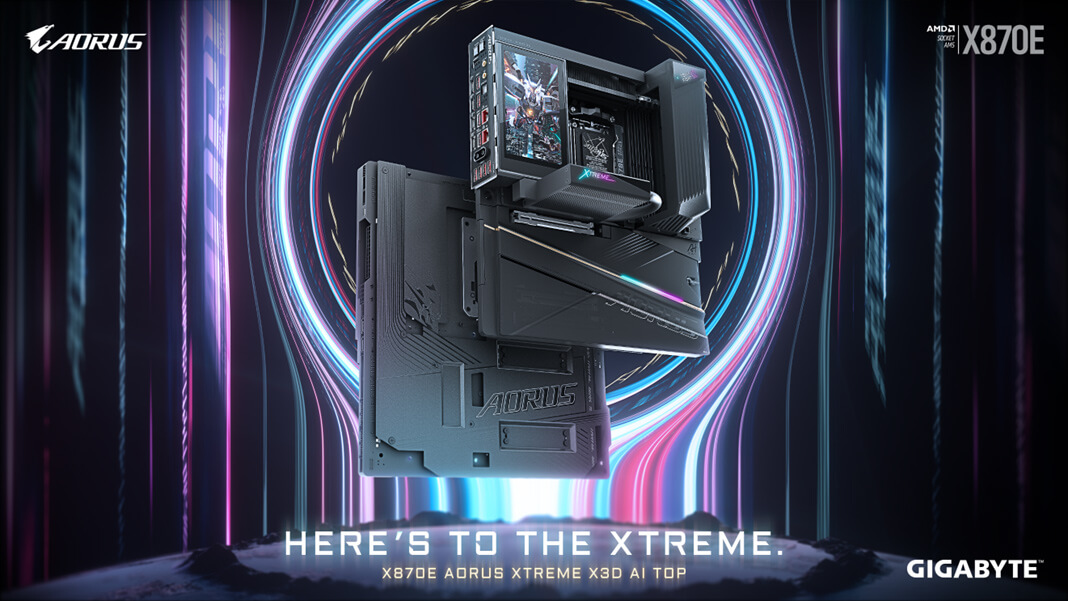
Gigabyte just took the wraps off its new flagship for AMD’s AM5 platform, and it’s built to spoil extreme PC builders. The X870E AORUS Xtreme X3D AI TOP is an E-ATX powerhouse aimed at wringing every last drop of performance from Ryzen 9000, 8000, and 7000 processors—especially X3D chips.
The headliner is X3D Turbo Mode 2.0, an AI-assisted tuning suite designed to squeeze extra, cache-aware performance from Ryzen X3D CPUs with smarter voltage/frequency behavior. If you’re eyeing a Ryzen 9000X3D build, this board is purpose-built to let those chips stretch their legs.
Power delivery and memory tuning are equally serious. A digital twin 24+2+2 phase VRM with 110A and 60A stages keeps high-core-count CPUs under control, backed by an aggressive thermal solution. DDR5 support climbs to DDR5-9000 with up to 256 GB across four DIMMs, and Gigabyte adds active DIMM cooling to keep memory stable under heavy overclocks.
Cooling is a major theme throughout. The CPU and VRM zones are covered by a Thermal Matrix design with finned heatsinks, dual 10 mm direct-touch heatpipes, and high-conductivity 12 W/mK pads. The new DDR Wind Blade Xtreme module provides active airflow for RAM, cutting temps by up to 9°C. Storage gets the same treatment: multiple M.2 Thermal Guard solutions, including a primary heatsink with a heatpipe and an integrated fan, can reduce SSD temps by up to 22°C.
Expansion and storage support are top-tier. You get three full-length PCIe slots—two PCIe 5.0 (x16/x8) and one PCIe 4.0 x4—plus five M.2 slots, two of which run at PCIe 5.0 x4 for next-gen NVMe speeds. While there are only two SATA ports, the M.2 count and bandwidth clearly target all-SSD builds.
Connectivity is over the top. Expect 22 USB ports in total with dual USB4 Type-C on the rear I/O (with DisplayPort functionality), a USB 3.2 Gen 2×2 Type-C around back, and a front-panel USB-C header that supports up to 65W PD 3.0/QC 4+ fast charging. Networking is equally premium with dual 10 GbE ports and Wi‑Fi 7 paired with a directional high-gain antenna. Audio is anchored by DTS:X Ultra with an ESS ES9280A DAC and ES9080A, plus an optical S/PDIF out, aimed at creators and audiophiles alike.
Builders will appreciate the quality-of-life touches. Tool-less M.2 EZ-Latch Click and EZ-Latch Plus mechanisms make SSD and heatsink swaps painless, PCIe EZ-Latch Plus Duo simplifies GPU removal, and Wi-Fi EZ-Plug speeds antenna installs. There’s also a dedicated EZ Debug Zone, and a DriverBIOS that pre-installs Wi‑Fi drivers so you can get online right after first boot. For style and status at a glance, a massive 5-inch LCD Edge View display adds real-time system info and customizable visuals, out-sizing rivals and giving showcase builds a premium look.
Rear I/O essentials include:
– Q-Flash Plus and OC Ignition buttons
– HDMI output
– 2 x USB4 Type-C with DP-Alt functionality
– 1 x USB-C Gen 2 and 1 x USB-C Gen 2×2
– 8 x USB 3.2 Gen 2 Type-A
– Dual 10 GbE LAN
– Wi‑Fi 7 antenna connectors (2T2R)
– ESS-powered audio jacks and optical S/PDIF
Other notable hardware touches include a reinforced Titanium PCIe 5.0 x16 slot for heavy GPUs, a PCB Thermal Plate that improves board thermals by up to 14%, and bundled front USB DAC hardware for cleaner audio.
Key highlights at a glance:
– X3D Turbo Mode 2.0 for AI-assisted tuning of Ryzen X3D CPUs
– 24+2+2 phase VRM with robust thermal armor and dual direct-touch heatpipes
– DDR5 up to 9000 MT/s, with active DIMM cooling
– 3 x PCIe x16 (2 x PCIe 5.0), 5 x M.2 (2 x PCIe 5.0 x4)
– 22 USB ports including dual USB4 Type-C and front USB-C with up to 65W charging
– Dual 10 GbE + Wi‑Fi 7 networking
– Advanced M.2 Thermal Guard solutions and tool-less EZ-Latch ecosystem
– 5-inch LCD Edge View screen for live system data and aesthetics
– DTS:X Ultra audio with ESS DACs
As an ultra-enthusiast E-ATX board with bleeding-edge features and a lavish build, expect pricing well north of 1000 USD and limited quantities. If you’re building a no-compromise AM5 system—especially one centered on a Ryzen 9000X3D—the X870E AORUS Xtreme X3D AI TOP reads like a wish list turned into a motherboard.


