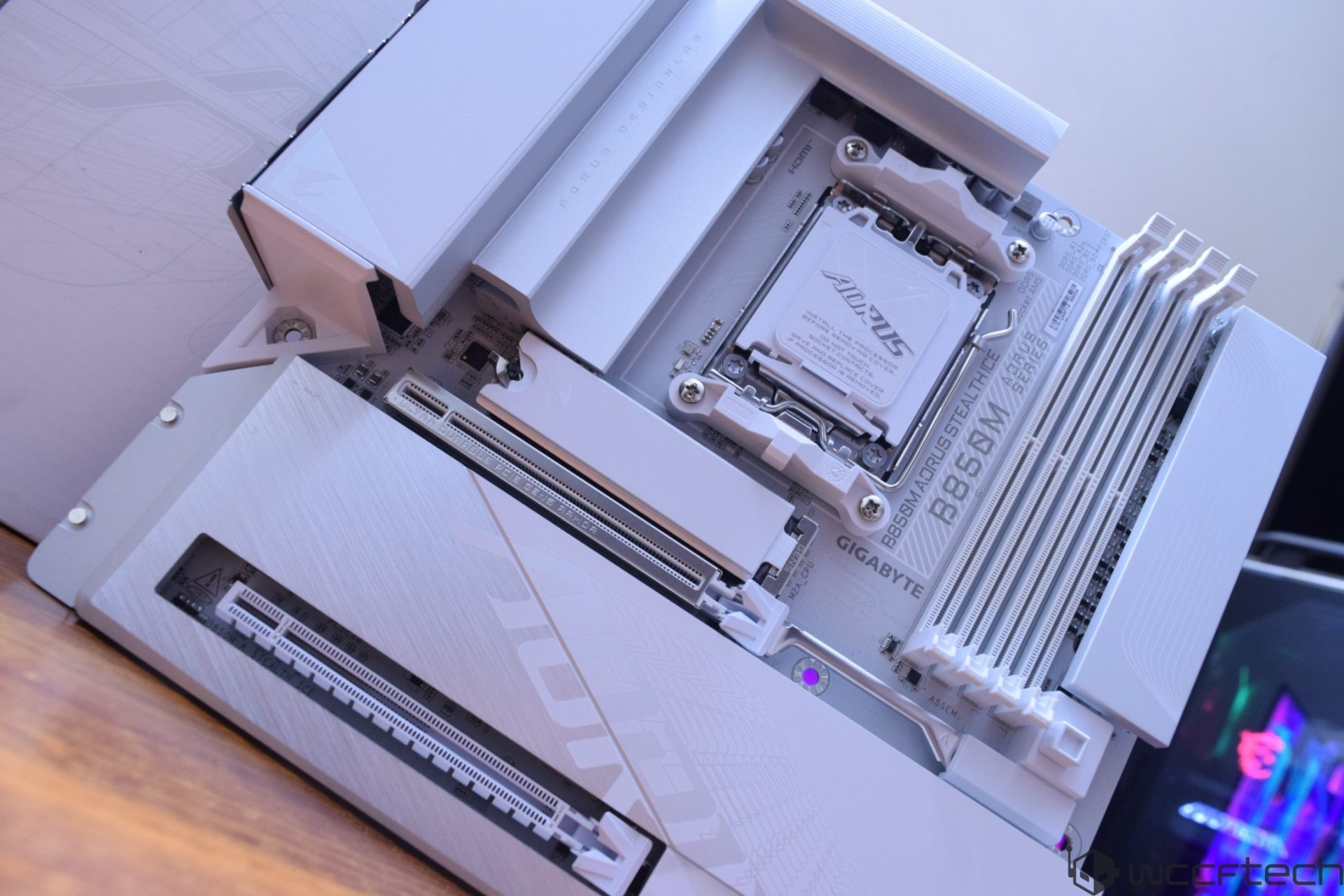
Gigabyte B850M AORUS Stealth ICE Preview: A Fresh AM5 Motherboard for Ryzen Builders
The AMD AM5 platform has been around for three years, and it has already supported a wide range of processors across the Ryzen 7000, Ryzen 8000, and Ryzen 9000 families. Even though the original 600-series AM5 motherboards still offer strong compatibility and modern features, AMD and its motherboard partners are moving the platform forward with the newer 800-series chipset lineup.
One of the more interesting new additions is the Gigabyte B850M AORUS Stealth ICE, a mainstream AM5 motherboard expected around July 2026 with an estimated price of about $250. Designed for users building a modern Ryzen gaming PC or content creation system, this board is part of Gigabyte’s Stealth family and aims to bring newer platform features to a more accessible segment.
The AM5 platform continues to evolve
AMD’s AM4 platform had an unusually long life. First introduced in 2017, it remained relevant for years and continued receiving new processors long after many expected it to fade away. Even in 2026, AM4 still has a place in budget and upgrade-focused systems.
However, AM5 is now AMD’s main platform for modern Ryzen processors. With DDR5 memory, PCIe 5.0 support, and a long-term upgrade path, AM5 is designed for current and future Ryzen CPUs. AMD has also committed to supporting AM5 beyond 2029, which makes it especially appealing for buyers who want a motherboard that can last through multiple CPU generations.
The 800-series chipset family builds on that foundation. It includes premium options such as X870E and X870, along with mainstream chipsets like B850 and B840. These boards are designed to support Ryzen 9000 “Granite Ridge” processors and future AM5 CPUs, while offering improved connectivity, better memory support, and updated overclocking capabilities.
Where the AMD B850 chipset fits in
The AMD B850 chipset is aimed at mainstream users who want modern AM5 features without paying for a flagship X-series motherboard. It sits below X870 and X870E but still offers a strong feature set for gaming PCs, productivity systems, and enthusiast builds.
B850 motherboards support both CPU and memory overclocking, which is a major advantage for users who want to tune their Ryzen processor and DDR5 memory. This makes B850 more flexible than entry-level chipsets such as B840 and A620, which are more limited in overclocking support.
PCIe support is another important part of the B850 platform. These motherboards can offer PCIe 5.0 support mainly for NVMe storage, while graphics support is typically PCIe 4.0. Some motherboard makers may choose to allocate PCIe 5.0 lanes differently depending on the board design, but the mainstream focus remains clear: fast storage, strong GPU compatibility, and a more affordable price compared to high-end AM5 options.
B850 also supports USB 3.2 with speeds up to 20 Gbps. Unlike the higher-end X870 and X870E chipsets, USB4 is not a standard feature on B850. For most gamers and everyday PC builders, though, the available USB connectivity should still be more than enough.
Gigabyte B850M AORUS Stealth ICE: what to expect
The Gigabyte B850M AORUS Stealth ICE is positioned as a stylish and capable AM5 motherboard for Ryzen users who want a modern board without moving into ultra-premium pricing. With an expected price around $250, it targets builders who want strong features, clean aesthetics, and support for the latest AMD processors.
As a B850 motherboard, it is expected to support Ryzen 7000, Ryzen 8000, and Ryzen 9000 processors, along with DDR5 memory. Native DDR5-5600 support is part of the AM5 platform, while higher-end boards can reach much faster speeds through memory overclocking, with some designs pushing beyond 8000 MT/s.
The “ICE” branding suggests a bright, clean visual theme, while the AORUS name places it in Gigabyte’s gaming-focused lineup. For builders putting together a white-themed or minimalist PC, this model could be especially attractive.
AM5 and Ryzen 9000 improvements
AMD introduced new Precision Boost Overdrive and Curve Optimizer algorithms with Ryzen 9000 processors. The newer 800-series motherboards, including B850 models, are built to support these technologies out of the box.
Precision Boost Overdrive helps Ryzen CPUs boost more aggressively when thermal and power conditions allow. Curve Optimizer gives users more control over voltage behavior, which can improve efficiency, reduce temperatures, or unlock better performance depending on the tuning approach. For enthusiasts, these tools remain some of the most useful parts of the Ryzen ecosystem.
With B850 supporting both CPU and memory overclocking, boards like the Gigabyte B850M AORUS Stealth ICE should appeal to users who want hands-on tuning without paying for the most expensive chipset tier.
AMD 800-series chipset lineup explained
AMD’s current AM5 chipset range gives buyers several options depending on budget and feature needs.
X870E is the top-tier option, offering PCIe 5.0 support for graphics and NVMe storage, USB4 as standard, CPU and memory overclocking, and support for high-end multi-GPU lane configurations.
X870 also includes PCIe 5.0 support for graphics and NVMe storage, USB4 as standard, and full CPU and memory overclocking support, but it is generally positioned slightly below X870E.
B850 is the mainstream performance option. It offers PCIe 5.0 support primarily for NVMe storage, PCIe 4.0 graphics support in typical configurations, USB 3.2 20 Gbps support, and both CPU and memory overclocking.
B840 is the more affordable mainstream option. It is more limited, with reduced PCIe capabilities and memory overclocking support only. It is aimed at lower-cost AM5 builds.
A620 remains the entry-level AM5 choice. It is designed for budget systems and system integrators, offering basic AM5 support with fewer enthusiast features.
This lineup gives AMD a wide platform range, from affordable everyday PCs to high-end Ryzen gaming and workstation builds.
The AM5 LGA 1718 socket
One of the biggest changes from AM4 to AM5 is the socket design. AM4 used a PGA layout, where the pins were on the processor. AM5 moved to an LGA design, meaning the pins are now inside the motherboard socket.
The AM5 socket is known as LGA 1718, referring to its 1,718 contact points. This design allows more communication between the CPU and motherboard, helping support newer features such as DDR5 memory, PCIe 5.0 connectivity, and improved power delivery.
For users upgrading from AM4, this is a major platform shift. AM4 processors are not compatible with AM5 motherboards, and AM5 requires DDR5 memory instead of DDR4. However, the benefit is a more modern platform with a longer future upgrade path.
Cooler compatibility remains a major plus
A key advantage of AM5 is that it maintains cooler compatibility with many existing AM4 cooling solutions. Ryzen 7000, Ryzen 8000, and Ryzen 9000 desktop CPUs use a 45 mm x 45 mm package size and feature a thick integrated heat spreader.
Because of the mechanical design, many AM4 coolers can be reused on AM5, depending on the mounting hardware. This is helpful for upgraders who already own a quality air cooler or liquid cooler and want to reduce the total cost of moving to a new platform.
The AM5 heat spreader is also sealed around the sides, helping prevent thermal paste from spreading into unwanted areas during installation. That makes the building process a little cleaner and more user-friendly.
Why B850 could be the sweet spot for AM5 buyers
For many PC builders, B850 may become the most practical AM5 chipset. It offers the features most users actually need: Ryzen 9000 support, DDR5 memory, PCIe 5.0 storage capability, CPU overclocking, memory tuning, and fast USB connectivity.
While X870 and X870E are better suited for users who demand USB4, more advanced connectivity, or maximum expansion options, B850 should be enough for most gaming and productivity builds. That is especially true for users pairing the board with a powerful Ryzen 7 or Ryzen 9 CPU and a modern graphics card.
The Gigabyte B850M AORUS Stealth ICE appears to fit that role well. At around $250, it is not an entry-level board, but it could offer a strong balance of design, features, and future-ready AM5 support.
Final thoughts
The Gigabyte B850M AORUS Stealth ICE represents the next phase of mainstream AMD AM5 motherboards. With support for modern Ryzen processors, DDR5 memory, PCIe 5.0 storage, USB 3.2 20 Gbps, and overclocking for both CPU and memory, it brings many enthusiast-friendly features to a more accessible chipset.
AMD’s 800-series platform shows that AM5 is not standing still. With long-term support promised beyond 2029, the platform gives buyers confidence that a motherboard purchased today can remain useful for future Ryzen upgrades.
For PC builders planning a new AMD gaming rig, a compact high-performance desktop, or a stylish Ryzen-based workstation, the Gigabyte B850M AORUS Stealth ICE could become one of the more appealing B850 motherboard options in the mainstream AM5 market.


