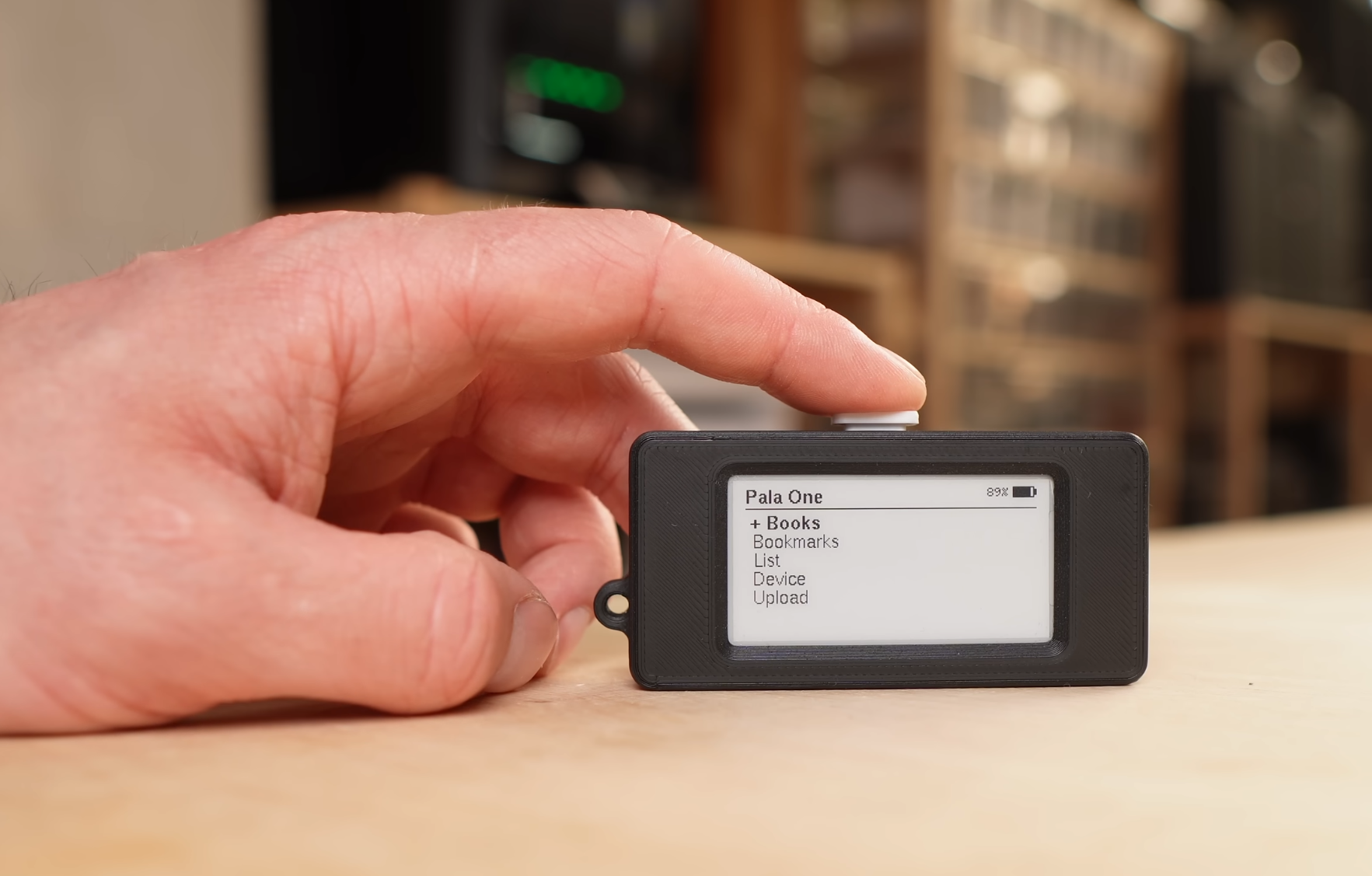
After his first pint-sized e-reader build went viral in March, maker Paul Lagier is back with a much more polished version two—and it’s still delightfully tiny. Designed as a minimalist alternative to doomscrolling and mobile gaming, this DIY e-ink reader is about the size of an AirPods case and can be built with roughly $30 worth of parts.
The original model proved the concept: an ESP32 microcontroller paired with a 2.9-inch monochrome e-paper display gave readers a simple, distraction-free way to carry books in their pocket. But early adopters quickly ran into practical problems. The 3D-printed enclosure depended on small plastic pins that many hobbyists found tricky to print and assemble reliably. On top of that, the software didn’t use the ESP32’s 8 MB of flash storage efficiently, leaving only around 1.5 MB for books—enough space for roughly two titles, which limited the whole “library in your pocket” appeal.
Version two directly tackles those pain points and feels built for everyday use rather than just a proof-of-concept. The casing has been redesigned into a sturdier screw-down enclosure that uses M2 threaded inserts, making assembly easier and the finished device far more solid. Lagier also addressed one of the most common complaints about the first version: the loud mechanical click from the single navigation button. A small piece of self-adhesive foam on the internal plunger helps dampen the sound, making page turns quieter and less jarring.
The biggest leap, though, is on the software side. Lagier implemented a partitioning fix that frees up about 5.5 MB of storage for books, a major improvement over the first build. There’s also automated text compression now, which stretches that storage even further. In practical terms, the updated tiny e-reader can hold about six to ten full-length books at a time, depending on file sizes and content.
Navigation and library management also get meaningful upgrades without abandoning the simple spirit of the device. Version two adds a folder-based library system, a storage indicator in the web interface, and a way to jump to specific page positions—something that wasn’t realistically possible with the original single-button interface.
Lagier is keeping the project accessible for DIY builders. The design remains open-source, and he’s made available multiple case designs along with the firmware versions for a small fee (listed at €4.90). If you’ve been looking for a low-cost DIY e-ink reader project—especially one that’s intentionally focused, pocketable, and built to reduce screen-time distractions—this second iteration looks like a smarter, sturdier, and more practical take on the world’s smallest e-reader concept.