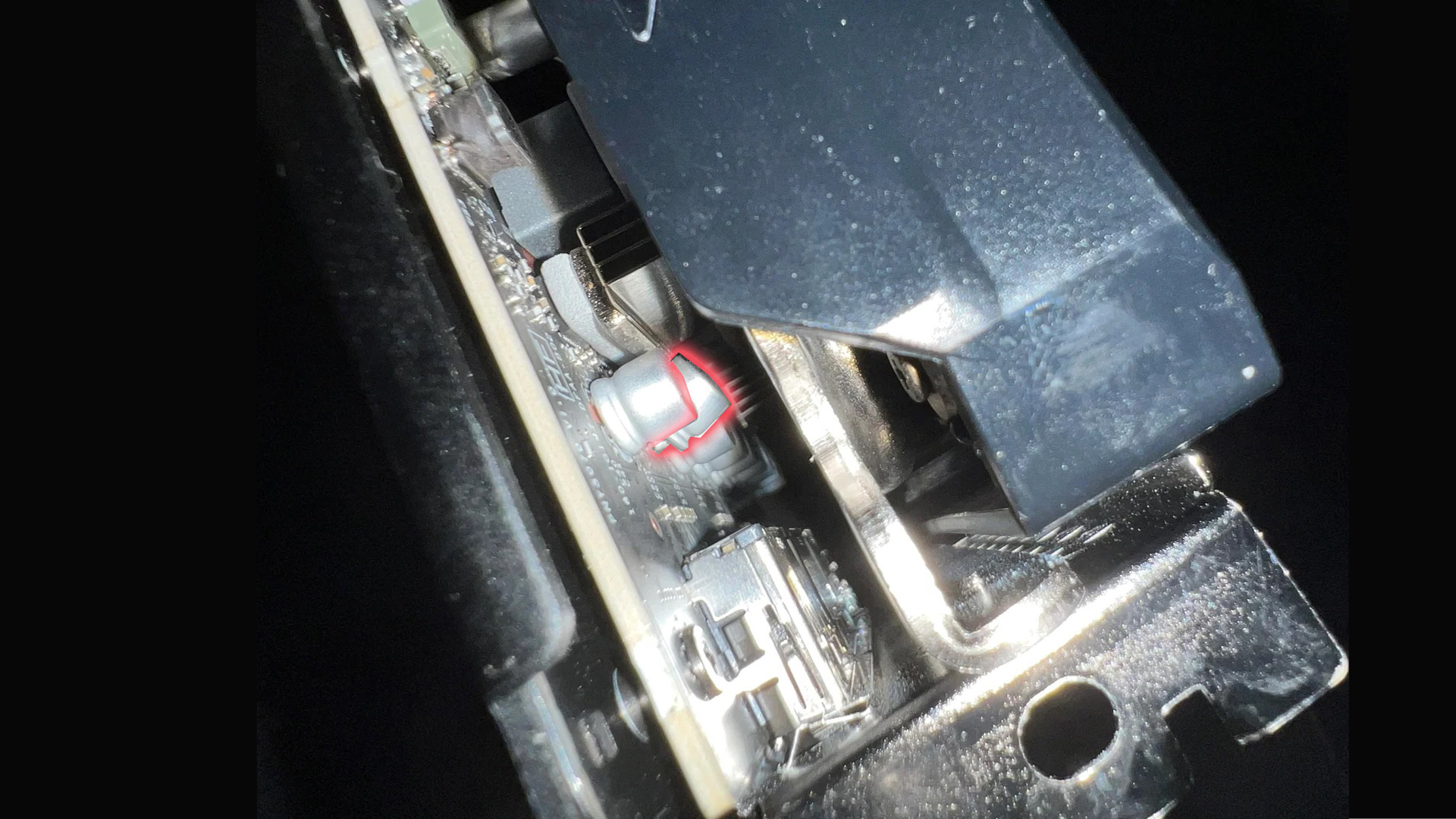
Something unusual may be going on with PNY’s RTX 50‑series graphics cards. In the span of just a few days, two separate users have reported blown capacitors on different PNY models: first on an RTX 5090 ARGB OC, and now on an RTX 5070. While capacitor failures do happen, they are typically rare and isolated. Seeing two similar incidents so close together has raised eyebrows, especially since there haven’t been comparable reports from other board partners for the RTX 50 series so far.
The latest case comes from a Reddit user who says a loud pop came from the PC while playing Marvel Rivals, followed by a burning smell. On inspection, a capacitor had clearly ruptured and detached from the board. Photos suggest the failure looks strikingly similar to the earlier RTX 5090 report. There is, however, a key difference: on this RTX 5070, the failed capacitor did not appear to touch the heatsink at all. In fact, there seems to be roughly a 1 cm gap between the component and the heatsink, making contact-induced failure unlikely.
Based on its position near the I/O area and close to the inductors, the damaged part appears to be tied to the VRM power delivery network. That points to possibilities such as a defective capacitor, a marginal solder joint, or an out-of-spec transient load that the component couldn’t handle. Notably, the card still functioned after the incident, indicating the PCB and other components weren’t catastrophically damaged; however, continuing to run it would shift extra stress onto the remaining capacitors. The owner has already started an RMA.
This does not look like a straightforward overheating issue, and it may mirror what happened on the previously reported RTX 5090 unit. Another commenter noted a similar capacitor failure on a 40‑series card from a different brand, underscoring that while rare, these incidents can occur across generations and manufacturers. Still, as of now, only PNY’s RTX 50‑series models have surfaced in back‑to‑back reports.
What could be happening
– Component defect or bad batch: A single faulty lot of capacitors can manifest in early-life failures.
– Solder or assembly tolerance: A marginal joint under thermal cycling or vibration can weaken and fail.
– Power transient behavior: Intensive gaming workloads can create sharp power spikes; if filtering is inadequate or a part is weak, it may pop.
– Design variance between models: Different heatsink and PCB layouts can change thermal and mechanical stress on nearby components, even within the same brand.
Practical advice if you own a PNY RTX 50‑series card
– Don’t ignore unusual sounds or smells. Power off immediately if you hear a pop, smell burning, or see smoke.
– Inspect visually if safe. Look for dislodged or bulging capacitors near the I/O bracket and VRM area.
– Avoid continued use after a suspected failure. Running the card may overload remaining components.
– Contact support and initiate an RMA. Provide photos and a description of what you experienced.
Key takeaway: two reports don’t establish a trend, but they are close enough in time and similar enough in nature to warrant attention. Until there’s an official explanation, these appear to be isolated failures, possibly tied to component quality or assembly. If you experience anything similar, stop using the card and pursue warranty service.