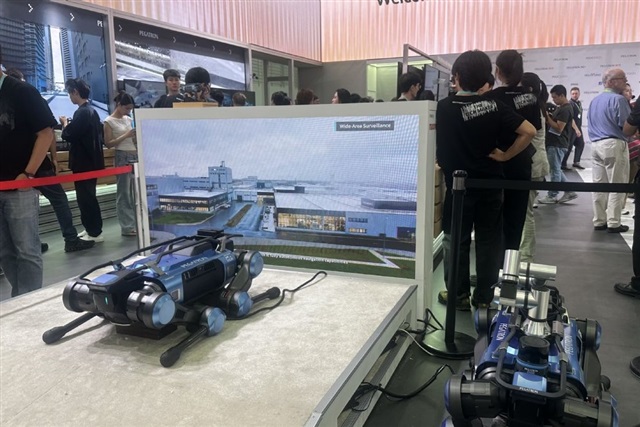
Pegatron Deepens Nvidia Partnership With Simba Robot Dog and Physical AI Push
Pegatron is broadening its collaboration with Nvidia beyond AI server manufacturing, moving into one of the fastest-growing areas of artificial intelligence: physical AI. The company is now exploring digital twins, robot simulation, and intelligent robotics, with its second-generation quadruped robot dog, Simba, serving as an early platform for testing and development.
The move highlights how major technology manufacturers are preparing for a future where AI is not limited to data centers, software platforms, and cloud services. Instead, artificial intelligence is increasingly being built into machines that can move, react, learn, and operate in real-world environments.
Pegatron has already been closely tied to the AI infrastructure boom through server production, a market that has grown rapidly as demand for generative AI, accelerated computing, and high-performance data centers continues to rise. By extending that relationship into robotics and simulation, the company is positioning itself for the next wave of AI adoption.
At the center of this effort is Simba, Pegatron’s second-generation robot dog. The quadruped robot is being used as a testbed for physical AI applications, allowing engineers to explore how advanced computing, sensors, simulation tools, and real-world robotic movement can work together.
Robot dogs have become an important development platform for companies working on autonomous systems. Their four-legged design allows them to navigate uneven terrain, climb obstacles, and operate in places where wheeled robots may struggle. This makes them useful for testing future applications in factories, logistics centers, inspection sites, emergency response, security, and smart industrial environments.
Pegatron’s focus on digital twins is also a key part of the strategy. A digital twin is a virtual version of a real-world system, machine, factory, or robot. By building accurate digital replicas, companies can test scenarios, improve designs, train AI models, and simulate robot behavior before deploying hardware in the real world.
This can reduce development costs, speed up testing, and improve safety. For robotics, simulation is especially important because physical testing can be slow, expensive, and risky. A robot can be trained in a virtual environment to handle different surfaces, obstacles, lighting conditions, and movement patterns before being tested in actual locations.
The connection with Nvidia is significant because the company’s platforms are widely used in AI computing, robotics simulation, and accelerated workloads. Pegatron’s expansion from AI servers into physical AI suggests that it sees robotics as a natural extension of the infrastructure it already helps build.
As AI continues to evolve, the industry is shifting from simply generating text, images, and code toward systems that can understand and interact with the physical world. This is where physical AI becomes important. It combines machine learning, robotics, computer vision, sensors, edge computing, and simulation to create machines that can operate with greater autonomy.
Pegatron’s Simba robot dog may still be an early test platform, but it represents a larger direction for the company. Rather than focusing only on supplying hardware for AI data centers, Pegatron is exploring how AI can be applied to machines that move through real environments and support industrial automation.
The robotics market is expected to become increasingly competitive as manufacturers, chip companies, and AI developers race to build smarter autonomous systems. Quadruped robots like Simba could play a role in this transition by helping companies test new software, improve robotic mobility, and develop practical use cases for intelligent machines.
Pegatron’s expanded work with Nvidia shows how the AI supply chain is changing. The future of artificial intelligence will not only depend on powerful servers and data centers, but also on robots, simulations, and digital environments that bring AI into the physical world. Simba is an early step in that direction, offering a glimpse of how Pegatron may participate in the next phase of intelligent robotics.