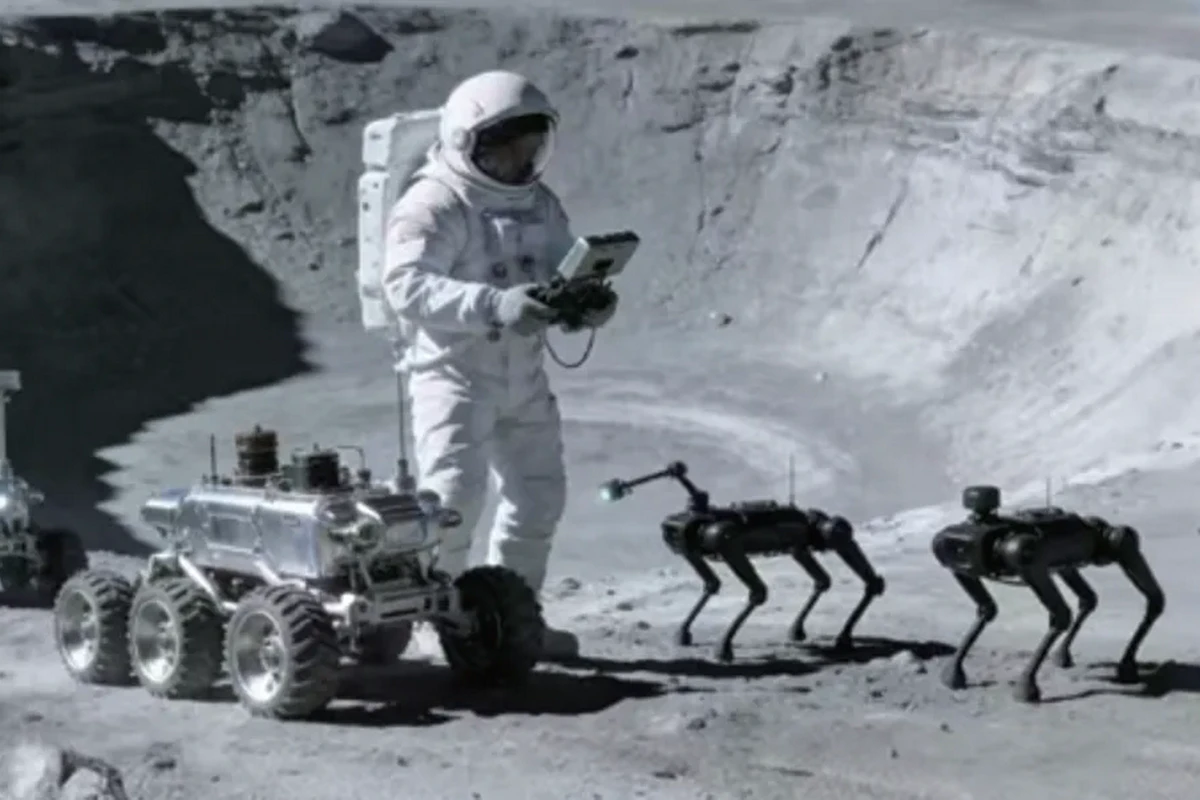
China Plans Robot Dogs for Future Moon Bases to Help Astronauts Mine Ice and Explore Lunar Terrain
China is looking beyond traditional rovers for its future Moon missions. Researchers are now proposing a new kind of lunar assistant: robot dogs designed to work alongside astronauts on the Moon’s surface.
These four-legged machines could become a key part of China’s future lunar base plans, helping crews explore dangerous terrain, collect samples, monitor habitats, build infrastructure, and search for valuable resources such as water ice. But their role may go further than physical labor. Chinese engineers also believe robotic companions could help astronauts cope with the loneliness and mental stress of spending long periods far from Earth.
The idea is part of a broader vision for future lunar bases where humans and autonomous machines share responsibilities. The Moon is an extremely difficult place to live and work. Astronauts must deal with low gravity, high radiation, sharp lunar dust, huge temperature changes, rough terrain, and delayed communication with Earth. Because of these challenges, relying only on human crews would be risky and inefficient.
Instead, researchers suggest a mixed team approach. Astronauts would focus on complex decisions, delicate scientific work, and unexpected problems, while robots would take on repetitive, dangerous, or physically demanding tasks.
In one proposed mission setup, three astronauts would work with two robot dogs during a lunar expedition. One astronaut would guide the robotic dogs as they move ahead of the crew, scanning the ground, checking for hazards, and mapping safe routes. Another astronaut would work directly outside, collecting lunar rocks and carrying out detailed surface operations. A third crew member would remain inside a pressurized vehicle or module, coordinating the mission and controlling additional robotic systems when needed.
Robot dogs could be especially useful on the Moon because four-legged designs are better suited for uneven surfaces than many wheeled vehicles. Lunar terrain can include rocks, slopes, loose dust, ledges, and shadowed areas near craters. A walking robot may be able to climb, balance, and adjust its movement more easily in areas where wheels might struggle.
The machines could also play an important role in using local lunar resources. Future Moon bases will likely need to rely on materials found on the Moon rather than bringing everything from Earth. Robot dogs and other robotic systems could help locate and extract water ice, process minerals, and support construction using lunar soil and rock.
Water ice is one of the most important targets for future Moon exploration. It could be used for drinking water, oxygen production, and even rocket fuel. This makes the Moon’s south pole, where permanently shadowed regions may preserve ice deposits, a major focus for upcoming lunar base plans.
Beyond exploration and mining, robots could help build and maintain the base itself. Researchers imagine machines preparing shelters, inspecting equipment, cleaning living areas, monitoring air quality, checking temperature levels, tending plants, and possibly assisting with food preparation. They could also help prepare lunar lava tubes, which are natural underground formations that may offer protection from radiation, micrometeorites, and extreme temperatures.
One of the more unusual ideas is giving robot dogs a social role. Long-duration missions on the Moon could be mentally exhausting for astronauts. Crews would live in confined spaces, separated from Earth by hundreds of thousands of kilometers, with limited real-time communication. A robotic companion able to communicate with astronauts could offer emotional support, reduce isolation, and make daily life more manageable.
To make this kind of human-robot teamwork possible, researchers propose a layered control system. Robots would need to sense their surroundings, process information, plan actions, and carry out tasks. Human involvement could vary depending on the situation. In some cases, astronauts might directly control a robot. In others, the robot could operate mostly on its own and only request help when it encounters something unusual or difficult.
This approach could make lunar missions safer and more efficient. If robot dogs can scout dangerous zones, carry supplies, inspect structures, and perform routine work, astronauts would have more time for scientific research and mission-critical decisions. It could also reduce the number of risky spacewalks and limit human exposure to radiation and dust.
China’s robot dog concept is tied to its long-term lunar ambitions. The country plans to establish an initial Moon base near the lunar south pole by around 2035. A later stage, expected to continue through 2045, could expand this into a larger lunar research network with surface facilities and orbital support.
If these plans move forward, future astronauts may not explore the Moon alone. Their companions could be intelligent, four-legged machines built to walk across alien terrain, mine ice, maintain habitats, and provide a little comfort in one of the most isolated places humans have ever lived.