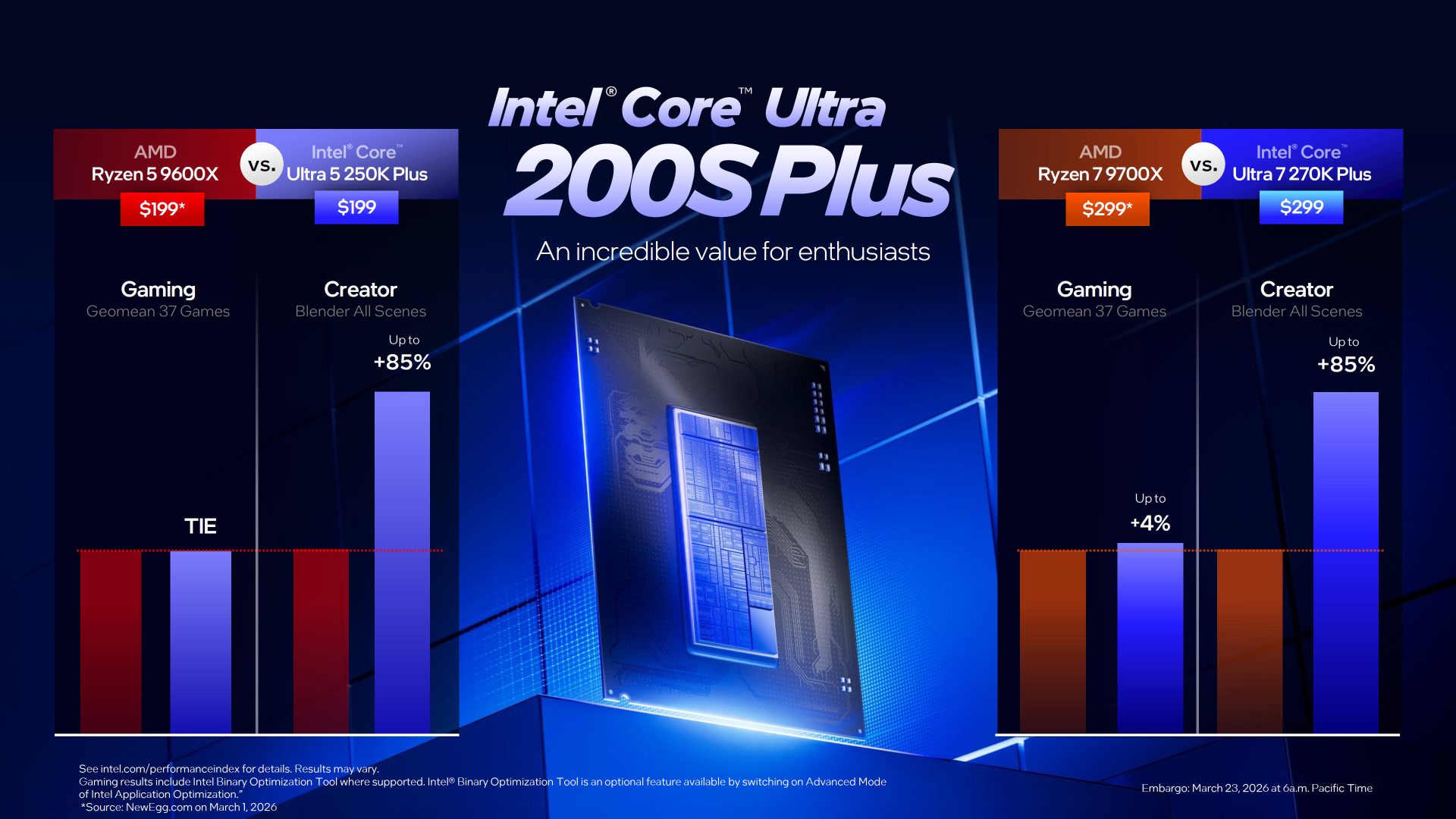
Intel is turning up the heat in the midrange CPU battle with newly shared official performance numbers for its Core Ultra 7 270K Plus and Core Ultra 5 250K Plus. According to the company’s benchmarks, these “Plus” chips don’t just refine the existing Core Ultra 200S lineup, they push Intel back into a stronger position for both gaming performance and heavily threaded creative work, all while keeping prices aimed squarely at AMD’s most popular Ryzen alternatives.
Intel’s message is clear: Core Ultra 200S Plus is now its fastest gaming CPU family to date, even edging past the previously top-tier Core i9-14900K in the results it published. For the head-to-head comparisons, Intel pairs the Core Ultra 7 270K Plus against the AMD Ryzen 7 9700X, and the Core Ultra 5 250K Plus against the Ryzen 5 9600X. Those matchups make sense based on pricing, and Intel also includes comparisons versus its own earlier Core Ultra “non-Plus” parts and 14th Gen chips to highlight generational gains.
Gaming performance: Core Ultra 7 270K Plus
In Intel’s 1080p gaming tests across a wide spread of titles, the Core Ultra 7 270K Plus delivers a notable uplift compared to the Core Ultra 7 265K. The company reports an average gain of 15%, with game-by-game results ranging from a modest 1% up to a sizeable 39% improvement. For a processor that sits in the same general class as its non-Plus counterpart, Intel is positioning this as a meaningful refresh for high-FPS gaming builds.
Against the Core i7-14700K, Intel reports the 270K Plus is 9% faster on average in gaming, with peak improvements reaching 33% in certain titles. More attention-grabbing is the comparison with the Core i9-14900K: Intel says the 270K Plus comes out 5% faster on average, with up to 25% higher FPS depending on the game. If those numbers translate broadly, it’s a strong claim considering Intel is placing the 270K Plus at $299.
Against AMD’s similarly priced Ryzen 7 9700X ($299), Intel reports an average 4% gaming advantage for the 270K Plus. While Intel acknowledges it loses in a few games, it says its peak lead can stretch to 23% in the most favorable cases.
Intel also includes a comparison to the more expensive Ryzen 7 9800X3D, often considered a top choice for pure gaming performance. That chip typically sells around $480, roughly 60% more than the 270K Plus in Intel’s pricing. Intel’s data indicates the 270K Plus is only about 12% behind on average in that matchup, which is meant to highlight value per dollar, even if AMD’s X3D processors still hold the crown for maximum gaming performance.
Gaming performance: Core Ultra 5 250K Plus
For the Core Ultra 5 250K Plus, Intel claims a 13% average gaming improvement versus the Core Ultra 5 245K. When compared with the Ryzen 5 9600X at the same $199 price point, Intel suggests gaming performance is broadly comparable. The bigger story, Intel argues, is what happens outside of games.
Application and creator performance: where “Plus” aims to separate itself
Intel’s published results lean heavily into multi-threaded workloads, and that’s where the Core Ultra 7 270K Plus and Core Ultra 5 250K Plus are positioned to stand out against similarly priced AMD chips. Intel claims up to 2x performance gains in multi-threaded tasks versus its Ryzen competitors, which it ties to higher core counts: Intel frames it as 24 cores versus 8 cores/16 threads in the 270K Plus vs 9700X comparison, and 18 cores versus 6 cores/12 threads in the 250K Plus vs 9600X comparison.
For the Core Ultra 7 270K Plus, Intel highlights strong results across workstation and creator workloads designed to use many cores. In SPECWorkstation, Intel says the 270K Plus leads the Ryzen 7 9700X by 50%, and it also claims wins in single-threaded work. Intel further states the 270K Plus can be up to 10% faster in content creation than the Ryzen 9 9950X, a chip that typically costs $500 or more, a comparison clearly intended to underline value rather than direct market positioning.
For the Core Ultra 5 250K Plus vs Ryzen 5 9600X, Intel provides a list of specific percentage advantages it says it achieves in common creator and productivity tasks:
103% faster multi-core performance
130% faster 3D rendering
5% faster single-thread performance
19% faster video editing
8% faster photo editing
75% faster video export
Key benchmark results (as shared by Intel)
Intel also publishes a table of benchmark scores and 1080p (High) gaming results. A few highlights from the numbers provided include:
Cinebench 2024 Multi-Core: 270K Plus 2515 vs 9700X 1307; 250K Plus 1872 vs 9600X 943
Geekbench 6.3 Multi-Core: 270K Plus 23966 vs 9700X 17020; 250K Plus 20643 vs 9600X 14672
PugetBench Premiere Pro overall: 270K Plus 15760 vs 9700X 7132; 250K Plus 21496 vs 9600X 12590
PugetBench Photoshop overall: 270K Plus 11478 vs 9700X 13562; 250K Plus 11298 vs 9600X 13050
On the gaming side (1080p High), Intel’s listed results include:
Cyberpunk 2077: 270K Plus 229 vs 9700X 219; 250K Plus 219 vs 9600X 207
Shadow of the Tomb Raider: 270K Plus 364 vs 9700X 296; 250K Plus 287 vs 9600X 289
Total War: Warhammer III (Mirrors of Madness): 270K Plus 171 vs 9700X 167; 250K Plus 165 vs 9600X 142
Final Fantasy XIV: Dawntrail Benchmark: 270K Plus 281 vs 9700X 281; 250K Plus 244 vs 9600X 286
Pricing, platform choices, and the upgrade question
Intel sets the Core Ultra 7 270K Plus at $299 and the Core Ultra 5 250K Plus at $199, putting them directly against the Ryzen 7 9700X and Ryzen 5 9600X at the same respective prices. Based on Intel’s own data, the pitch is that you can get similar or better gaming performance while gaining a large advantage in multi-threaded workloads, which could be especially appealing for streamers, editors, and creators who want one PC to handle both play and production.
There is, however, a practical platform concern. Intel points to improvements on its LGA 1851 platform, but the larger issue is timing: the socket is expected to be replaced later this year. That makes the decision more complicated for new builders weighing long-term upgrade paths. AMD’s AM5 platform has public support commitments extending through 2027 and beyond, while choosing Intel here could mean a motherboard change again if you plan to upgrade beyond the Core Ultra 200S and 200S Plus generation.
For current LGA 1851 owners, Intel’s own positioning suggests the upgrade appeal is strongest for those coming from lower-tier or non-K parts, rather than people already using a closely related non-Plus K-class CPU.
Release timing
Intel says Core Ultra 200S Plus CPUs arrive at retailers on March 26, with new motherboards launching in the coming months.
If you want, I can rewrite this again in a more “buyer guide” tone (who should buy 270K Plus vs 250K Plus, and who should stick with Ryzen), while keeping the same facts and avoiding any banned terms and links.