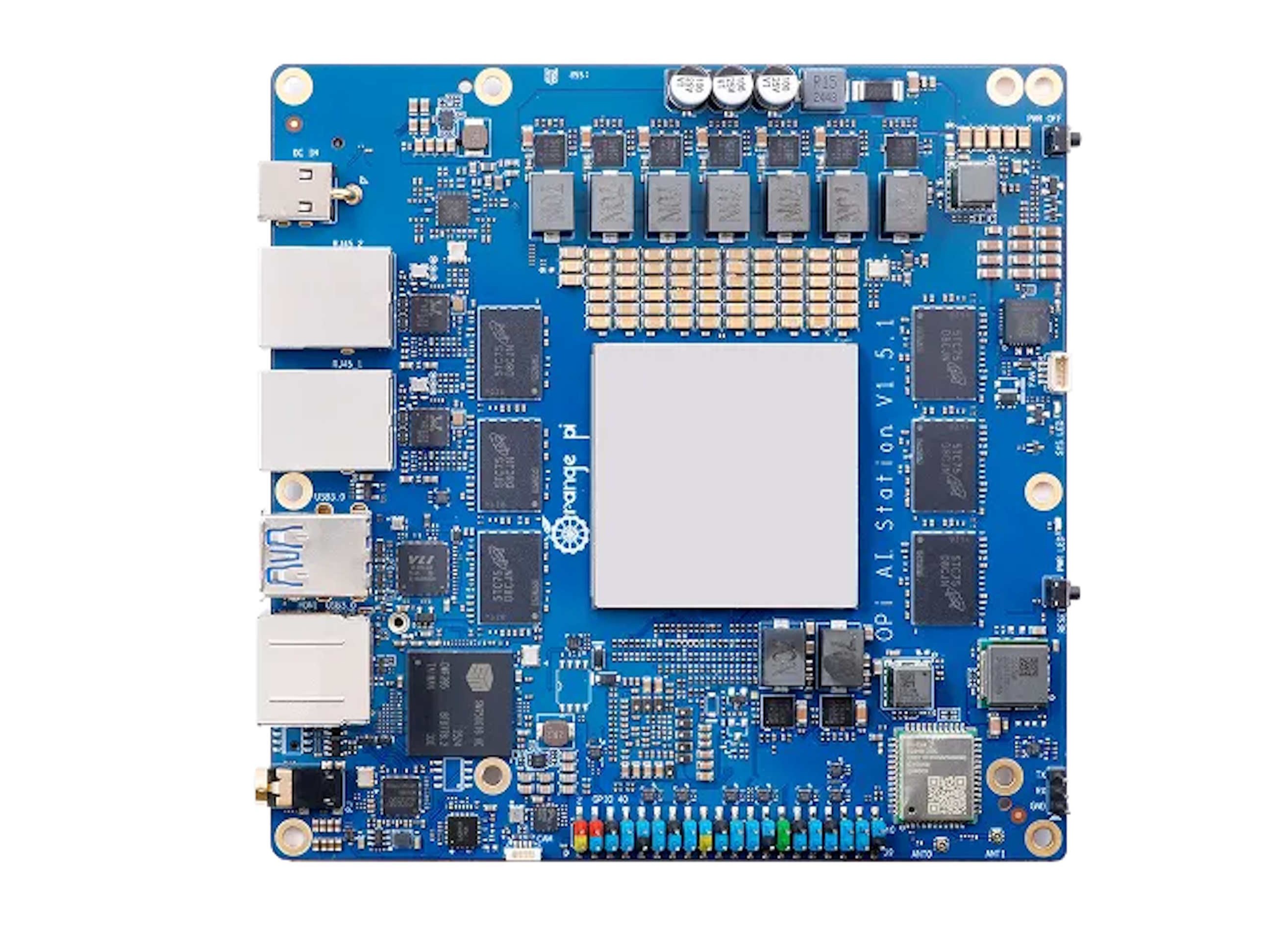
Orange Pi has unveiled a new single-board computer built with one clear goal in mind: running demanding AI workloads locally, without relying on the cloud. Called the Orange Pi AI Station, the device is described by the company as a mini PC platform, but in practical terms it’s an SBC designed for DIY builders, developers, and anyone creating custom automation or AI-driven projects.
Rather than being a plug-and-play consumer computer, the AI Station is meant to serve as a foundation. You bring the project idea—anything from computer vision to smart monitoring—and the board provides the compute, connectivity, and expansion options to make it real. The included software direction is also developer-friendly, as the system is designed to run openEuler 22.03.
At the heart of the Orange Pi AI Station is a Huawei Ascend 310 system-on-chip. It combines a neural processing unit with 10 AI cores, alongside 16 CPU cores clocked at up to 1.9GHz and 8 vector cores for acceleration. Orange Pi is positioning this board heavily around AI performance, advertising up to 176 TOPS. That figure signals the target audience: edge AI use cases where fast local processing matters, such as real-time image analysis. One example scenario is live video monitoring that can identify risky zones in crowded areas quickly—without sending footage off-device.
Memory and storage options also reflect the board’s workstation-like ambitions. Depending on configuration, the AI Station offers 48GB or 96GB of LPDDR4X RAM, which is unusually high for an SBC class product and helpful for large AI models or heavier multi-tasking. For storage, it supports up to 256GB of onboard eMMC, plus microSD card expansion and PCIe-based SSD support—meaning you can attach an M.2 SSD for faster performance and higher capacity compared to typical SBC storage setups.
Connectivity is another strong point. The board includes two Gigabit Ethernet ports for reliable wired networking, as well as built-in WiFi for flexible deployment. For display output, HDMI supports Full HD (1080p) at 60fps, making it suitable for local dashboards, monitoring screens, or UI-driven development work. There’s also support for active cooling via an installable fan, which is especially relevant when running sustained AI workloads.
To make the AI Station useful beyond pure computing, Orange Pi includes a 40-pin GPIO header—an important feature for robotics, industrial control, and smart sensor builds. With GPIO, the board can interface with external sensors, triggers, and actuators, letting you do things like drive a motor, activate an alarm, or build automated responses based on AI detection results.
Orange Pi hasn’t shared official pricing or a release date yet. Still, based on its specifications—Ascend 310 AI hardware, up to 96GB RAM, PCIe SSD support, dual Gigabit Ethernet, and GPIO expansion—the Orange Pi AI Station looks positioned as a powerful edge AI development platform for creators who want local inference, faster response times, and more control over data privacy.