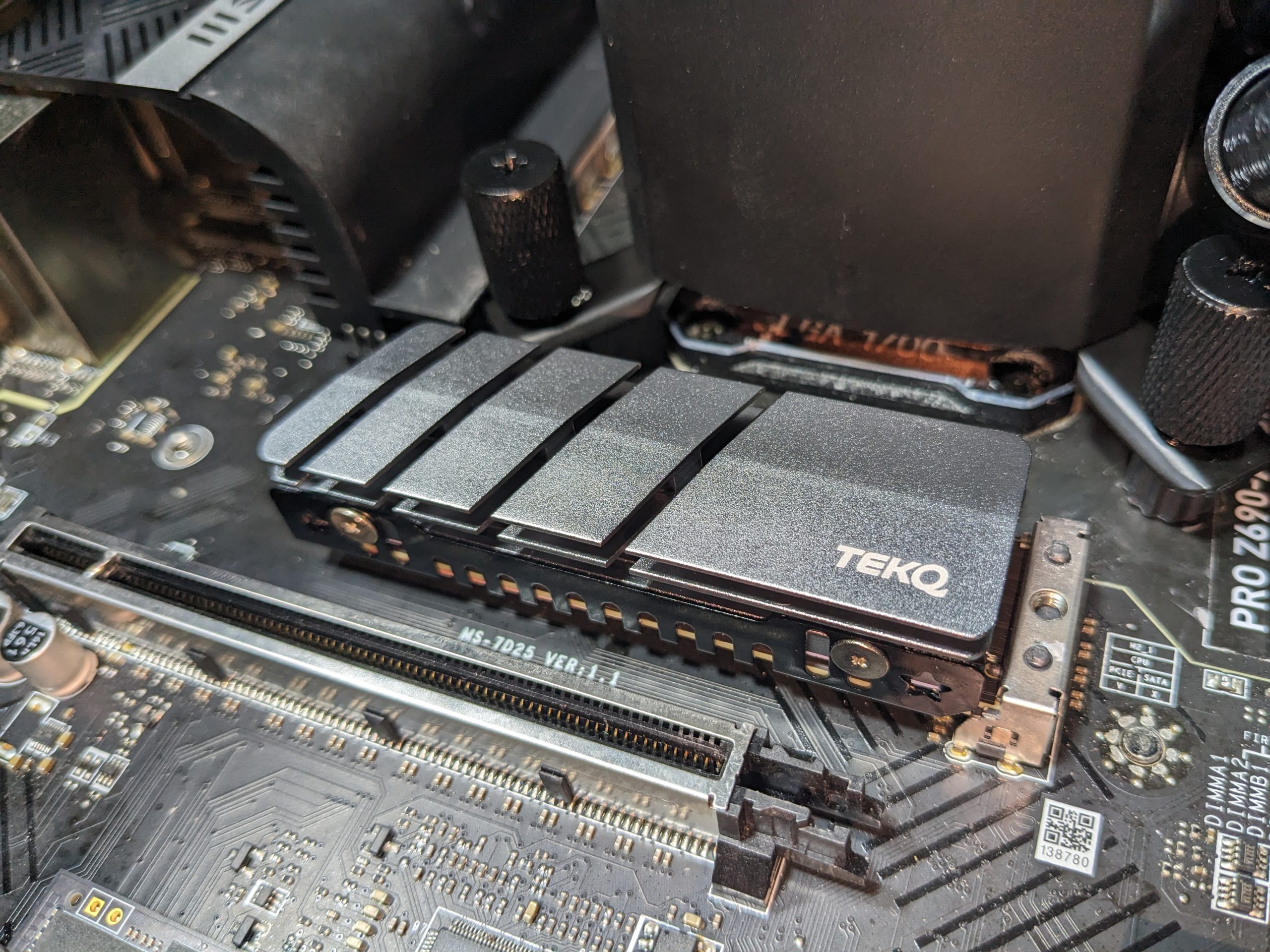
Maintaining proper temperatures for NVMe drives has become critical, especially with the advent of cutting-edge PCI-e Gen 5 SSDs that tend to run hotter than their predecessors. Overheating can lead to thermal throttling, which inhibits performance. The Phison E26 controller, found in many current PCI-e 5 SSDs, has a TJ Max of 125°C. To combat these high temperatures, a range of m.2 heatsinks with varying sizes and cooling capabilities have entered the market.
If your SSD comes with a pre-installed heatsink, it’s likely that it will suffice for general use unless it is of particularly low quality. Aftermarket heatsinks often provide aesthetic enhancements rather than substantial performance gains.
Users of PCI-e 5 devices will undoubtedly need efficient heat dissipation to prevent performance loss. A popular choice for the average user is Iceberg Thermal’s IceFLOE SSD heatsink. Priced attractively, its slim design ensures compatibility with other components, and it offers adequate cooling for normal usage conditions without breaking the bank.
For professionals dealing with storage-heavy tasks, a sturdier heatsink like Thermalright’s HR-10 Pro, with its active cooling fan and moderate height, can be very effective at maintaining optimal SSD temperatures. Despite its high performance, it remains reasonably priced.
For those seeking unsurpassed cooling efficiency, Jiushark’s M.2-Three stands out, although its larger size might pose installation challenges in some setups. It is especially beneficial for high-performance configurations, and while its availability is somewhat limited outside Asia, it can be imported at a competitive price point.
An alternative choice for those needing strong passive cooling is the Acidalie VB01, which features copper heatpipes and a small finned radiator. It’s designed to fit with most graphics cards on the market, except for some of the bulkier models.
TeamGroup offers a unique solution for those looking for an all-in-one (AIO) cooling system that caters to both the CPU and SSD. Although innovative, this dual-block AIO setup comes with a premium price tag and is not widely available.
When considering the various cooling options for your NVMe drive, it is important to assess your usage scenarios and balance the trade-offs between performance, compatibility, aesthetics, and cost. By choosing the appropriate cooling solution, you can ensure your SSD operates within optimal temperatures, thus extending its lifespan and maintaining peak performance.