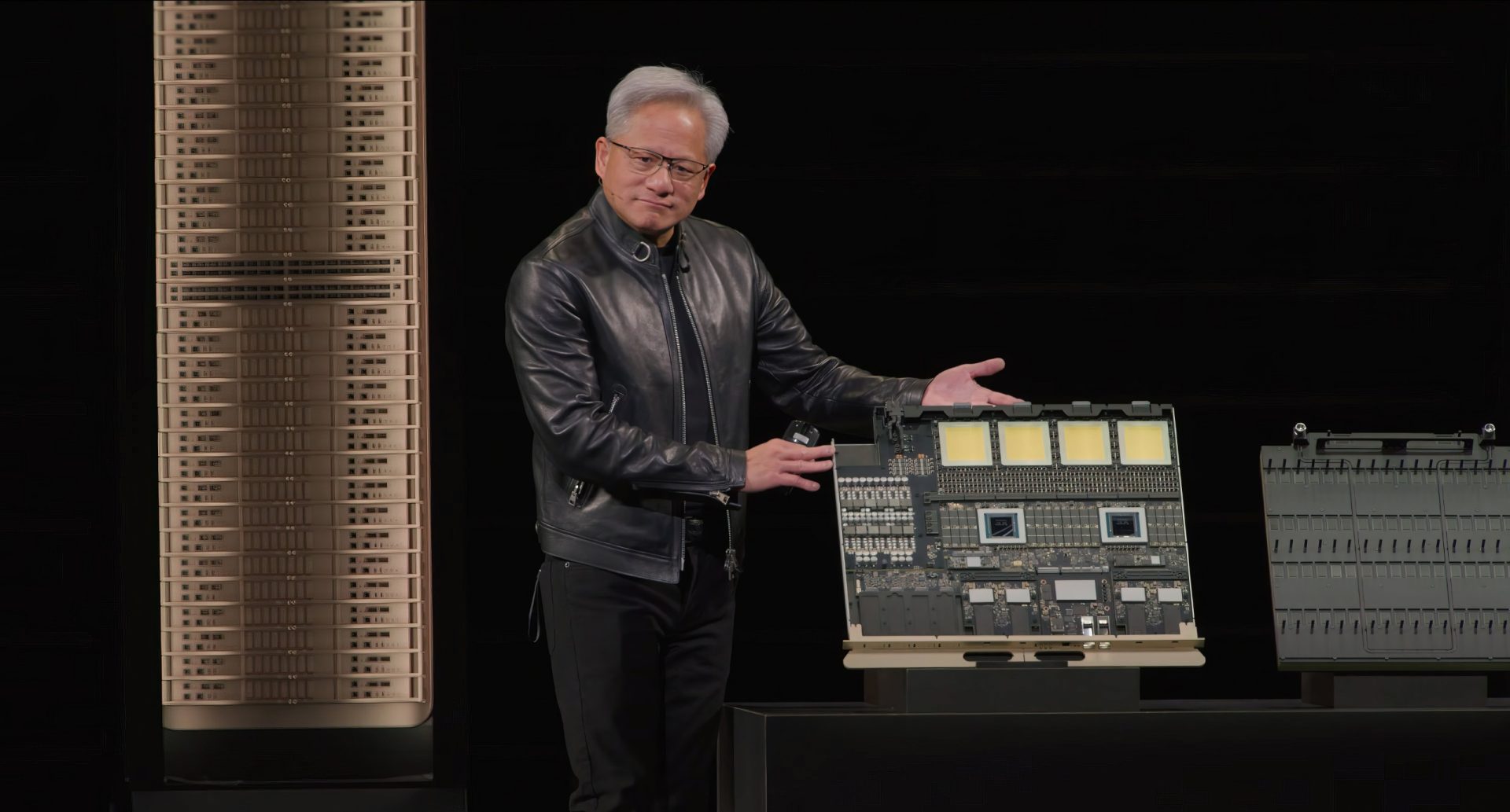
NVIDIA Rubin Ultra NVL576: A 576-GPU AI Rack Built to Behave Like One Giant GPU
NVIDIA is preparing a major leap in AI computing with Rubin Ultra, a next-generation GPU platform designed to scale far beyond today’s rack-level systems. The centerpiece is Rubin Ultra NVL576, a massive liquid-cooled rack solution that connects 576 GPUs through advanced NVLink and co-packaged optics, also known as CPO.
The goal is ambitious: make hundreds of GPUs inside a rack work together as one enormous accelerator, delivering extreme AI performance with industry-leading performance per watt.
Rubin Ultra follows the standard Rubin platform and pushes NVIDIA’s rack-scale architecture into a much larger class. While the Vera Rubin VR200 systems use Oberon NVL72 servers, Vera Rubin Ultra is designed around a larger Kyber rack. This rack is fully liquid-cooled and built to support the massive power, memory, and networking demands of future AI workloads.
According to NVIDIA’s official specifications, Rubin Ultra NVL576 is expected to deliver up to 15 exaflops of FP4 inference performance and 5 exaflops of FP8 training performance. Compared with Blackwell GB300 NVL72, that represents a performance increase of up to 14 times, showing just how aggressively NVIDIA is scaling its AI infrastructure roadmap.
Memory is another major upgrade. Rubin Ultra is expected to feature up to 1 TB of HBM4E memory across a large 4-reticle GPU design. At the rack level, this scales to roughly 365 TB of HBM memory and up to 4.6 PB/s of memory bandwidth. For AI training and inference, where memory capacity and bandwidth are critical, this is a huge step forward.
The platform also introduces NVIDIA’s next-generation NVLink7 interconnect, offering up to 1.5 PB/s of bandwidth. Alongside that, NVIDIA is preparing a new ConnectX-9 Spectrum chip capable of 115.2 TB/s, further strengthening the networking backbone needed for massive AI clusters.
One of the most important details revealed about Rubin Ultra is that all 576 GPUs in the Kyber rack will be connected using NVLink. Instead of acting like a loose group of individual accelerators, the system is being designed to function as one unified GPU resource. NVIDIA says this will make Rubin Ultra one of the fastest and most efficient rack-scale AI systems ever built.
The design includes a Vera Rubin Ultra compute tray that contains two Rubin Ultra GPUs and one Vera CPU, all cooled with liquid cooling. NVIDIA has also shown its next-generation NVLink 7 CPO switch tray, a key component that enables high-speed optical connections across the rack.
CPO is central to Rubin Ultra’s design. Co-packaged optics move optical networking closer to the compute hardware, helping reduce latency, improve bandwidth, and increase energy efficiency. As AI systems grow larger, traditional electrical interconnects become harder to scale efficiently. NVIDIA appears to be betting heavily on optical connectivity as the future of AI data center networking.
The Rubin Ultra NVL576 platform is also based on OCP standards, which should make deployment and maintenance easier for large-scale data centers. NVIDIA says the system builds on the modular, plug-in style design introduced with Vera Rubin, reducing installation time from hours to minutes. For hyperscale AI operators, that kind of simplification can make a major difference when deploying thousands of GPUs.
NVIDIA’s Ian Buck, Vice President and General Manager of Hyperscale and High-Performance Computing, described Rubin Ultra as a system where 576 GPUs are connected with NVLink through next-generation CPO networking. He said the platform is being built to support AI models with around 10 trillion parameters, a scale that will require enormous compute density, memory bandwidth, and networking performance.
The timing is also important. NVIDIA has stated that CPO racks are moving into volume production, signaling that optical interconnect technology is no longer just experimental. Rubin Ultra is expected to be one of the first major rack-level AI platforms to fully exploit this technology, potentially setting a new standard for future AI infrastructure.
Rubin Ultra NVL576 is aimed at the most demanding AI workloads, especially next-generation large language models and multimodal AI systems with 10 trillion or more parameters. Training and running models at that size requires enormous capital investment, but NVIDIA is trying to reduce complexity by offering reference designs that can shorten deployment timelines. Its DSX Pod concept, for example, is intended to reduce deployment time from months to as little as 14 days.
In simple terms, NVIDIA Rubin Ultra is not just another GPU upgrade. It represents a shift toward treating an entire rack as a single computing engine. With 576 GPUs, huge HBM4E memory capacity, next-generation NVLink, CPO optical networking, and a fully liquid-cooled OCP-based design, Rubin Ultra is built for the next era of artificial intelligence.
If NVIDIA delivers on its roadmap, Rubin Ultra could become the foundation for the world’s most advanced AI data centers, giving researchers and cloud providers the performance, efficiency, and scalability needed to build models far larger than anything widely deployed today.