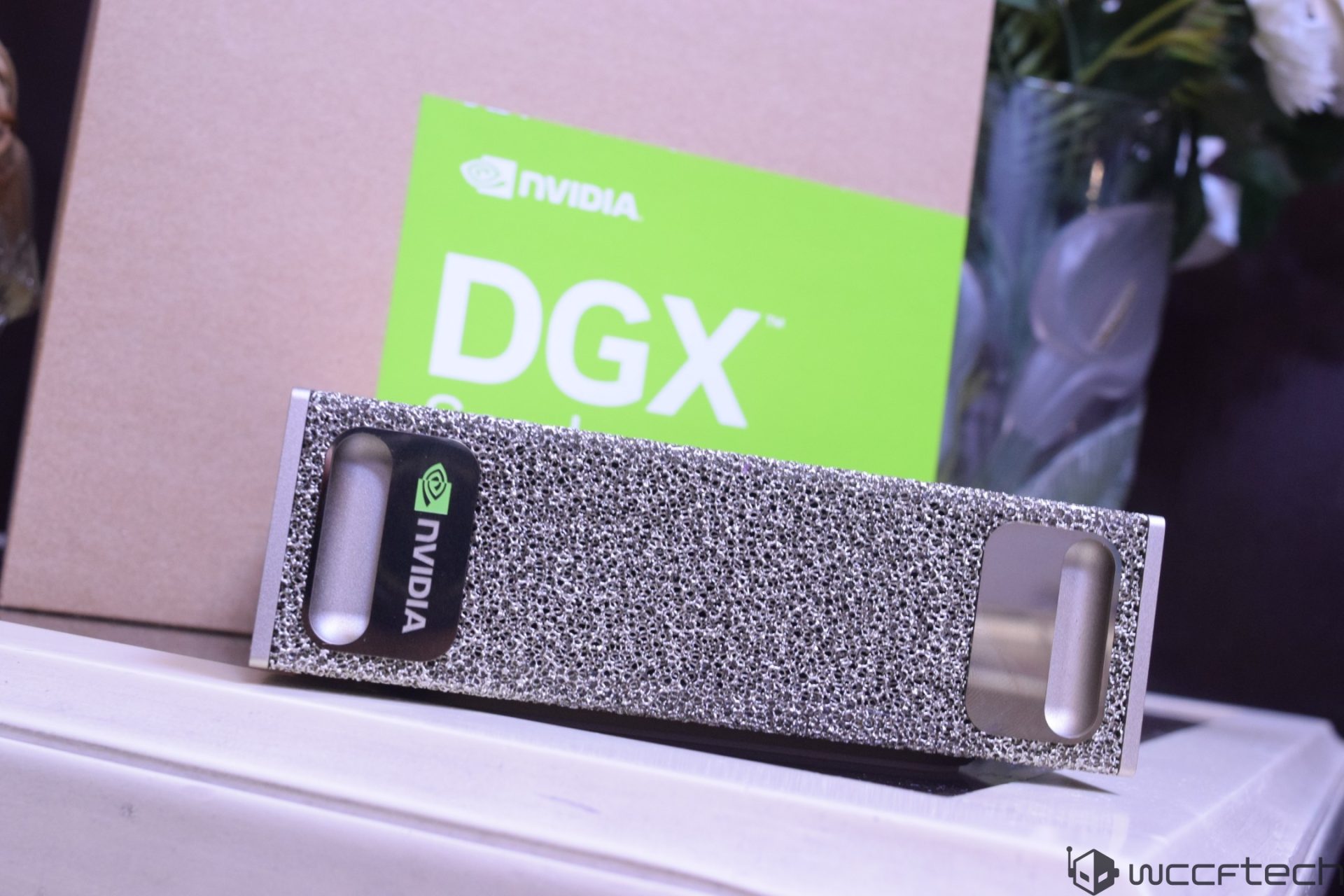
NVIDIA is preparing to launch a new 64GB version of its DGX Spark AI supercomputer, giving developers and AI enthusiasts another configuration of the compact machine. However, the biggest surprise is the price: the new model is expected to arrive at the same $4,999 price point that was previously associated with the 128GB version.
The move comes as memory and component costs continue to rise across the industry. The original NVIDIA DGX Spark launched at $3,999, but pricing has steadily increased in recent weeks, with listings moving to $4,699 and then $4,999. Now, instead of keeping the 128GB model at that level, NVIDIA is introducing a 64GB variant to occupy the $4,999 tier, while the 128GB model is expected to become even more expensive.
The NVIDIA DGX Spark is designed as a compact AI supercomputer for developers, researchers, and advanced users working with generative AI, large language models, and other demanding AI workloads. Despite its small size, the system is built around NVIDIA’s AI software ecosystem and ships with DGX OS and the NVIDIA AI software stack ready to use from day one.
The new 64GB DGX Spark will be offered through major PC partners, including Acer, ASUS, Dell, Gigabyte, HP, and MSI. Availability is expected to begin on October 23.
Aside from the reduction in unified memory, the 64GB DGX Spark is expected to retain the same core specifications as the higher-memory model. That means users will still get the same compact AI-focused platform, along with support for clustering multiple DGX Spark units together for additional performance and memory capacity.
One of the most important features of the DGX Spark is its ability to scale. Each system includes a built-in ConnectX-7 network interface card, allowing two or more DGX Spark machines to be connected directly using a QSFP cable. This makes it possible to create small AI clusters without requiring a large data center setup.
When multiple DGX Spark systems are connected, users can pool unified memory and expand the system’s ability to work with larger AI models. NVIDIA says this clustering capability can help support workloads involving AI models with more than 200 billion parameters. For developers experimenting with large language models, this could be a major advantage over traditional standalone workstations.
NVIDIA also provides setup guidance through playbooks that walk users through the process of connecting DGX Spark systems together. The company’s Sync Cluster assistant is designed to simplify configuration further, making clustering more approachable for users who want more performance without building a full-scale server environment.
According to NVIDIA’s performance claims, connecting just two DGX Spark systems can deliver up to a 1.7x performance improvement while doubling memory bandwidth. For AI development, model fine-tuning, inference, and research workloads, that kind of scaling could make the DGX Spark attractive to teams that need flexibility in a compact form factor.
Still, the pricing situation makes the new DGX Spark lineup more complicated. At $4,999 for the 64GB version, NVIDIA’s compact AI system now faces stronger competition from AMD Ryzen AI Halo and Ryzen AI Max platforms, which are currently available in the roughly $3,500 to $4,500 range depending on configuration.
The comparison becomes even more interesting when looking at memory capacity. The 128GB DGX Spark is already being seen at prices above $6,000, while some 192GB AMD Ryzen AI Halo systems are starting at around $6,500. Meanwhile, 128GB Ryzen AI-based systems can be found around $4,699. For users working with larger local AI models, higher unified memory capacity can be a deciding factor, since larger LLMs often require more memory to run efficiently.
That puts NVIDIA in a challenging position. The DGX Spark benefits from NVIDIA’s mature CUDA ecosystem, which remains one of the strongest software advantages in AI computing. CUDA support is widely used across machine learning frameworks, development tools, and production AI workflows, making NVIDIA hardware an easy choice for many developers.
AMD’s competing platforms, however, offer their own strengths. Ryzen AI Halo and Ryzen AI Max systems provide high memory configurations at competitive prices, and AMD’s ROCm software stack continues to improve for AI workloads. These systems also support both Windows and Linux, giving users flexibility depending on their preferred development environment.
For now, AMD-based AI PCs may offer stronger value in terms of memory per dollar, especially for users focused on running larger models locally. However, NVIDIA’s DGX Spark remains appealing for those who want CUDA support, a ready-to-use AI software stack, and the ability to cluster multiple systems together for greater performance and memory pooling.
The new 64GB NVIDIA DGX Spark makes the lineup more accessible in terms of configuration, but not necessarily in terms of price. With memory costs climbing and AI hardware demand continuing to grow, buyers may need to weigh software support, memory capacity, scalability, and long-term workload needs more carefully than ever.
For developers, researchers, and AI enthusiasts, the DGX Spark still represents a powerful compact AI supercomputer. But with the 64GB model arriving at $4,999 and the 128GB version moving higher, the competition in the local AI workstation market is becoming much more intense.