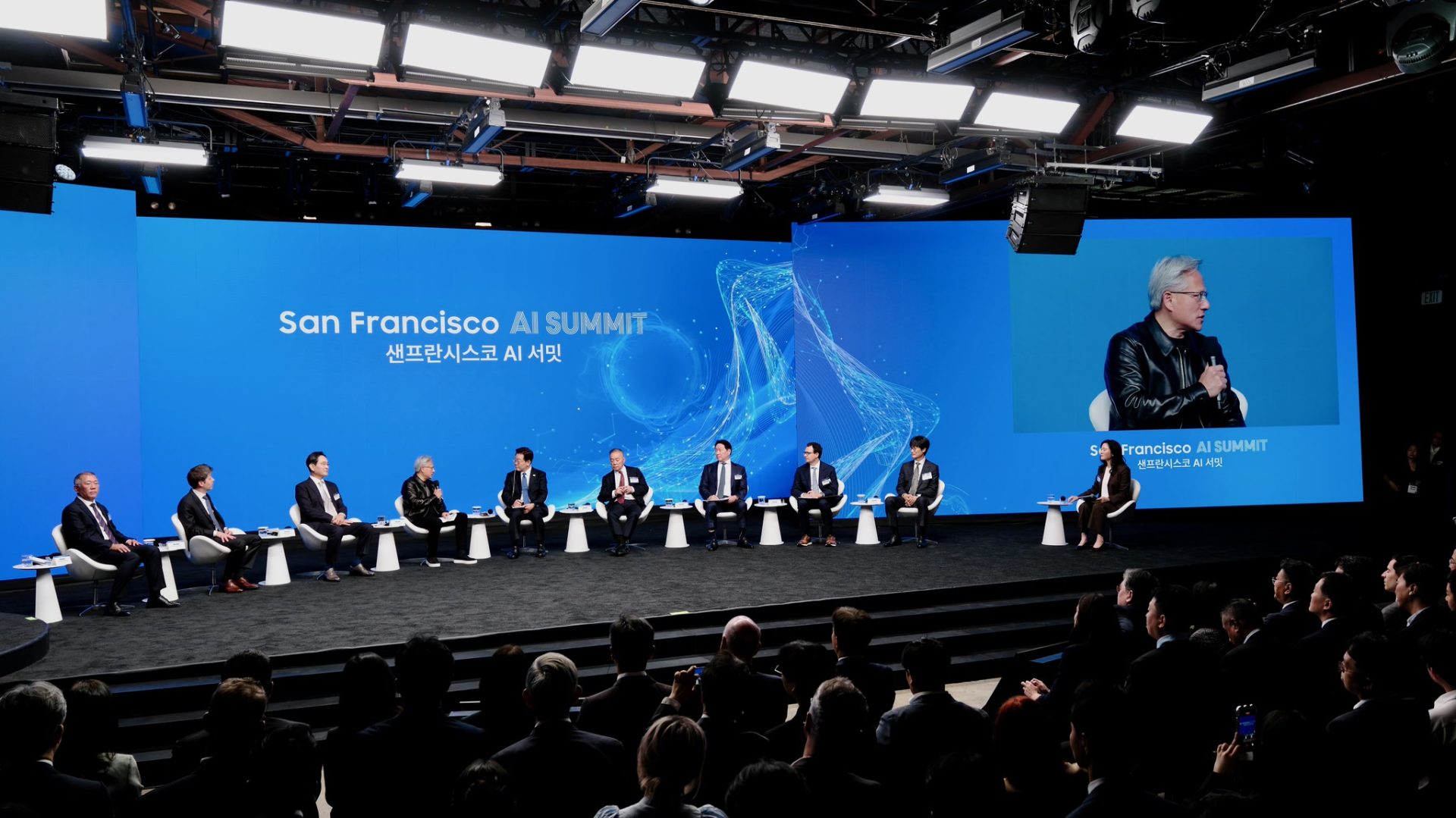
South Korea’s San Francisco AI Summit Delivers Major Deals for NVIDIA, Samsung, SK hynix, Broadcom and Naver
South Korea’s push to become a global artificial intelligence powerhouse gained major momentum in San Francisco, where President Lee Jae-myung led a high-profile AI summit that quickly turned into a major deal-making event for the semiconductor and cloud computing industries.
Within just a few hours, companies at the summit announced long-term agreements and memorandums of understanding valued at roughly $750 billion. The deals centered on some of the most important building blocks of the AI boom: advanced memory chips, cutting-edge foundry technology, high-performance data centers, AI accelerators and next-generation packaging.
The event brought together some of the biggest names in technology and manufacturing, including NVIDIA, Broadcom, Microsoft, Samsung, SK hynix, Hyundai Motor and Naver. Beyond the formal agreements, the summit also highlighted South Korea’s ambition to deepen its role in the global AI supply chain at a time when demand for chips, memory and data center capacity continues to surge.
One of the most significant developments involved NVIDIA and SK hynix. Under the agreement, NVIDIA will receive an opportunity to co-develop SK hynix’s next-generation high-bandwidth memory, commonly known as HBM.
HBM has become one of the most critical components in the AI hardware market. It is used alongside powerful AI processors to handle the massive data movement required for training and running advanced AI models. As demand for AI servers rises, securing stable HBM supply has become a top priority for companies building AI infrastructure.
For NVIDIA, closer cooperation with SK hynix could help reduce supply pressure in one of the industry’s biggest bottleneck areas. For SK hynix, the partnership strengthens its position as one of the leading memory suppliers for the AI era.
NVIDIA is also expected to support SK Telecom, an affiliate within the same broader corporate ecosystem as SK hynix, in the development of a massive 2-gigawatt AI data center. The project is expected to use NVIDIA’s upcoming Vera Rubin systems, which are designed for high-performance AI computing workloads.
The data center agreement could be worth as much as $500 billion over the long term, making it one of the largest AI infrastructure-related commitments discussed at the summit. If completed as envisioned, the project would significantly expand South Korea’s ability to host and operate large-scale AI workloads.
Naver, one of South Korea’s most important internet and cloud companies, also emerged as a major participant. NVIDIA announced plans to invest $1 billion in Naver as the company continues building AI data centers powered by NVIDIA GPUs.
The investment supports Naver’s broader strategy to strengthen its cloud and AI computing capabilities. As companies across Asia and beyond look for more regional AI infrastructure options, Naver’s expansion could help South Korea become a more competitive hub for cloud-based AI services.
Samsung and Broadcom also signed a major memorandum of understanding valued at around $200 billion. The agreement is designed to expand their strategic collaboration across memory and foundry technologies, with a focus on next-generation AI infrastructure.
The partnership runs through 2030 and centers on Samsung’s 2-nanometer and more advanced chip manufacturing processes. Broadcom is expected to use these technologies for several product categories, including wireless broadband communications solutions.
The collaboration may also extend into advanced chip packaging technologies based on Samsung’s 2nm process. These include 2.3D and 2.5D integration methods, which are increasingly important for building faster, more efficient AI and networking chips. Advanced packaging allows multiple chip components to work together more effectively, improving performance while reducing power consumption.
For Samsung, the agreement strengthens its position in the competitive foundry market, where companies are racing to provide the manufacturing technology needed for AI processors, networking chips and custom silicon. For Broadcom, the deal offers access to advanced production and packaging capabilities that could support future AI and connectivity products.
The summit aligns closely with President Lee Jae-myung’s broader goal of sharply expanding South Korea’s semiconductor capacity by 2030. Lee has called for the country’s memory production capacity to double, arguing that South Korea must move quickly to maintain leadership as AI reshapes the global chip industry.
Samsung and SK hynix are already investing in large new fabrication facilities across the country. Samsung’s P5 Fab 1 is expected to begin operations by July 2027, while P5 Fab 2 and another facility in Yongin are scheduled to start production by 2029.
SK hynix is also expanding aggressively. Its Yongin Y1 fab is expected to come online in February 2027, followed by the Y2 facility in the second half of 2028. These projects are expected to play a central role in increasing South Korea’s output of advanced memory and other high-value semiconductor products.
After the summit, the South Korean government hosted a dinner attended by executives and representatives from NVIDIA, Broadcom, Microsoft, Samsung, SK hynix, Hyundai Motor and Naver. President Lee reportedly described the group as “family,” underscoring the cooperative tone South Korea wants to project as it courts global technology leaders.
The evening also included a lighter moment when NVIDIA chief Jensen Huang asked for “one more beer.” President Lee joked that the South Korean government official handling the bill would not approve it, adding a humorous note to an otherwise business-heavy event.
The San Francisco AI summit made one message clear: South Korea wants to be at the center of the next phase of artificial intelligence growth. With major agreements involving AI chips, HBM memory, foundry technology, advanced packaging and data center infrastructure, the country is positioning itself as a key partner for the world’s largest technology companies.
As AI demand continues to accelerate, South Korea’s combination of memory leadership, manufacturing capacity and government-backed industrial strategy could make it one of the most important players in the global AI infrastructure race.