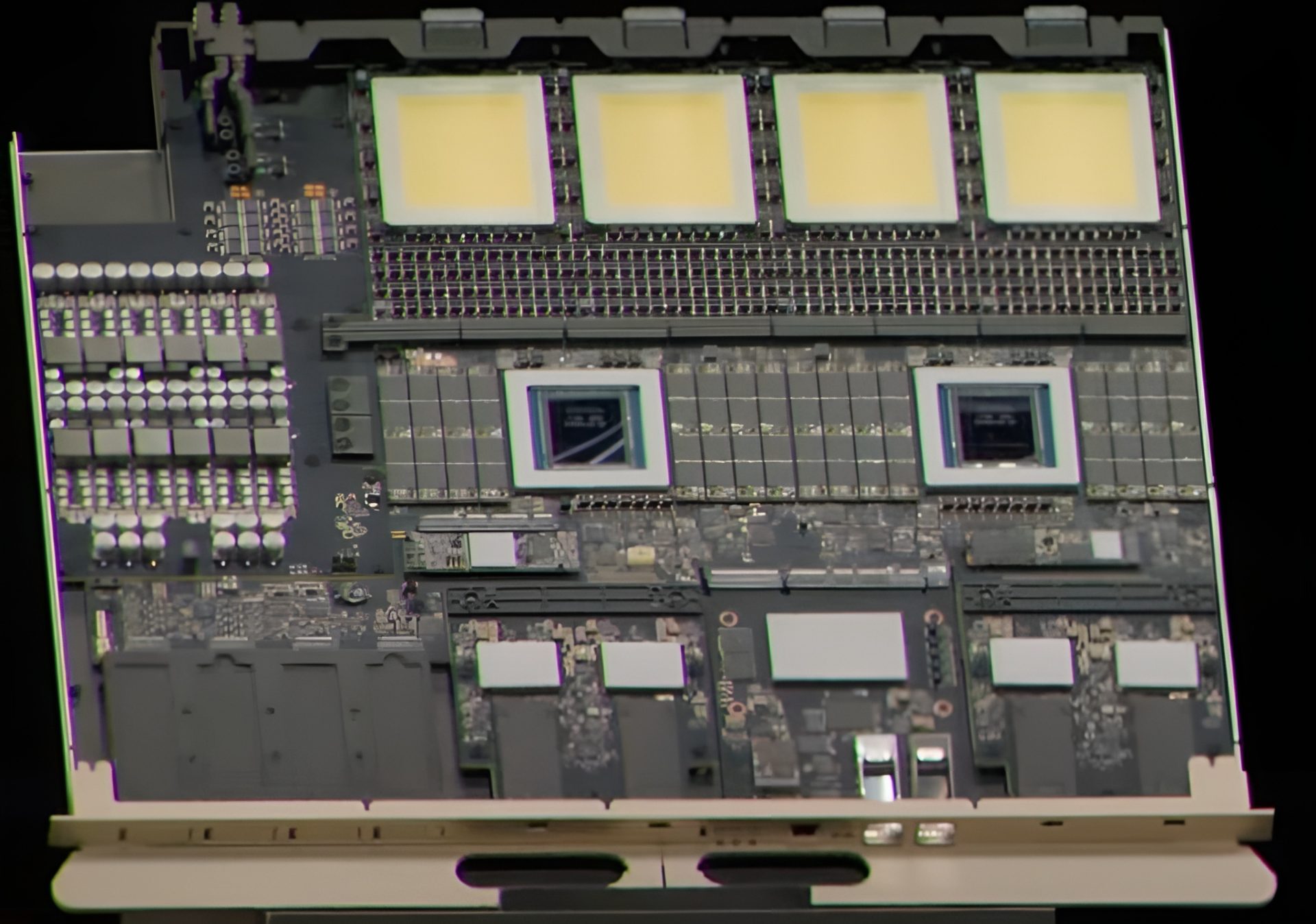
NVIDIA’s next-generation Rubin Ultra GPU is reportedly getting a major design rethink, with the company aiming to reduce supply chain headaches and improve manufacturability while keeping performance targets intact.
Instead of placing four GPU dies into a single massive package as previously expected, the latest reports from Taiwanese sources say NVIDIA is shifting Rubin Ultra toward a more practical approach: a dual-die package strategy paired with board-level scaling. In other words, Rubin Ultra may no longer be a “four dies in one package” monster. The four-die total still happens, just not in the way many anticipated.
If you’ve been following NVIDIA’s recent pace, this move fits a familiar pattern. NVIDIA may talk about annual cycles publicly, but partners in the supply chain often work on tighter timelines—closer to eight to ten months—making overly complex packaging choices harder to execute reliably at scale. Historically, NVIDIA tends to avoid changes that introduce large manufacturing overhead unless the payoff is worth the risk.
Why the change? The original concept for Rubin Ultra sounded ambitious: four reticle-sized GPU dies, 16 HBM4 memory stacks reaching up to 1TB total capacity, and advanced CoWoS-L packaging. That kind of ultra-dense integration can create real-world production problems. Larger, heavier, more complex packages raise the risk of thermal and structural stress. Warping is one concern often associated with large multi-die packages, and even small mechanical issues can translate into poor yields, higher costs, and slower ramp to volume.
Industry analysts suggest this is less about a downgrade and more about a reconfiguration—moving from extremely tight package-level integration to a design that achieves the same effective scaling through board-level assembly.
According to the reporting, compute performance is not expected to drop. The idea is that NVIDIA will still deliver the logical equivalent of a four-die Rubin Ultra setup by deploying the GPUs in a 2+2 configuration on a rack-level board. That means the total compute and HBM4 capacity should remain aligned with earlier expectations, but implemented in a way that’s easier for manufacturing partners to build consistently.
One detail mentioned is that a single Kyber blade would include four Rubin Ultra GPU dies, just not fused into one oversized package. This approach could make it far easier for the supply chain to adapt, while also reducing the yield risks that come with pushing packaging size and complexity to the extreme.
For now, the end specifications reportedly remain the same despite the change in how the dies are arranged. The big unanswered questions are practical ones: how NVIDIA will manage the physical footprint of such large GPU components on the board, and how it will handle thermals when shifting more of the scaling challenge from packaging to rack board design.
If the reports hold true, Rubin Ultra may end up as a strong example of NVIDIA optimizing for real-world production at scale—delivering high performance without forcing the entire ecosystem to wrestle with an ultra-complicated, high-risk package.