### Nvidia G-Sync is Set to Become More Accessible and Affordable Through MediaTek Partnership
In 2013, Nvidia launched their revolutionary G-Sync technology to enhance gaming experiences by eliminating screen tearing, stutter, and input lag. This innovation worked by matching a GPU’s output frames per second to a monitor’s refresh rate, creating smooth visuals for gamers. Originally requiring a high-tier GPU like the GeForce GTX 650 Ti, along with a dedicated G-Sync module within the monitor, this technology represented a significant advance but also came with a premium price.
Fast-forward to today, and many high-end desktop and laptop displays incorporate the G-Sync module. In an attempt to expand the reach of G-Sync, Nvidia also started certifying certain AMD FreeSync monitors as “G-Sync compatible” in 2019. Although compatible monitors may lack some features found in fully supported G-Sync monitors, they benefit from not requiring an additional module, thanks to FreeSync’s integration into standard DisplayPort 1.2 and HDMI 2.1 specifications.
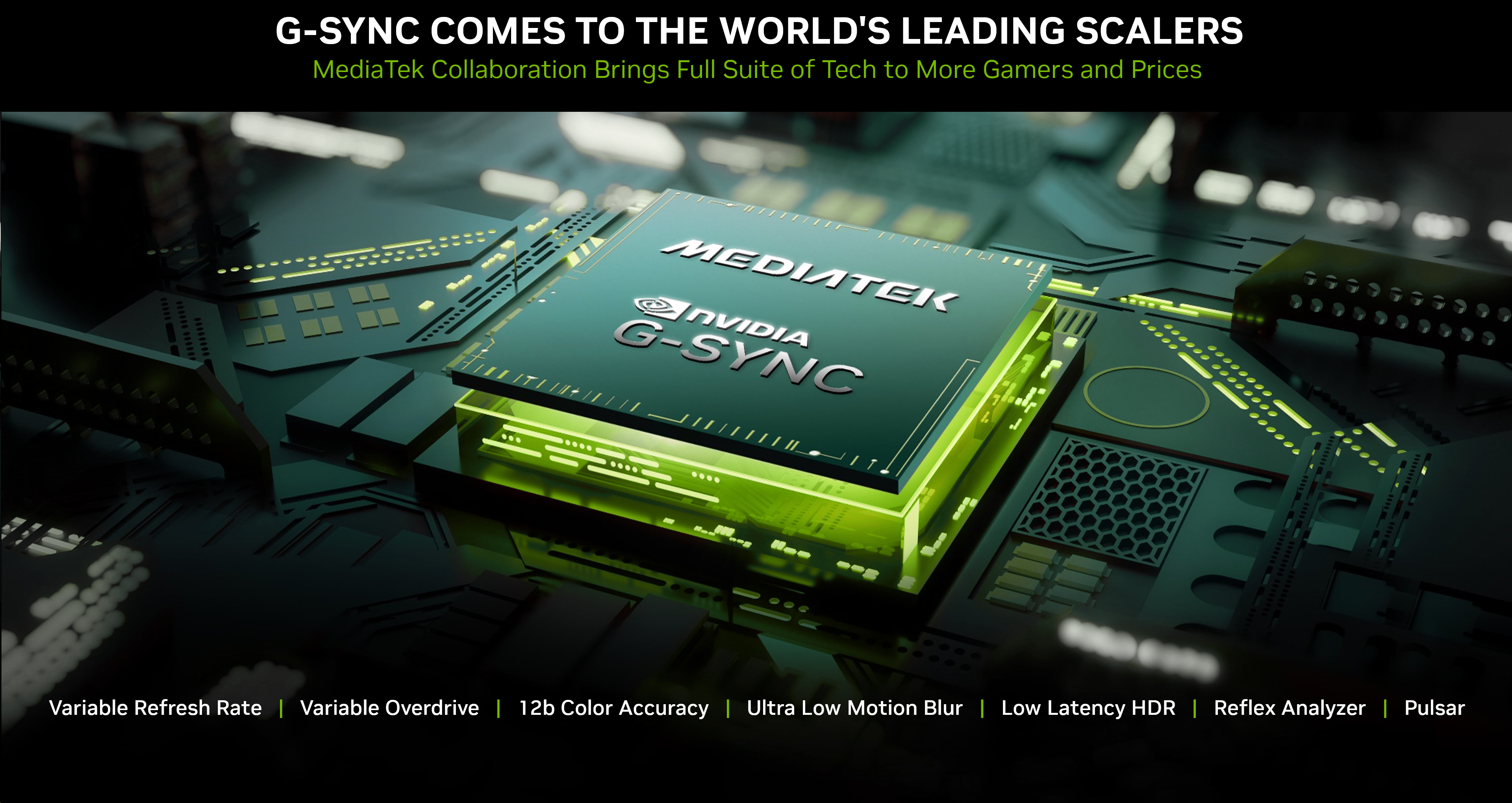
Moving beyond these incremental steps, Nvidia has taken a significant leap by enlisting the aid of MediaTek’s widely used scalers. By layering the complete G-Sync stack on top of MediaTek scalers, Nvidia aims to integrate G-Sync technology into a more extensive range of displays.
Included in this new range of MediaTek G-Sync scalers is full support for G-Sync Pulsar, unveiled at CES 2024. G-Sync Pulsar introduces variable frequency strobing for enhanced motion clarity, reducing flickering by synchronizing display backlight strobing with the game’s refresh rate.
Nvidia has specified the MediaTek MT9810 scaler as one of the first to support the full breadth of G-Sync technology. As it stands, this new functionality will not be backwards compatible with current displays using the MT9810 scaler, necessitating the acquisition of new hardware.
In conjunction with this technological shift, Nvidia has announced a trio of new gaming monitors featuring this new MediaTek G-Sync scaler. These include the AOC AGON Pro AG276QSG2, Acer Predator XB273U F5, and Asus ROG Swift 360 Hz PG27AQNR, all of which boast a high refresh rate of 360 Hz and a resolution of 1440p.
Although the potential for reduced costs exists due to the use of more widespread scaler technology, concrete pricing details and the scale of savings for consumers remain uncertain.
The transition to MediaTek chipsets is expected to foster broader G-Sync adoption, making this premium gaming feature more widespread and potentially more cost-effective. Yet, the true impact of this partnership on the market and gaming landscape will only become clear with time and the release of the new monitors sporting this technology.