NVIDIA has taken a monumental leap forward with the unveiling of DLSS 4, a groundbreaking upscaling technology designed to significantly enhance gaming performance and visuals on the new RTX 50 GPUs. This latest iteration of NVIDIA’s Deep Learning Super Sampling promises a staggering 8x performance boost, thanks to its innovative Multi-Frame Generation feature.
DLSS, NVIDIA’s suite of neural rendering technologies, harnesses the power of GeForce RTX Tensor Cores to boost frame rates while ensuring that the quality of images remains sharp and crisp. This technology is already integrated into over 700 games and applications, delivering visuals that rival native resolution rendering.
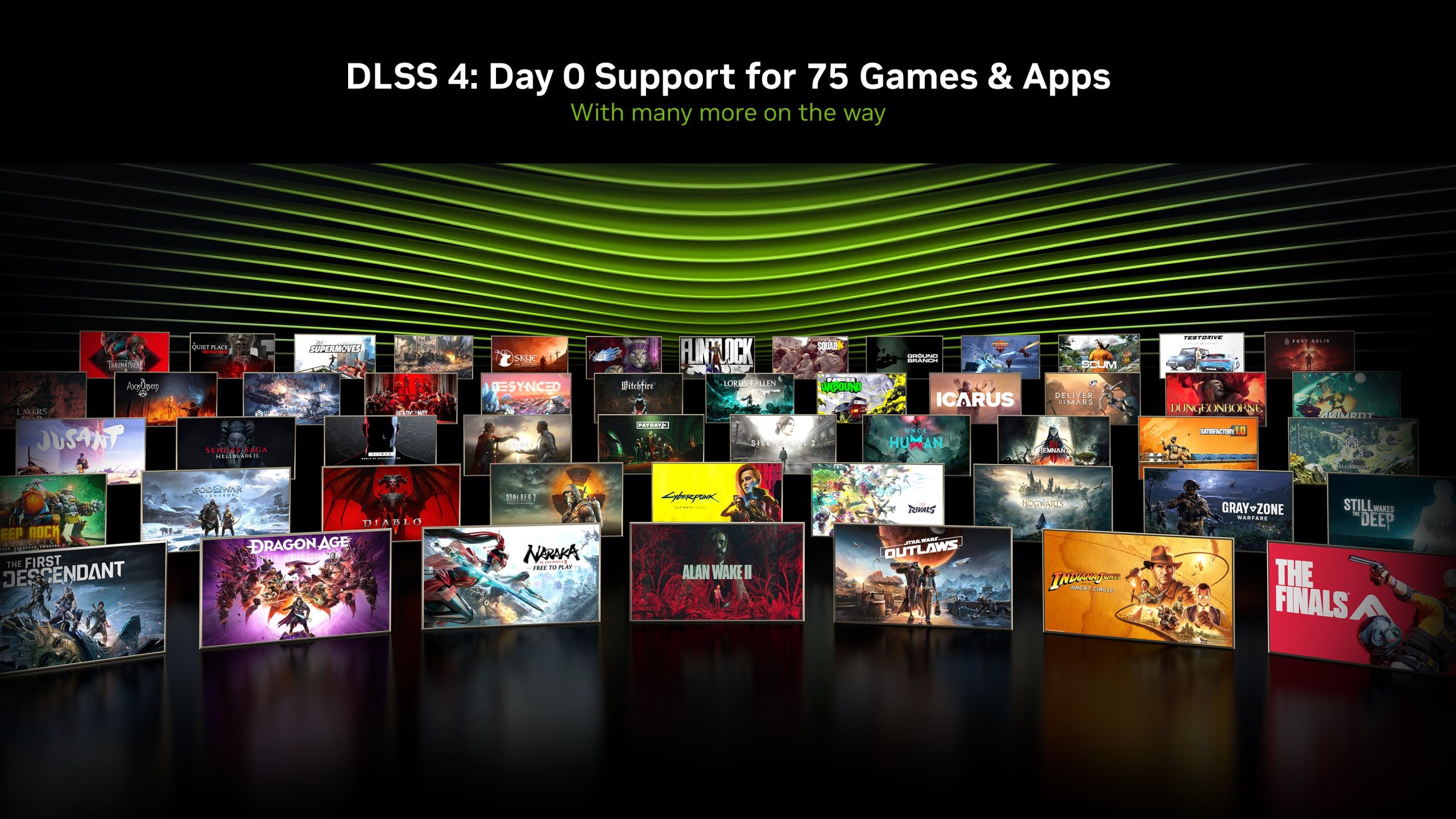
At CES 2025, the spotlight shone on DLSS 4 as NVIDIA detailed its new Multi-Frame Generation capabilities for the GeForce RTX 50 Series graphics cards. A total of 75 games and applications are set to support this feature upon release. By generating up to three additional frames for each traditionally rendered frame, DLSS Multi-Frame Generation can multiply frame rates by up to 8 times compared to traditional methods. This technological marvel will enable the GeForce RTX 5090 to offer stunning 4K 240 FPS gaming with full ray tracing capabilities.
DLSS 4 introduces the most significant upgrade to NVIDIA’s AI systems since the launch of DLSS 2.0 in 2020. It incorporates cutting-edge neural networks powered by ‘transformers’, a sophisticated architecture also driving advanced AI models like ChatGPT and Flux. These transformers elevate image quality by delivering improved temporal stability, reduced ghosting, and finer details in motion.
The GeForce RTX 50 Series doesn’t only benefit from better AI. The new DLSS technology itself is optimized for reduced VRAM usage and increased frame rates. This results in performance boosts in many of today’s popular games. For instance, in Warhammer 40,000: Darktide, DLSS Frame Generation delivers a 10% faster frame rate while conserving 400MB of memory at 4K max settings.
The new DLSS frame generation model is built on Blackwell hardware and utilizes software innovations that enhance both the generation speed and quality of multiple frames. Despite the advancement, RTX 50 Series GPUs can execute five distinct AI models for each frame, driven by 5th Generation Tensor Cores, which offer more than double the AI processing power.
DLSS 4 has achieved impressive strides not only in boosting performance but also in improving the visual flow of games. Hardware Flip Metering, a new addition, ensures an even distribution of frame pacing, contributing to smoother and more immersive gameplay experiences.
Another highlight of DLSS 4 is the introduction of a revolutionary transformer model. Replacing the older Convolutional Neural Networks (CNNs), this new model offers a deeper understanding of scenes, further improving pixel generation for enhanced details and smoother edges. The result is improved image quality in complex ray-traced settings and better motion stability.
With over 75 games and applications ready to support Multi-Frame Generation from the start, and the existing pool of games benefiting from DLSS Ray Reconstruction, Super Resolution, and DLAA enhancements, the future of gaming visuals looks brighter than ever. High-profile games such as Cyberpunk 2077 and Alan Wake 2 are among those harnessing the power of DLSS 4, ensuring more immersive and visually stunning experiences.
The introduction of DLSS 4 alongside the latest GeForce RTX 50 series GPUs marks a significant upgrade for all RTX users, promising a new era of unparalleled image quality and gaming performance advancements. Keep an eye on NVIDIA for upcoming developments that will continue to redefine gaming visuals and elevate the gaming experience to unprecedented levels.